
Fly Corp Airline Manager MOD APK (Unlimited Money, DLC)

Description
Fly Corp: Airline Manager hands you a world map with almost 200 countries and asks you to link real cities before a single airport overflows. New airline bosses who keep watching one red airport end their run will get the habits that keep passengers moving and credits coming in. The biggest single fix is simple: when an airport fills, add a plane to its busiest route before you pay for a bigger terminal, because extra space alone never clears the crowd already waiting.
How to Play Fly Corp: Airline Manager
To play Fly Corp: Airline Manager, you build airports in real cities, draw routes between them, and buy planes to carry passengers to their chosen destinations. Each delivered passenger earns credits, which you spend on new routes, aircraft upgrades and bigger airports before any terminal overloads and ends the run.
The whole thing runs in real time, so the clock never waits for a slow decision. KishMish Games made the original, and AI Games FZ now publishes the mobile release on Android and iOS. It costs nothing to install and earns through ads and optional purchases.
Two ideas carry the design. First, every city holds a real population figure, and that number decides how many people want to fly. Second, money stays tight, so you can never link every city to every other city.
How the Passenger Flow System Moves Real City Populations
The passenger flow system gives each traveler a fixed destination the moment they appear at an airport. If no direct route exists, they take transfer flights through other airports in your network until they arrive. A quiet regional airport can therefore turn busy simply because it sits on the shortest path between two big cities.
Real population drives everything here. A city like São Paulo or Delhi produces far more travelers than a small town, so its airport fills faster and pays more over time. In my runs, I treat every big city as both a money source and a risk. The same crowd that earns credits can also overflow the terminal.
The Airline Tycoon Premise Across Almost 200 Countries
There is no story campaign and no named cast. Instead, you play the founder of a young airline, and the goal is to grow it into the biggest air network on the planet. Almost 200 countries and thousands of real cities sit on the map, waiting for an airport.
Geography sets the tone of each run. European distances are short, so quick hops keep traffic easy to handle. Transatlantic routes, by contrast, make you weigh travel time against the higher price of opening a long line. Clean, minimal 2D graphics keep your eyes on the map rather than on flashy effects.
How Fly Corp Compares to Airline Manager 2026 and Mini Metro
Airline Manager 2026 from Trophy Games leans into spreadsheet depth, with more than 360 real plane types, over 4,000 real airports, alliances and stock values. Fly Corp skips the paperwork. You watch crowds pile up and react before an airport overloads, instead of picking aircraft models from a catalog.
Mini Metro is the closer cousin in feel. Both games ask you to draw lines between growing stops, and both end the run when one stop overflows. However, Fly Corp adds money, real population data and random events, so it plays more like a tycoon sim than a pure puzzle. Idle Airport Tycoon, meanwhile, focuses on running one airport rather than a world network.
Android Version vs the Steam and Console Fly Corp
The same studio sells a paid edition on Steam, PlayStation, Xbox and Nintendo Switch, usually listed at around $15 before sales. That edition adds daily scenarios with their own rankings. It also offers paid expansions such as American Dream and Delivery.
The Android version trades a mouse for taps and pinch zoom. That works well for short sessions, but precise plane timing gets harder on a small phone screen. Since mobile costs nothing up front, it is the smarter first try, and the PC edition suits players who want long, uninterrupted runs.
Fly Corp Controls: Routes, Planes and Airport Capacity
Route drawing is the main control in Fly Corp, where a player taps one airport, drags to a second city and pays credits to open a flight line. Every action after that happens on the same world map, with no deep menus to dig through.
Capacity limits sit at the center of the controls. Planes and airports both hold a maximum number of passengers, and a full plane simply leaves people behind. A full airport is far worse, because it ends the whole run. The pause button therefore matters as much as any upgrade.
Longer routes also cost more to open. A single drag across an ocean can eat most of your early credits, so the first few lines should stay short.
Drawing Routes Between Two Real Cities
Opening a route means picking two airports you already own and confirming the price. Short domestic flights cost little, while a line spanning thousands of kilometers takes a big bite out of your balance. Once the route opens, one plane starts flying it back and forth on its own.
You can also remove a route when the network needs a reshape. I do this most often after a scenario throws a disaster at me. Cutting a weak line lets you redraw the network around a stronger hub instead.
Reading Green, Orange and Red Airport Capacity Warnings
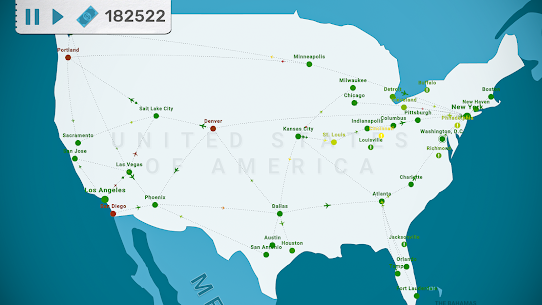
Each airport changes color as its waiting crowd grows. Green means plenty of room, yellow and orange signal a filling terminal, and red warns that the airport is close to overflowing. A fresh airport holds only about 50 passengers, so it can turn red fast next to a big city.
During busy stretches I zoom out every few seconds just to scan for orange. Catching it early gives you time to add a plane or redraw a line. Waiting until red usually leaves one choice, which is an emergency upgrade you may not afford.
What Happens When a Scenario Ends or an Airport Overloads
A run ends in one of two ways. In Scenarios, you hit the goal and the game records your result. In every mode, an overloaded airport ends the session on the spot.
A loss means starting that map again from your first two cities. The sting of losing a long run to one forgotten town is real. It pushes you to check every airport, not only the big ones, and that habit separates long runs from short ones.
How to Unlock New Countries Before the 6-Minute Timer Ends
Unlocking a new country in Fly Corp costs credits, and in Unlock All Countries you must buy one before the 6-minute timer hits zero or the run ends. Every unlock refills the clock while leftover time carries over, so cheap neighbors bought early bank minutes for pricier giants later.
This rule belongs to Unlock All Countries, the mode where the full world map is the finish line. Free Play has no such clock, and Scenarios set their own limits.
In my runs, unlock prices climb roughly with country size, so the order you choose matters more than raw income. A bad pick, such as jumping from a tiny island nation straight to the United States, can drain your balance right when a terminal turns orange. Each country unlock is a trade between time, money and crowd size.
How Country Unlock Costs and the Timer Carry-Over Work
The timer starts at 6 minutes the moment a run begins. Unlock a country with 5 minutes left, and you keep those minutes on top of the fresh window. Players call this country hopping, and it turns the timer from a threat into a time bank.
The catch is money. Each unlock costs credits you might need for planes, so hopping too fast can leave a new country connected to nothing. I keep at least one cheap unlock affordable at all times.
Choosing Neighbor Countries for Cheap Expansion
Small neighbors cost less and sit within short flight range, so their routes are cheap to open too. Chaining Belgium, the Netherlands and Luxembourg off a hub in France is a classic early move. Each one adds time without stretching the network.
Neighbors also keep transfer flights short. A passenger from Brussels heading to Lisbon moves through two quick hops in a tight European web, rather than one costly long line. Long gaps between unlocked countries, however, force expensive routes just to keep travelers moving.
Why Big-Population Countries Pay Off Later
The United States, China, India and Brazil hold the biggest populations, and population means ticket sales. Most countries top out near 25 cities, but the United States offers more. Long internal flights there also earn strong income, because fares grow with distance.
Timing is the trick. Unlock a giant only when your balance covers the unlock fee plus at least two planes. Otherwise its huge crowds will flood one airport long before the income arrives.
How to Upgrade Airports and Aircraft in Fly Corp
Tap any airport in Fly Corp to open its panel, then press upgrade to buy the next level and raise the terminal’s passenger cap. Planes have their own upgrade levels that add seats, and a second or third plane often clears a crowded airport faster than any terminal upgrade.
Upgrades swallow most of your credits after the first few minutes. Since the cap on planes and airports never moves on its own, each purchase decides where the next crowd can safely wait.
Location matters as much as spending. Your transport hub soaks up transfer traffic, so it decides which terminals need upgrades first. Small end-of-line towns, by contrast, rarely need anything at all.
Airport Capacity Upgrades and When to Buy Them
Each airport level raises the waiting limit and costs more than the last. The panel shows the next level and its price, so you can tell at a glance whether it fits your budget. I buy levels only for cities that act as transfer points or sit next to a giant population.
End-of-line towns stay green almost all game. Their travelers leave on the next plane, so upgrades there sit unused. Spending on them is the most common way I see new players run dry before the next country unlock.
Adding Planes vs Upgrading Planes on Transatlantic Routes
A route can hold several planes, and each plane can climb through upgrade levels that add seats. More planes raise how often flights leave, while aircraft upgrades raise how many people each flight takes. On short European hops, extra planes win because round trips are quick.
Long routes behave differently. A transatlantic plane spends a long time in the air, so a second aircraft halves the wait at both ends. When a long line already has several planes and its airports still fill, that is the moment to pay for bigger aircraft instead.
Building a Transport Hub in a Capital City
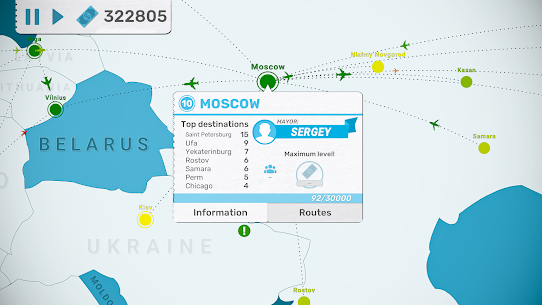
A capital city often makes the best hub, since many capitals hold their country’s biggest population. Route most international flights through it, then fan domestic flights out to nearby towns. Moscow and Paris both work well as early anchors.
A hub concentrates transfer traffic, so it needs the most airport levels in your network. Keep a separate credit reserve just for it. When the hub turns orange, every connected city suffers next.
All Three Fly Corp Game Modes Compared
Three game modes ship with the mobile release of Fly Corp: Unlock All Countries, Scenarios and Free Play. Each one uses the same map and controls but changes what counts as winning.
Unlock All Countries is a race against the clock. Scenarios hand you a fixed setup and a single target. Free Play removes the pressure and lets the network grow for as long as you like.
Picking the right mode for your mood matters. A short bus ride fits one scenario neatly, while a long weekend suits a world-spanning Free Play map. Random events appear in all three, so no mode is fully predictable.
Unlock All Countries Rules and Win Condition
Your target here is to open every country and cover the whole world map with your network. The 6-minute timer runs the entire time, and missing one deadline ends the run. Very few players finish, since the late game stacks huge crowds on top of rising prices.
Planning beats speed in this mode. I sketch a rough continent order before the first purchase, usually Europe first, then a hop toward North America. That path keeps routes short while income builds.
Scenario Goals Like Survival Timers and Virus Outbreaks
Scenarios set preset conditions and one clear goal. Some ask you to survive for a fixed period, while others want a specific sum of money. Each one comes with its own twist.
Two twists stand out. One scenario keeps opening new airports nonstop, so you must connect them as fast as they appear. Another hits a country with a virus outbreak and forces you to rebuild the network around closed borders. Those runs test how fast you can cut and redraw routes, not how big you can grow.
Free Play for Relaxed Idle Tycoon Sessions
Free Play drops the timers and targets. You pick where to start and grow the network without limits, which suits fans of idle tycoon games.
It is also the best sandbox for testing ideas. I try hub layouts here before taking them into Unlock All Countries, because a failed experiment costs nothing but time. Airports can still overload, though, so the core rule never fully switches off.
How Fly Corp Credits, Progress and the Leaderboard Work
Progress in Fly Corp comes from credits, which each delivered passenger earns and which pay for countries, routes, planes and airport levels. Leaderboard points stack up separately for passengers carried, scenarios finished and infrastructure bought, ranking you against other players.
There are no character levels, skill trees or collectibles. Your progress lives inside the network you build, so each run starts fresh from a couple of cities.
Credits also move fast in both directions. Random events can drop a sudden investment into your account or take a chunk away. A small reserve therefore often matters more than one extra plane.
How Credits Grow From Passengers and Distance
Every passenger who reaches their destination pays a fare, and longer trips pay more. Arrival speed does not change the fare, so a slow transfer path earns the same as a direct flight. What really matters is that planes free up and fly again.
That math makes long-haul lines the real earners once your hubs can handle the crowds. A route over 7,000 km pays far more per trip than a short domestic hop. Pair one long line with short feeder flights, and the feeders keep the hub drained while the long line pays the bills.
Earning Leaderboard Points for Passengers and Infrastructure
The leaderboard rewards three things: passengers transported, scenarios completed and money spent on more advanced airport infrastructure. Because infrastructure counts, a run that ends with fully upgraded hubs can outscore one that hoarded credits.
On iOS, these rankings link to Game Center, which also lets you challenge friends. Chasing a friend’s score is the best reason I have found to replay a scenario I already beat.
Common Fly Corp Mistakes That Overload Your Airports
Overloaded airports cause almost every lost run in Fly Corp, and most overloads trace back to a handful of avoidable habits. None of them come from bad luck alone.
The usual advice to upgrade airports and lean on capital hubs is sound. Still, it skips how the waiting queue behaves once it forms. It also ignores plane spacing and the way random events hit an unprepared network.
I lost plenty of runs to each of these before spotting the pattern. Fixing them did more for my survival time than any single upgrade.
Upgrading an Airport Instead of Clearing Its Queue
A bigger terminal raises the ceiling, but it does nothing for the crowd already waiting. Passengers keep piling in after the upgrade, so an airport can turn red again within seconds. Steam players who tested this land on the same fix: put more seats in the air on the busiest outbound route.
Before paying for any airport level, pause and check where the crowd wants to go. If most travelers share one destination, add a plane to that single line. The queue shrinks at the source, and the upgrade money stays free for later.
Bunching Planes Together on One Route
A new plane on a route takes off the moment you buy it, often right behind the first one. Two planes flying nose to tail act like one plane with a long gap afterward. Both ends of the route fill up during that gap.
Timing fixes it. Buy the second plane when the first one reaches the far end, so the two sit on opposite sides of the line. A third plane fits best when the first two pass each other in the middle. Even spacing cuts the wait at every stop without spending a single extra credit.
Ignoring Random Events That Block Flights
Random events land without warning and come in three flavors. Positive ones bring investment money into your company. Negative ones, such as disasters, block flights to or from certain countries, and some are just silly, like a businessman suing you over coffee spilled during turbulence.
Blocks are the dangerous kind. When a country goes dark, every passenger heading there stays stuck at your transfer airports. Keep at least one alternate path around each major hub, and the block becomes a slowdown rather than a game over.
Best Fly Corp: Airline Manager Tips and Tricks for Beginners
The pause button in Fly Corp freezes the clock while still letting you buy planes, open routes and upgrade airports. That makes it the strongest tool a beginner has, since most early losses come from deciding too fast.
Good habits in this airline tycoon game are simple but strict. Read before you buy, keep transfers short and protect your balance for the next deadline.
My own Fly Corp: Airline Manager tips all came from runs I lost. The costliest one was a Tokyo hub that overflowed while I was busy unlocking Mongolia.
Pause and Read the Passenger List Before Buying Planes
Tap any busy airport while paused to see where its waiting travelers want to go. The list shows which route deserves the next plane. You stop spending credits on lines that were already coping.
I check the list at every landing during rush periods. It takes a few seconds and saves far more than it costs. Once this becomes a habit, red airports start to feel rare instead of constant.
Link Domestic Flights So Transfers Stay Inside One Country
Domestic flights inside one country act like a local train network for your airline. When several cities in the same country connect to each other, travelers spread across many small airports instead of crowding the capital. That keeps the hub free for international traffic.
Keep each domestic web inside its own borders. Mixing cross-border hops into a cluster makes it hard to see which country feeds which airport. Clean clusters also make a disaster block easier to route around.
Keep a Credit Buffer for the Next Country Unlock
The most common failure in Unlock All Countries is reaching the deadline with too little cash. Every credit spent on a nice-to-have upgrade is a credit you cannot use when the clock hits zero.
My rule is simple: never let the balance drop below the price of the next cheap neighbor. Negative events can also take a few hundred credits at once, so I pad that buffer after the first ten minutes. A small reserve feels slow. Even so, it turns each deadline into a routine checkpoint.
Frequently Asked Questions About Fly Corp: Airline Manager
Is Fly Corp: Airline Manager available on Android and PC?
Yes. Fly Corp: Airline Manager is free to install on Google Play and the App Store, with ads and optional purchases. A separate paid edition runs on Steam, PlayStation, Xbox and Nintendo Switch. On the App Store, the mobile game holds a 4.4-star average from roughly 11,000 ratings.
How do you stop losing in Fly Corp?
Most losses come from one overloaded airport, so treat orange as an emergency. Spread planes evenly on busy routes, keep a credit buffer for the next unlock, and wait on giant countries until your hubs can cope. Early runs in Unlock All Countries often end around the fifteen-minute mark, so expect a few restarts.
Does Fly Corp get new content after you finish the map?
Yes, in two ways. The App Store lists an Editor purchase for building custom scenarios, priced around $12.99. The PC edition goes further, letting players upload scenarios and play hundreds made by others. Random events also keep repeat runs from feeling identical, since no two disaster sequences land the same way.
Who Should Play Fly Corp: Airline Manager
Fly Corp: Airline Manager suits players who enjoy fast decisions under pressure, especially anyone who liked Mini Metro but wanted money, real cities and a full world map. Casual idle tycoon fans should start in Free Play, while puzzle-minded players will get the most from Scenarios. I have spent more evenings chasing a full Unlock All Countries map than I expected, and watching a crowded hub finally turn green still feels earned. The mobile release costs nothing to try, so install it, build one capital hub and space your planes evenly. That single habit separates short runs from world-spanning airlines.
Images



Download links
ℹ️ Download link not working? Please refresh the page and try again.
Developer's apps










New Apps
Most Played Mobile Games


