
Unmatched Air Traffic Control MOD APK (Free Shopping)

Description
Unmatched Air Traffic Control hands you a real airport control tower with full authority over landings, taxi routes and departures. New controllers who keep losing aircraft on the Rocky Mountains Regional taxiways will find the traffic flow order that stops it here. Opening gates before buying aircraft is the order that decides your first 10,000 coins.
How to Play Unmatched Air Traffic Control Without Collisions
Unmatched Air Traffic Control puts you in an airport control tower with authority over every landing, taxi route and departure. You clear each aircraft down to the runway, send it to a free gate, then push it back out again without letting two aircraft touch.
Rocky Mountains Regional is where every account starts. It has one runway, 12 gates and a cramped apron that punishes sloppy timing. Most new controllers survive ten minutes, then watch two aircraft meet nose to nose on the Alpha row.
The simulation runs in real time and never pauses. Because of that, your best work happens before a conflict exists, not during it. A collision ends the session, so spacing matters more than speed at every airport in the game.
How Landing, Taxi and Pushback Orders Fit Together
Every aircraft in the game passes through the same four-step chain. First it requests landing, then it requests a gate after clearing the runway, then it requests pushback when ready to leave, and finally it requests take-off. You tap the aircraft and pick the order from a short menu.
The chain sounds simple, and it is. However, the trouble starts once six aircraft sit in different stages of that chain at the same time. One arrival taxiing inbound while two departures push back into the same lane is how most sessions end.
The Airport Setting, Weather and Day Night Cycle
Weather in this title is not decoration. Rain, snow and thunderstorms roll through, and a full day and night cycle changes visibility across a long session. Snow at Snow Lake Regional looks calm, yet the traffic rate stays exactly as punishing as anywhere else.
Thunderstorms deserve respect for a practical reason. Traffic keeps arriving, gates keep filling, and an aircraft with nowhere to park will sit on the taxiway and block the flow behind it. As a result, storm periods punish anyone who has opened more gates than they can actually work.
How It Compares to World of Airports and Airport Madness 3D
Three air traffic titles dominate this niche on Android. World of Airports focuses on ground handling, turnarounds and servicing aircraft at the stand. Airport Madness 3D, built by working controllers, drops you into a swivel-chair tower view across eight real airports including Los Angeles and Boston Logan.
This title sits between the two. You get the tower perspective and the ground authority, plus a coin economy and an airport ladder that neither competitor structures the same way. For example, Airport Madness 3D sells airports directly, while here you earn them through departures.
Gameplay Controls, Approach Radar and Taxiway Orders
The approach radar in this simulation shows every inbound aircraft as a tagged blip, with a grey feather marking the localizer that leads to the runway threshold. Reading that feather is the single most useful control skill in the game.
Controls stay deliberately light. You tap an aircraft, a short command menu appears, and you pick a route or a clearance. No text entry, no radio phraseology, no altitude assignment.
That simplicity hides real depth. Taxiways carry letter names such as Alpha, Bravo, Charlie and Golf, and choosing the wrong one sends an aircraft straight into oncoming traffic. Because the game never rewinds, one careless taxi order can cost a twenty-minute session.
Reading the Approach Radar and the Localizer Feather
The App Radar displays arrivals well before they become your problem. Once an aircraft reaches the localizer feather, it is committed to the approach and the runway must be clear for it.
Check the radar before every take-off clearance, not after. If an arrival has already touched the feather, hold the departure at the threshold instead. A go-around costs far more time than the few seconds you gained by rushing.
Clearing Pushback, Taxi and Runway Crossing
Pushback is the most dangerous order in the game, because an aircraft reversing off a gate cannot see anything behind it. At Rocky Mountains Regional, clearing gates B2 and B3 for pushback at the same moment is a guaranteed collision.
Runway crossings appear at the double-runway airports, and Capeville City International uses them heavily. Use the holding-short point as a checkpoint. Hold an aircraft there while you check the apron, then release it once the route is genuinely clear.
Camera Views and What Happens After a Safe Landing
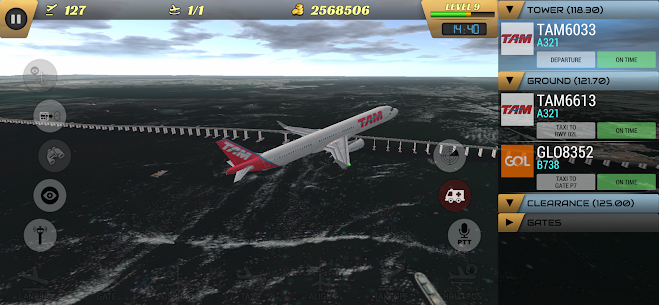
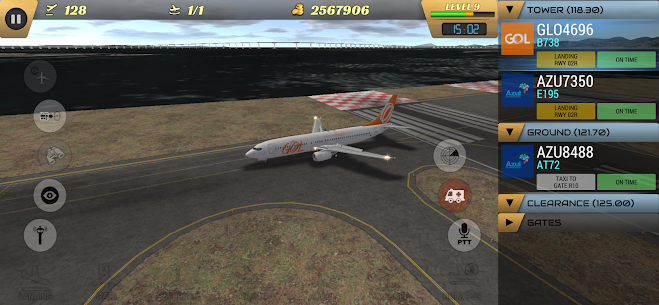
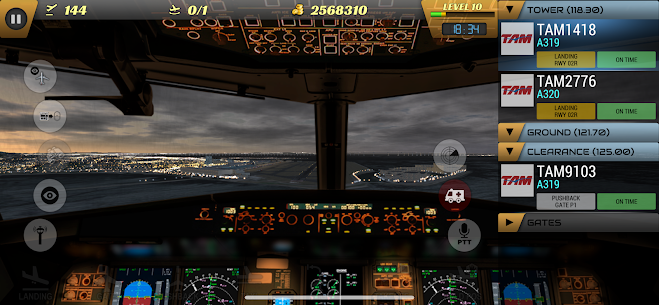
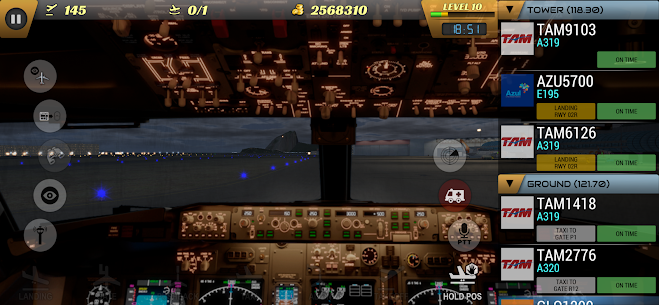
Several camera angles ship with the game, including the tower view, an airport overview and a cockpit view from inside the aircraft. The VIP Lounge adds further angles. Most serious controllers stay on the overview, since the cockpit view is a treat rather than a working tool.
A completed departure is the moment that pays. The aircraft lifts off, the counter ticks, and after the required number of take-offs your coin reward lands. Arrivals alone earn nothing, which surprises a lot of new players.
How to Unlock Gates and Raise Your Airport Level
Gate unlocks cost coins and stay permanent once purchased, and they are the fastest way to raise your airport level because more gates means more departures per session. Open them one at a time, working each new gate into your routine before buying the next.
Airport level also shifts your income cadence. Early on, coins arrive after every 3 successful take-offs. Once the airport levels up, the payout moves to every 5 take-offs with a larger sum attached.
Gate classes matter as much as gate count. Rocky Mountains Regional carries 7 Bravo gates and 5 Alpha gates, and only the Alpha stands accept the ATR 72-600. Your gate mix decides which aircraft the game sends you.
Why Gate Unlocks Come Before New Aircraft
A closed gate is a hard ceiling on throughput. Ten aircraft in your fleet cannot help if only five stands exist to receive them, so the first coins you earn at any new airport belong to gates.
Aircraft purchases still matter, though they matter second. The sequence that works is straightforward: open what you can work, then expand the fleet, then open another gate. In my runs this order roughly doubled the coins per hour compared with buying aircraft first.
Alpha, Bravo and Charlie Gate Classes
Alpha gates take the smallest aircraft, including turboprops and regional jets such as the Embraer 195. Bravo gates handle mainline narrowbody and larger passenger types. Charlie gates exist only at airports with cargo operations and accept freighters.
Paradise Island International shows the split clearly with 5 Alpha, 5 Bravo and 4 Charlie stands. The Alpha and Charlie rows share one apron route there. Two aircraft meeting face to face on that route is the classic Paradise Island disaster.
Why Opened Gates Never Close Again
Here is the detail no competing article states plainly: once you open a gate, you cannot close it. The game permanently raises your traffic rate to match the stand count, and there is no setting to scale it back down.
Streamwood International punishes this hardest with 19 gates available. Three Alpha stands, three of the B1 to B5 gates, two of the B6 to B10 gates and three Charlie stands already produce a demanding workload. Buy slowly, therefore, and treat every unlock as a permanent commitment.
How to Earn Coins Faster at Every Airport
Every completed take-off feeds the coin counter, and the payout size depends on three things: how many aircraft you own, how large those aircraft are, and your current airport level. Coins arrive in batches rather than per departure, which is why income feels random to new players.
The economy is genuinely slow by design. Ngurah Rai Bali costs 100,000 coins, and reaching that on free play takes roughly 40 to 60 hours of steady sessions.
Three levers speed it up. Fleet ownership thresholds, aircraft size and emergency bonuses all stack, and using all three together changes the pace of the whole game.
The Three and Five Take Off Payout Cycle
At a fresh airport, the reward lands after every 3 successful take-offs. After the airport levels up, the cycle stretches to every 5 take-offs, but each payout grows to compensate.
Knowing the cycle changes how you prioritise. When two aircraft are ready and you can only clear one before an arrival, send the one that completes the current batch. Finishing the cycle pays immediately, while an extra aircraft sitting at the threshold pays nothing.
Why Buying Aircraft in Groups of Five Pays More
Fleet size raises payouts at specific thresholds: 5, 10, 15, 20 and 25 aircraft. Nine aircraft earns exactly what five earns. Those four extra purchases bought you scenery and nothing else.
So buy in groups of five, then stop and open a gate before the next group. Repeat until you hold 25 aircraft, then pour everything remaining into the last stands. This single ordering rule is the difference between a grind and steady progress.
How Emergency Landings Add 500 Coins
A correctly handled emergency pays a flat 500 coin bonus, which is the largest single reward available outside the batch cycle. Four scenarios appear: a gear-up landing, a nose-gear failure, an engine fire on take-off and an engine fire on landing.
Clear the runway completely when one arrives. Move pending departures off the threshold, hold taxiing aircraft short, and give the emergency aircraft an empty strip. Handled cleanly, one emergency is worth roughly two full payout cycles at a starter airport.
All 13 Airports and What Each One Costs in Coins
Thirteen airports sit in the selection screen, divided into 10 fictional locations built for the game and 3 realistic ones based on real-world layouts. Every airport can now generate emergencies, and the graphical quality is consistent across both categories.
Prices climb steeply. Paradise Island International costs 10,000 coins, Capeville City International costs 20,000, and the ceiling sits at 100,000 for the most expensive location on the list.
Gate counts vary just as widely. Rocky Mountains Regional and Snow Lake Regional carry 12 stands each, while Las Palmas de Gran Canaria carries 36. Picking the right airport for your current skill matters more than picking the priciest one you can afford.
Fictional Airports From Rocky Mountains to White Center
Rocky Mountains Regional is free and single-runway. Paradise Island International at 10,000 coins is your first international field with widebody and cargo traffic. Capeville City International at 20,000 is the cheapest double-runway airport, running 17L/35R and 17R/35L.
Snow Lake Regional costs 40,000 and is the priciest fictional regional field. Green Valley International, Streamwood International, Brooksvalley International, Springbrook International and White Center International each cost 60,000 coins. Springbrook is the only airport in the game with perpendicular runways, which forces a completely different departure rhythm.
Realistic Airports: Las Palmas, Rio de Janeiro, Bali
Three real-world fields round out the roster. Las Palmas de Gran Canaria in Spain costs 80,000 coins and carries 36 gates across two runways. Rio de Janeiro in Brazil costs 90,000 and runs 17 stands.
Ngurah Rai Bali in Indonesia costs 100,000 coins and is the most expensive purchase available. It pairs 36 gates with a single runway, which is the hardest combination in the game. Save it for last, because that ratio will expose any weakness in your taxi routing.
Winter Harbour and the VIP Lounge Subscription
Winter Harbour International cannot be bought with coins at all. It unlocks only through the VIP Lounge, a monthly subscription that also opens every gate at every airport and enables multiplayer sessions plus extra camera angles.
The subscription is the fastest route past the coin economy, although it is not the only one. Some subscribers have noted that Winter Harbour reads as a snow-dressed variation on a field they already owned. Weigh that before committing to a recurring charge.
Aircraft, Airline Liveries and Cargo Gate Rules
Alpha, Bravo and Charlie gates each accept a different aircraft size, and your fleet purchases decide what actually shows up at those stands. The roster spans the A320 family, the 737 family, the 747, 757, 767, 777 and 787, the A330, A340, A350 and A380, the Embraer 195, the MD-11 and the ATR 72-600.
Regional airports restrict you to narrowbody types. International airports accept everything, including freighters at the Charlie stands.
Liveries sit on top of all this. Hundreds of real airline paint schemes are purchasable, and you choose which carriers operate at your airport. That choice quietly controls your income.
Narrowbody and Widebody Aircraft at Each Gate Class
Rocky Mountains Regional accepts the A319 through A321neo, the 737-700 through 737-900 Max, the Embraer 195 and the ATR 72-600. Nothing larger will ever appear there.
Paradise Island International opens the widebody roster. Suddenly the A330, A340, A350-900, A380, 747-400, 777-300 and 787-800 all request gates, alongside cargo variants such as the 747-400F and 767-300F. Bravo stands take the big passenger types while freighters head for Charlie.
Picking Airline Liveries for Your Airport
The livery menu lets you switch individual airlines on and off for your current field. Turning a carrier off removes its aircraft from your traffic mix entirely.
Use this as an economy tool rather than a cosmetic one. At Paradise Island International, switching off the ATR 72-600 pushes higher-value jets into the Alpha stands instead. Similarly, keeping a handful of special liveries active gives long sessions some visual variety without changing the workload.
Why Cargo Aircraft and the A380 Pay Better
Aircraft size directly raises the take-off reward. A departing A380 or 747 pays noticeably more than a departing A320, and freighters carry a premium of their own.
At Rocky Mountains Regional, the Embraer 195 is the only type worth more than the rest, so one or two in your starting five is a sound buy. Once you reach an international field, however, a couple of widebodies and at least one freighter will lift your hourly coin rate more than any other purchase.
Common Mistakes That Cause Collisions and Go Arounds
A go-around triggers when a landing aircraft finds the runway still occupied, and the arrival then loops back around for a second attempt. It costs you time, blocks the approach, and delays every departure queued behind it.
Collisions are worse and end the session outright. Three specific errors cause the overwhelming majority of them, and all three are avoidable with a rule rather than reflexes.
None of these mistakes involve reaction speed. Each one comes from issuing an order without checking the apron or the approach radar first.
Pushing Back Two Neighbouring Gates at Once
Two adjacent gates cleared for pushback at the same moment will collide. At Rocky Mountains Regional, B2 and B3 are the classic pair, and the aircraft cannot stop once the manoeuvre begins.
Treat pushback as a one-at-a-time order in any gate row. Clear one aircraft, watch it complete the reverse and start taxiing, then handle the next request. The waiting aircraft will not complain.
Taxiing Against the Flow of Traffic
This is the rule that prevents most crashes, and almost nobody states it. At any moment your airport has a dominant flow direction, and an aircraft moving against that flow will eventually meet one moving with it.
The practical version is simple. Send departures to the runway via Bravo whenever possible, and send arrivals to the gates via Alpha. If an aircraft exits runway 18 at Golf while traffic is flowing upward, route it via Alpha even though Bravo looks shorter. Longer routes that respect the flow beat short routes that fight it.
Squeezing a Take Off Before a Landing Aircraft
Clearing a departure immediately after an arrival touches down does work, and the timing can be satisfying. It is also the most common cause of a ruined session.
The safer alternative is line-up and wait, provided the space exists without triggering a go-around. Gaining eight seconds is never worth a loop of the pattern. Hold the departure, let the arrival clear, then release.
Best Unmatched Air Traffic Control Tips and Tricks for Beginners
Opening every gate at Rocky Mountains Regional before touching the aircraft shop is the fastest route to a second airport. The starter field is small, forgiving and free, which makes it the right place to build habits that transfer everywhere else.
Three habits carry the most weight: a fixed taxi routing rule, a disciplined purchase order, and a calm response to weather events. Each one is specific to how this simulation handles its traffic.
Most players who quit early do so because progress stalled, not because the tower work was too hard. Fixing the purchase order fixes the stall.
Build Tower Habits at Rocky Mountains Regional First
Twelve gates and one runway is the right training load. Work every stand, handle a few emergencies, and settle into a routing pattern you can repeat without thinking about it.
Do not rush to Paradise Island International the moment you hold 10,000 coins. A controller who is comfortable at a single-runway field will handle a double-runway field far better than someone who bought their way there early.
The Buy Five, Open One Gate Coin Order
Buy exactly five aircraft, including at least one Embraer 195 for its higher value. Then open one gate. Then buy another five, open another gate, and repeat until you hold 25 aircraft.
Stopping at nine or fourteen aircraft wastes coins, because payout value only rises at the 5, 10, 15, 20 and 25 marks. This single sequence is why two players with identical play time can sit 30,000 coins apart.
Handling Thunderstorms and Night Traffic Calmly
When a thunderstorm arrives, your gate capacity becomes the limiting factor. An arrival with no free stand will park itself on a taxiway and block everything behind it, which is how storms turn into collisions.
Keep one stand empty during heavy weather if you can. Night traffic is less dangerous but harder to read, so lean more heavily on the approach radar than on the visual tower view. Both situations reward patience over throughput.
Frequently Asked Questions About Unmatched Air Traffic Control
Is Unmatched Air Traffic Control free to play?
Yes. The download costs nothing on Google Play and the App Store. Unmatched Air Traffic Control has been listed since June 2015 and passed ten million installs. Coin packs and the VIP Lounge subscription cost real money. Every fictional airport still stays reachable without spending anything.
How do you earn coins faster without paying?
Switch off the slowest aircraft types in your fleet menu. At Paradise Island, turning off the ATR 72-600 pushes bigger jets into the Alpha gates, and those pay more per departure. Most sessions also run smoother when you keep one cargo aircraft active, since freight departures carry a higher reward.
Does the game have a multiplayer mode?
Yes, through the VIP Lounge subscription, which also opens Winter Harbour International and extra camera angles. Shared sessions let two controllers work the same airport. One quirk players report often: aircraft belonging to the other controller can appear in plain white liveries rather than their real airline paint.
Who Should Take On This Airport Simulation
This one suits patient players who enjoy pressure without violence, aviation fans who watch departure boards for fun, and anyone who wants a hobby that genuinely works the memory. Impatient players should skip it, because the coin economy will frustrate them long before Bali. I have run hundreds of sessions at Rocky Mountains Regional and still get a small jolt when two aircraft come nose to nose on the apron, which tells me the tension is real rather than manufactured. Install it, work the starter field properly, and the rest of the roster opens up on its own.
Images

Download links
ℹ️ Download link not working? Please refresh the page and try again.
Related apps



What's new
Fixed "invisible" aircraft detected on some devices Minor bugs fixed Graphics Optimized
New Apps
Most Played Mobile Games


