
Turboprop Flight Simulator MOD APK (Unlimited Money)

Description
Turboprop Flight Simulator 3D puts you in the cockpit of 14 real-world-inspired aircraft — including the legendary C-130 military cargo plane and the tilt-wing XV-40 VTOL — with full rudder, flap, spoiler, and thrust reverser controls on your mobile device. This post is written for beginners who just installed the game and for returning players who want to get more out of the mission system and free-flight mode. You will find a full breakdown of the aircraft roster, cargo operations, the JATO/L system, the destruction mechanic, and the best beginner tips tied to specific in-game systems.
What Is Turboprop Flight Simulator 3D
Turboprop Flight Simulator 3D is a free mobile flight simulator developed by AXgamesoft for Android and iOS. The game focuses entirely on turboprop-powered aircraft — planes that use propellers driven by a turbine engine rather than jets or pistons. That focus makes it different from most mobile flight games. It offers a fleet of 14 aircraft inspired by real-world planes, each with its own flight characteristics and mission set.
The game runs across three main formats. Players can work through training missions that cover the basics of taxiing, takeoff, and landing. They can take on varied story-style missions that involve cargo delivery, search and rescue, and special operations. However, they can also enter free-flight mode at any time for unrestricted flying with no objectives.
AXgamesoft has updated the game consistently since its launch. The 2026 version adds the C-130 family, the MS-26 special operations seaplane, and improved aircraft destruction physics. Because of those regular updates, the content available now goes well beyond what early reviews described.
How the Realistic Physics Engine Powers Every Flight
The realistic physics engine is the foundation of every flight in this simulator. Players feel the difference between aircraft immediately. The C-400 tactical airlifter handles slowly and needs a long runway. The XV-40 VTOL can take off vertically. That range makes the physics engine feel relevant no matter which aircraft players choose.
Each aircraft responds to inputs like rudder angle, flap position, spoiler deployment, and engine thrust. Consequently, a bad crosswind landing with too much flap and no rudder correction will always end poorly. Players who spend time in training missions start to feel how the physics engine reacts before they take on the harder cargo missions.
The Aviation Setting — Military Ops, Coastguard Rescues, and Regional Routes
The game covers three broad aviation themes. Military operations use the C-400, MC-400, C-130, and MC-130. Coastguard search and rescue missions use the HC-400 and HC-130. Regional airliner routes use the RL-42 and RL-72, which are inspired by the real-world ATR-42 and ATR-72.
Each theme brings a different flying style. Military cargo ops require players to land on improvised runways and use JATO/L (Jet Assisted Take-Off and Landing) for short-field performance. Coastguard missions focus on reaching locations quickly. Regional airliner routes are smoother and reward stable, consistent flight paths. Therefore, the variety in tone keeps long play sessions interesting.
How Turboprop Flight Simulator 3D Compares to RFS and Infinite Flight on Android
Among the top mobile flight simulators, RFS — Real Flight Simulator and Infinite Flight are the closest competitors on Android. RFS focuses on global real-world routes and multiplayer. Infinite Flight offers online air traffic control. However, neither places the same emphasis on military aircraft, special operations missions, or cargo operations.
This sim occupies a different position. It prioritises hands-on military and cargo gameplay over route planning and multiplayer. The VTOL mechanics of the XV-40, the airdrop system of the C-130, and the improvised runway landings have no direct equivalent in RFS or Infinite Flight. For players who want action-oriented flying rather than simulation of commercial aviation, this title is the stronger fit among Android options.
How Controls and Cameras Work in Turboprop Flight Simulator 3D
The control system is one of the most flexible parts of the game. Players are not locked to a single input method. Instead, they can choose from tilt sensor alone, a virtual stick, a yoke, or a mixed tilt-and-stick setup. Each option suits a different play style. Beginners often find the tilt sensor easiest to start with, but the stick or yoke gives more precise control once players understand the physics engine.
Beyond the primary input, the game provides a full set of secondary controls. Rudder, flaps, spoilers, thrust reversers, auto-brakes, and landing gear each have their own on-screen buttons. Many players initially ignore these secondary controls. That is a mistake, because the physics engine reacts to all of them independently.
How Tilt Sensor, Stick, and Yoke Input Options Differ
The tilt sensor tilts the device to bank and pitch the aircraft. It is intuitive for very short sessions but can tire players during longer flights. The virtual stick works like a traditional joystick on screen. The yoke replicates a column-style input that commercial pilots would recognise. Additionally, the mixed tilt-and-stick option lets players use the sensor for roll while keeping a stick for pitch — many experienced players prefer this combination.
Switching between input types is available from the settings menu at any time. However, players should make that choice before starting a mission rather than mid-flight. Changing the input type during a complex cargo approach can cause immediate control loss.
How Rudder, Flaps, Spoilers, and Thrust Reversers Work Together on Landing
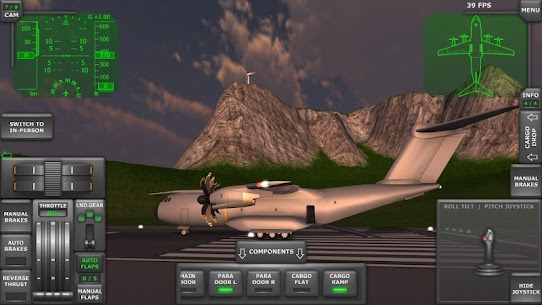
On a landing approach, all four secondary controls become critical. Flaps slow the aircraft and increase lift, allowing a lower approach speed. Spoilers reduce lift quickly on touchdown. Thrust reversers push engine power backward to slow the aircraft on the runway. The rudder keeps the nose straight during the rollout.
Using them together requires a sequence. Players should deploy flaps on approach, extend landing gear, deploy spoilers on touchdown, then activate thrust reversers and auto-brakes simultaneously. Skipping any step — especially forgetting the thrust reversers on a short improvised runway — typically triggers the aircraft destruction system. Therefore, forming a consistent landing checklist early saves many failed missions.
How Cockpit Camera Positions Help You Fly More Accurately
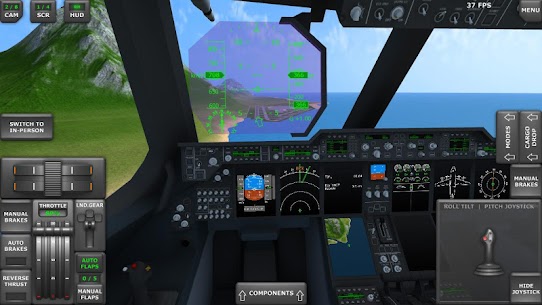
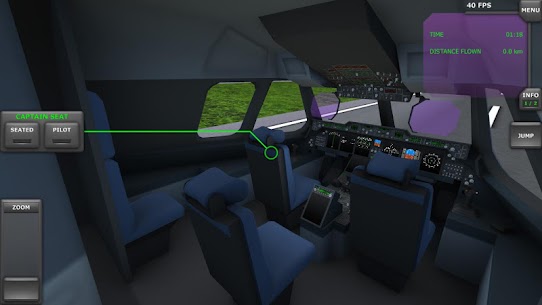
The game provides multiple camera views. However, the cockpit camera positions — including separate captain and co-pilot seats — are the most useful for accurate flying. From the cockpit view, players can see the pitch attitude relative to the horizon through the windscreen. That view is far more informative than an external camera during takeoff and landing.
The captain seat position is better for takeoff and crosswind landings. The co-pilot position gives a slightly different angle useful for monitoring the runway during taxi. Players who rely only on external cameras miss the positional feedback the cockpit view provides, and consequently struggle more with the physics engine on challenging landings.
What Aircraft Are Available in Turboprop Flight Simulator 3D
The aircraft roster contains 14 variants divided across four families: the C-400 series, the RL airliner series, the XV-40 VTOL series, and the C-130 series. Each family shares a base airframe but has variants tuned for different mission types. Players unlock aircraft by completing missions and spending the in-game currency those missions earn.
The variety is the strength of the roster. Players move from the relatively simple RL-42 regional airliner up to the MC-130 special operations aircraft as they progress. Because each family shares flight characteristics, learning one variant in a family transfers well to the others. That makes the progression feel rewarding rather than arbitrary.
The C-400 Family — Tactical Airlifter, Coastguard HC-400, and Special Ops MC-400
The C-400 is inspired by the Airbus A400M and is the flagship of the military family. It is a large, four-engine tactical airlifter capable of carrying vehicles and cargo. The HC-400 is the coastguard search and rescue variant. The MC-400 is tuned for special operations missions that require low approaches and improvised runway landings.
All three share the same basic flight physics but differ in mission role. The C-400 is a good aircraft to start with among the military family. It is responsive enough to feel satisfying but forgiving enough that new players can complete cargo missions without excessive frustration. The MC-400 is notably harder because its missions involve tighter landing zones.
Regional Airliners RL-42 and RL-72 Plus the E-42 Early Warning Variant
The RL-42 is inspired by the ATR-42 and is one of the gentlest-handling aircraft in the game. New players who find the military aircraft too demanding often use it to practice smooth landings. The RL-72 is the larger twin, based on the ATR-72, and handles similarly but requires more runway. The E-42 military early warning aircraft is derived from the RL-42 airframe but has a different mission profile focused on patrol and surveillance.
The airliner family is also where the game’s detailed cockpit interiors shine most clearly. First-person interior exploration is available in most RL-42 and RL-72 missions. Players can walk through the cabin and interact with doors, lighting, and equipment before and after each flight.
Military Cargo and Special Operations Variants — C-130, MC-130, and MC-400
The C-130 military cargo plane is inspired by the Lockheed C-130 Hercules — one of the most recognised military transport aircraft in the world. In the game, it is the primary aircraft for heavy cargo loading, airdrop missions, and mid-air refuelling operations. The HC-130 adds search and rescue functions. The MC-130 is the hardest variant, assigned to special operations missions that require night flying and confined-area landings.
The MC-400, also in this mission tier, mirrors the MC-130 in difficulty. Both demand consistent use of JATO/L — the Jet Assisted Take-Off and Landing system — to achieve safe departures from short improvised runways. Players who have not used JATO/L before should read the dedicated section below before attempting either aircraft on timed missions.
How Cargo Operations Work in Turboprop Flight Simulator 3D
Cargo operations are a core gameplay loop for the C-400 and C-130 families. These missions require players to load supplies or vehicles at one location, fly to a destination, and then unload or airdrop the cargo. The process involves managing the cargo ramp, timing the approach, and monitoring weight distribution during flight.
Many players skip cargo missions early because they seem complicated. However, they earn significantly more in-game currency than standard point-to-point flights. Completing cargo missions consistently is the fastest legitimate way to unlock new aircraft and island locations. Therefore, understanding the system early has a direct impact on progression speed.
How to Load and Unload Supplies Using the Cargo Ramp
The cargo ramp is an interactive item accessible from the first-person interior view. Players walk to the rear of the aircraft, interact with the ramp control, and watch the ramp lower. Ground vehicles and supply crates then load through the ramp during the designated loading sequence shown in the mission briefing.
Unloading works in reverse. Players fly to the destination, land, lower the ramp, and interact with the unload prompt. The mission marks as complete once all items have cleared the aircraft. However, the ramp must be fully raised before takeoff or the physics engine will register a structural fault during climb.
How to Airdrop Vehicles and Supplies with the C-130
Airdrop missions use the C-130’s rear ramp at altitude rather than on the ground. Players open the cargo ramp during a low-level pass over the drop zone shown on the map. The supplies or vehicles slide out automatically once the ramp is open and the aircraft is within the correct altitude and speed window.
Missing the drop zone means the mission marks as failed or requires a second pass. The most common error is approaching too fast. The C-130 must slow to near-stall speed with full flaps deployed before the airdrop window opens. Thrust reversers are not available in the air, so players must manage throttle carefully throughout the approach.
How Ground Vehicles Connect to Cargo Mission Objectives
Several cargo missions require players to drive a ground vehicle as part of the delivery sequence. After landing and lowering the cargo ramp, players can exit the aircraft and board a ground vehicle that spawned nearby. They then drive the vehicle to a marked delivery point before returning to the aircraft.
This mechanic adds a layer of variety that most mobile flight simulators do not include. The ground vehicle physics are simpler than the flight physics, but the driving segment is timed in many missions. Consequently, players who take a direct route to the delivery point rather than exploring will complete objectives faster and earn the full currency reward.
How Free-Flight Mode Works in Turboprop Flight Simulator 3D
Free-flight mode removes all mission objectives and lets players fly without restrictions across several islands and airports. It is the best place to practise unfamiliar aircraft before using them in scored missions. Players can choose any unlocked aircraft, set the time of day, configure weather and fog conditions, and then fly wherever they want.
The mode also supports custom flight route creation on the in-game map. Players can set waypoints between airports and the autopilot system will follow the route. Additionally, AI-piloted traffic can be unlocked in free-flight to simulate a populated airspace.
How to Create Custom Flight Routes on the Map
To create a custom route, players open the map from the free-flight menu before takeoff. They tap waypoints on the map in sequence. The game then draws the route as a visible line. After takeoff, the auto-pilot system can follow the planned route automatically, handling heading changes at each waypoint.
Custom routes are particularly useful for practising long-range navigation with the RL-72 and C-130. Because those aircraft burn more fuel over distance, planning a route in advance allows players to estimate flight time and identify refuelling stop options along the way.
How Auto-Pilot and Auto-Land Work in Free-Flight
Auto-pilot in free-flight mode can handle taxi, takeoff, cruise, and landing entirely on its own. Players activate it from the cockpit controls panel. It selects the nearest compatible airport runway for landing automatically. However, players can override the selected runway before activating auto-land if a specific airport is preferred.
Auto-land is most useful for practising approaches on unfamiliar islands. By watching the auto-land sequence from the cockpit camera, players can observe the flap schedule, descent rate, and thrust reverser timing the system uses. Therefore, it functions as a visual demonstration of correct technique.
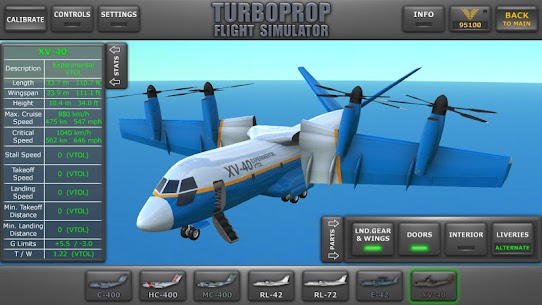
How VTOL Mode Works on the XV-40 and PV-40 Tilt-Wing Aircraft
The XV-40 and PV-40 are tilt-wing VTOL aircraft — they rotate their wing-mounted engines between horizontal flight position and vertical hover position. Switching between modes is done via a dedicated control button. In vertical mode, the aircraft hovers and responds to collective throttle like a helicopter. In horizontal mode, it flies as a conventional turboprop.
VTOL transitions require gradual throttle management. Switching to vertical mode at high forward speed without reducing throttle causes the aircraft to pitch sharply. Free-flight mode is the right place to practice VTOL transitions repeatedly before using the XV-40 or PV-40 in timed missions.
What the Aircraft Destruction System Does in Turboprop Flight Simulator 3D
The aircraft destruction system provides immediate physical feedback for every collision, bad landing, and overspeed event. It operates in stages: wing-tip clipping, full wing separation, tail separation, and complete fuselage breakage. Each stage corresponds to a different severity of impact. A minor runway edge clip might remove only a wing tip. A full nose-down impact will break the fuselage entirely.
The destruction system is not just a visual feature. It directly signals why a landing failed and which part of the approach went wrong. Players who pay attention to which part of the aircraft breaks first can diagnose their technique errors faster than players who simply restart and repeat.
How Wing-Tip Clipping and Full Wing Separation Happen
Wing-tip clipping occurs when the aircraft drifts sideways during a crosswind landing and one wing contacts the runway surface. It is a recoverable damage state in some aircraft but disables control response on the affected side. Full wing separation happens when the same impact occurs at a higher speed or angle. At that point the mission ends immediately.
The crosswind landing scenario triggers wing damage most often. Players who do not use rudder correction to keep the nose aligned with the runway centreline during the landing roll will experience this regularly in early sessions.
How Tail and Fuselage Breakage Signals a Mission Failure
Tail separation happens most often from a hard touchdown with insufficient flap deployed. Without adequate lift reduction from the flaps, the aircraft lands too fast and the tail section contacts the runway at an angle. The game visually separates the empennage and ends the flight. Fuselage breakage follows a full nose-down impact — typically from a missed approach or a stall recovery that is initiated too late.
Both events are automatic mission failures. However, the destruction animation clearly shows the point of impact. Consequently, players can identify whether they stalled too high, approached too fast, or failed to arrest the descent rate in time.
How to Use Destruction as a Learning Tool for Safer Landings
Rather than treating aircraft destruction as a punishment, players can use it as diagnostic information. After each destruction event, the stage that triggered first tells the player exactly what failed. Wing-tip clipping means drift. Tail separation means excess speed on touchdown. Fuselage breakage means missed approach or stall.
By mapping the destruction stage to a specific error, players can focus their practice on one thing at a time. Spending ten minutes in free-flight intentionally triggering each stage teaches the physical limits of the sim’s landing envelope faster than any checklist. Additionally, watching the destruction animations from the cockpit camera makes the cause-and-effect relationship unmistakable.
Best Turboprop Flight Simulator 3D Tips and Tricks for Beginners
Starting well in this simulator means understanding three things before anything else: when to use JATO/L, how to earn in-game currency efficiently, and why the first-person interior walk-through matters. Each of these is specific to how this game works. None of them apply to other mobile flight sims.
New players who skip the training missions and jump straight to cargo operations almost always struggle. Therefore, completing at least the takeoff and landing training sequences before attempting a mission is the single highest-value investment a beginner can make.
How JATO/L Changes Your Takeoff Runs on Short Improvised Runways
JATO stands for Jet Assisted Take-Off. JATOL adds the landing equivalent. In this sim, the system is available on the C-130, MC-130, and MC-400. Players activate it from the controls panel just before the takeoff roll. The system fires external rocket boosters that dramatically shorten the ground roll needed to reach rotation speed.
Without JATO/L, the C-130 and MC-130 cannot safely depart from the short improvised runways assigned in special operations missions. Players who attempt those missions without activating JATO/L before the roll will run off the runway end every time. Therefore, checking JATO/L availability before starting the takeoff roll on any improvised runway mission is a non-negotiable habit.
How to Earn In-Game Currency Faster Through Optional Rewarded Ads
The game does not use mandatory ads. However, optional rewarded ads between flights pay out in-game currency. Players who watch a short ad after each completed mission earn bonus currency on top of the mission reward. That bonus can be significant over a full session.
The most efficient approach is to complete three or four missions in sequence and then watch the rewarded ad after each one rather than skipping it. Additionally, selecting missions with cargo objectives earns more base currency than simple point-to-point flights. Combining both methods is the fastest way to unlock new aircraft without spending real money.
How First-Person Interior Walking Helps You Understand Aircraft Layout Before Flying
Before taking off in any new aircraft, players can enter first-person interior mode and walk through the cabin. This reveals the location of the cargo ramp control, the cockpit instrument positions, the emergency exits, and the interactive items like strobes and main lights. Knowing where these controls are before the flight removes hesitation during missions.
This is particularly valuable on the C-130. The cargo ramp control is at the rear of the aircraft. Players who have never walked through the interior often waste mission time searching for it during the loading sequence. A single pre-flight interior walk eliminates that problem entirely.
Frequently Asked Questions About Turboprop Flight Simulator 3D
Is Turboprop Flight Simulator 3D free to play on Android and iOS?
Yes, Turboprop Flight Simulator 3D is completely free on both Android and iOS. The developer AXgamesoft uses an optional rewarded ad model — no mandatory ads interrupt gameplay. Players earn in-game currency by completing missions or by choosing to watch short optional ads between flights. No real-money purchases are required to access the full aircraft roster.
How many aircraft are in Turboprop Flight Simulator 3D?
The game currently features 14 aircraft variants across four families. These include the C-400 tactical airlifter and its HC-400 and MC-400 variants, the RL-42 and RL-72 regional airliners plus the E-42 early warning version, the XV-40 tilt-wing VTOL and its PV-40 and MV-40 variants, the PS-26 seaplane and MS-26 variant, and the C-130 family including the HC-130 and MC-130.
Does Turboprop Flight Simulator 3D have a free-flight mode?
Yes. Free-flight mode is a core part of Turboprop Flight Simulator 3D. In this mode, players fly any unlocked aircraft across several islands with no mission objectives. They can create custom flight routes on the map, activate auto-pilot, adjust time of day and weather conditions, and enable AI-piloted traffic. The mode also includes VTOL aircraft and the full destruction system.
Why Turboprop Flight Simulator 3D Stands Out Among Mobile Flight Sims
Turboprop Flight Simulator 3D earns its place as one of the best free flight simulators on Android because it focuses on things competing apps avoid. The cargo airdrop system, the JATO/L mechanic, the tilt-wing VTOL aircraft, and the staged destruction model give it a texture that apps like RFS and Infinite Flight do not replicate. Those titles serve commercial aviation fans well. This one serves players who want hands-on military and cargo operations.
The game suits beginners willing to spend time in training missions before taking on harder objectives, and it suits experienced sim players who want more than automated route flying. From personal experience flying through special operations missions with the MC-130 on improvised runways using JATO/L boost, the physical challenge of getting that aircraft off the ground cleanly is genuinely satisfying in a way few mobile titles match. AXgamesoft continues updating the game in 2026, which means the content depth will only grow.
Images

Download links
ℹ️ Download link not working? Please refresh the page and try again.
Mod Info
- Unlimited Money
Related apps


What's new
Note: This is an emergency fix of version 1.34.2.
* Added the 'ROLLING BOMBS DISPENSER' feature to the SpecOps cargo planes.
* Added new liveries for the E-42, PS-26, and MS-26.
* Added a new secret location about the Gunships.
* Made the AI-piloted aircraft destructible when parked.
* Optimised the Cargo Drop interface.
* Upgraded (again) the Unity Engine.
* Fixed the UI disappearing bug from 1.34.2.
* Fixed other bugs.
New Apps
Most Played Mobile Games


