
Traffic Rider MOD APK (Unlimited Money, Key, Bikes Unlocked)

Description
Traffic Rider puts players directly behind the handlebars in full first-person view — a rare choice in mobile racing that changes how every overtake feels. This post is written for new riders and returning players who want to get more from the career mode and score system. Below, this post covers the core riding mechanics, the motorbike selection system, the career mode structure, the scoring bonuses, and the best beginner tips to help you progress faster.
What Is Traffic Rider and How Does It Work
Traffic Rider is a first-person motorcycle racing game for mobile, developed by Soner Kara. Players ride along endless highway roads, weaving through traffic, completing career missions, and upgrading or buying new bikes. The game builds directly on the foundation of Traffic Racer but adds a full career mode, a 34-bike roster, and professionally recorded engine sounds. Together, these additions move the experience beyond simple endless racing into something with real structure and long-term goals.
What the first-person riding mechanic is and how it functions
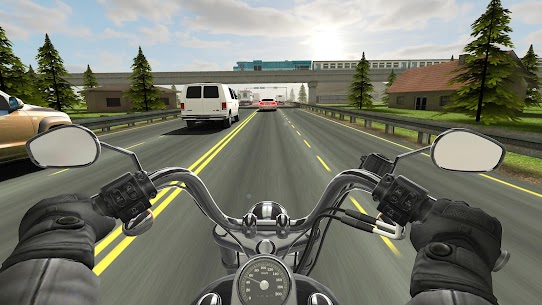
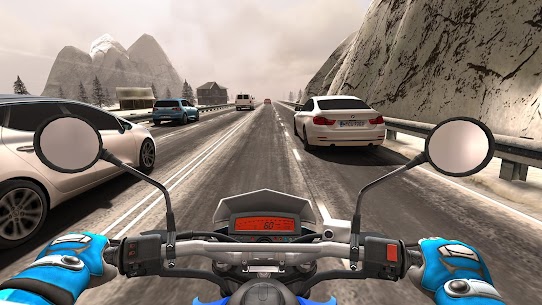
The first-person camera sits directly at handlebar level. This means players see the road from the rider’s perspective rather than from a third-person follow camera above the bike. Because the camera is lower and closer to the action, traffic feels faster and gaps feel tighter. Players must judge distances by how quickly cars fill the screen, not by watching a miniature bike from above.
This perspective makes every close overtake feel genuinely tense. Additionally, it rewards players who read traffic patterns early. Hesitation at speed is far costlier here than in any bird’s-eye racing game. Because the first-person view removes the overhead safety of seeing your whole bike, spatial awareness becomes the core skill that separates fast riders from slow ones.
The highway setting, environment variety, and game tone
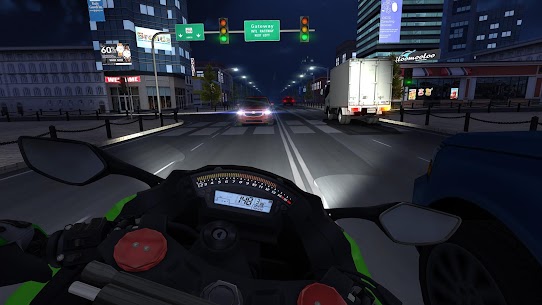
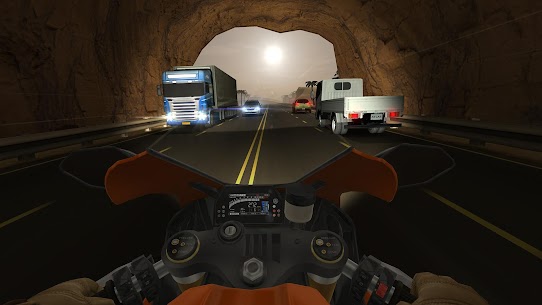
The game takes place on open highway roads with traffic flowing in both directions. Environments shift between day and night cycles, which changes visibility and creates a noticeably different atmosphere for each run. Daytime rides feel brighter and faster. Night rides reduce visual range, so players must react sooner to avoid collisions.
Soner Kara designed the environments with detail that goes beyond most mobile racers. Road markings, vehicle variety, and lighting transitions give the game a grounded look. The tone is arcade in speed and simplicity, but realistic enough in presentation to feel satisfying rather than trivial. Both casual riders and players chasing leaderboard times will find the visual environment serves them well.
How Traffic Rider differs from Traffic Racer in core design
Traffic Racer was Soner Kara’s earlier title — a straightforward endless racer from a slightly elevated rear camera. Traffic Rider keeps the core loop of overtaking traffic at speed, but the first-person view, career mode, and real engine audio make it a significantly deeper product. Where Traffic Racer rewards simple endurance, Traffic Rider rewards skill, strategy, and progression.
The most meaningful difference is structural. Traffic Racer has no career mode and no mission system. Traffic Rider has 90-plus missions with specific objectives. However, both games share the same underlying fun — the satisfaction of threading through dense traffic at high speed. Players who enjoyed Traffic Racer will find Traffic Rider extends that satisfaction with far more reason to keep coming back.
How Traffic Rider Gameplay Controls and Movement Work
The control scheme is intentionally simple. Players steer by tilting the device or using on-screen buttons, depending on settings. Acceleration is continuous, so the challenge is direction and timing rather than managing a throttle. Braking is available but used sparingly — in most situations, slowing down costs more score than it saves in safety.
Steering, acceleration, and braking in first-person view
Because the first-person camera eliminates overhead visibility, steering becomes about anticipation. Players look down the road and read traffic flow, then commit to a lane before a gap opens rather than reacting to it. This is the primary skill the view demands. Tilting too late leads to collisions at speeds where recovery is impossible.
Braking is most useful in career mode missions where a specific speed range must be maintained. In endless mode, however, most experienced players rarely brake at all. Therefore, new players should treat the brake as a last resort rather than a regular tool. Building confidence with speed is more valuable early on than leaning on the brake for comfort.
The overtake system and proximity bonus trigger
The close overtake bonus is one of the most important scoring mechanics in the game. When a player passes a vehicle at over 100 kmh while staying within close lateral distance of that vehicle, the game registers a bonus. This bonus adds both score multiplier value and cash. The closer the pass, the larger the reward.
Players who ride down the centre of the road and avoid traffic safely will earn far less than players who thread narrow gaps at high speed. However, the risk is real. A miscalculated pass at 120 kmh ends a run instantly. As a result, the scoring system directly rewards controlled aggression rather than cautious play. That tension between risk and reward is central to what makes the gameplay loop compelling.
What happens when a mission or endless run ends
In endless mode, a run ends when the player collides with a vehicle. The final score, cash earned, and any bonuses are then tallied and displayed on the results screen. Players can see how close they came to unlocking an achievement or reaching a leaderboard position. This screen also shows total cash earned, which feeds directly into bike upgrades and purchases.
In career mode, missions end when the player either completes the objective or fails it. Failing a mission does not cost cash — it simply requires another attempt. Completing a mission awards cash and unlocks the next mission in the sequence. Additionally, some missions award achievement progress, which ties into the 30-plus achievement system running alongside the career structure.
All Traffic Rider Motorbikes and How to Choose One
The 34-bike roster is one of Traffic Rider’s clearest selling points. Bikes range from accessible entry models to high-speed machines with significantly better stats. Each bike has its own engine sound, recorded from real motorcycles, which makes selection feel meaningful beyond pure numbers.
How the 34-bike roster is structured by class and stats
Bikes are arranged from lower-cost, lower-stat models at the start of the roster to premium, high-performance machines at the top. Each bike has distinct stats covering top speed, acceleration, braking, and handling. These stats are not cosmetic — they determine how a bike behaves on the road and which career missions it can realistically complete.
Entry bikes are slower but easier to control at close quarters. Premium bikes hit higher top speeds, which is essential for missions that require maintaining speed above certain thresholds. However, premium bikes also demand more precision. Therefore, jumping to the fastest bike before developing control skills often produces worse results than riding a mid-tier bike with confidence.
Which bikes offer the best performance for career missions
The best bike for career progression is not always the most expensive one. Many missions set minimum speed requirements or require completing an objective within a distance limit. For these missions, acceleration and handling matter as much as top speed. A bike that reaches 80 kmh quickly is more useful in a short mission than one that reaches 150 kmh slowly.
Players should assess each mission’s objective before deciding to upgrade or buy. If a mission requires a sustained high speed over a long stretch, a top-speed-focused bike wins. If a mission requires close overtakes within a short distance, a nimble mid-tier bike handles it better. Matching the bike to the mission type is the clearest path to efficient career progression.
How real recorded motor sounds affect the riding experience
Soner Kara recorded engine sounds from real motorcycles for each bike in the roster. In practice, this means every bike has a distinct audio identity — the low rumble of a cruiser sounds nothing like the high-pitched scream of a sport bike. These sounds are not just cosmetic. They provide genuine audio feedback on speed and acceleration that the first-person view alone cannot deliver.
At high speeds, the engine note rises and intensifies. This audio cue tells players how close they are to peak performance without looking at a speedometer. Moreover, the recorded sounds give different bikes a personality that keeps the roster from feeling repetitive. Riders who play with audio on consistently report a stronger sense of immersion than those who ride in silence.
How the Career Mode and Mission Structure Work
Career mode is the backbone of Traffic Rider’s long-term experience. It contains 90-plus missions organised into a sequential structure. Each mission sets a specific objective — reach a target speed, complete a set number of overtakes, ride a specific distance, or earn a set cash amount within a single run.
How the 90-plus mission system is organised
Missions are unlocked in order. Completing one opens the next. Early missions are straightforward — ride a certain distance or reach a basic speed threshold. Later missions become more specific and demanding, requiring combinations of close overtakes, high sustained speed, and precise manoeuvring within a single run. This escalation creates a natural skill curve.
The mission structure means players always have a clear goal. Unlike endless mode, where the session ends on failure, career mode provides a fixed objective and a fresh attempt each time. Because missions do not deduct cash on failure, players are free to try difficult objectives repeatedly without financial penalty. That design choice keeps frustration low and encourages experimentation.
How bike upgrades and purchases advance your career progress
Cash earned in both endless and career runs feeds the upgrade system. Players can spend cash on upgrading existing bikes — improving their speed, acceleration, braking, or handling — or on purchasing a new bike from the roster. Upgrades affect the specific bike they are applied to, so switching to a new bike resets the upgrade benefit on the previous one.
For players working through career missions, upgrading a reliable bike is usually more efficient than buying new early. A well-upgraded mid-tier bike often outperforms a stock premium bike on most mission types. However, some late-career missions set speed ceilings that upgraded mid-tier bikes cannot reach. At that point, purchasing a higher-class bike becomes necessary rather than optional.
What online leaderboards and achievements add to long-term play
The online leaderboard system tracks scores from endless mode runs and compares them globally. Players can see their position relative to others on the same platform. This adds a competitive layer that motivates longer sessions and more deliberate scoring technique. Chasing a leaderboard position changes how riders approach each run — every close overtake becomes a calculated decision rather than a casual move.
The 30-plus achievement system runs parallel to the leaderboard. Achievements reward specific behaviours — performing a set number of wheelies, reaching a distance milestone, or completing a certain number of close overtakes. Some achievements unlock cosmetic rewards. Others simply mark progress. Together, the achievements and leaderboard give players with no interest in career mode a separate set of long-term goals to pursue.
How Scoring, Bonuses, and Cash Rewards Are Calculated
Score in Traffic Rider is not just about distance. The scoring system rewards three specific behaviours beyond basic riding — close overtakes at speed, riding in the opposite direction, and performing wheelies. Each behaviour has a distinct bonus structure, and stacking all three in a single run produces significantly higher scores than riding safely in a single lane.
How close overtakes above 100 kmh trigger bonus cash
The close overtake bonus activates when a player passes within close lateral proximity to a vehicle while travelling above 100 kmh. The faster the speed and the tighter the gap, the larger the bonus. This bonus applies to both score and cash simultaneously, making it the most efficient way to progress financially and competitively at the same time.
Players who understand this mechanic seek out dense traffic rather than avoiding it. A stretch of road with many vehicles close together is an opportunity, not a hazard. Threading through five vehicles in a row at 120 kmh earns a bonus on each pass. However, sustaining that approach requires real spatial skill built through repeated play — not something that comes immediately to new riders.
How riding in the opposite direction multiplies your score
Two-way mode and certain career missions send players into oncoming traffic. Riding against the flow of traffic multiplies the score and cash earned for the duration of that section. This is the highest-risk, highest-reward mechanic in the game. Oncoming vehicles approach at combined speed, reducing reaction time dramatically compared to overtaking same-direction traffic.
Players who use this mechanic effectively treat it as a short-term burst strategy rather than a sustained approach. A brief opposite-direction sprint earns a large bonus, then players return to the safe lane. However, staying in oncoming traffic for too long with a premium fast bike is often fatal. Therefore, using this bonus in measured bursts rather than extended runs is the approach that maximises cash without ending the session prematurely.
How wheelies contribute to score and when to use them
Wheelies add a score and cash bonus for the duration they are held. Players perform a wheelie by accelerating sharply in conditions the game recognises as wheelie-ready — typically at lower speeds or on a clear stretch of road. Holding the wheelie longer extends the bonus window, but reduces visibility and steering control during the manoeuvre.
The best time to perform a wheelie is on a brief clear stretch between traffic clusters. Attempting one in dense traffic creates a collision risk that outweighs the bonus. Additionally, wheelies on straight empty sections of road are far easier to hold than on sections where steering adjustments are needed. New players should treat wheelies as a bonus earned on safe stretches rather than a constant pursuit.
What Most Riders Get Wrong About Traffic Rider
Most new players approach Traffic Rider the same way they approach third-person mobile racers — they avoid traffic, ride wide, and prioritise survival over score. In Traffic Rider, that approach produces poor results. The entire scoring and cash system punishes safe, conservative play and rewards risk taken with precision.
Why ignoring the first-person perspective leads to poor overtake timing
Players who have experience with third-person racers often misjudge gaps in Traffic Rider’s first-person view. They initiate overtakes too early or too late because they are used to judging distance from above. Because the first-person camera changes the visual reference point entirely, those instincts do not transfer directly. Players who acknowledge this shift early improve faster than those who try to apply third-person habits to a first-person system.
The fix is deliberate: focus on the gap ahead, not the vehicle beside you. In first-person view, the key signal is how quickly a vehicle fills the screen — not how far the bike appears to be from the side of the vehicle. Practising this perceptual switch on lower-speed runs before attempting close overtakes at maximum speed significantly reduces early collision rates.
Why buying new bikes too early slows career progress
New players often spend their first significant cash reserves on a more expensive bike before upgrading their current one. This feels logical — a better bike should perform better. However, a stock premium bike with no upgrades often has worse real-world mission performance than a well-upgraded mid-tier bike. Upgrades compound. Each one makes the bike noticeably more responsive.
Moreover, spending all available cash on a new bike leaves nothing for upgrades. Players then find themselves with a fast but unresponsive stock bike, unable to afford the upgrades that would make it usable for specific mission requirements. The smarter approach is to upgrade the current bike fully before assessing whether a new purchase is genuinely necessary for the next career mission tier.
Why players miss the opposite-direction bonus entirely
Many players complete the entire early career mode without ever deliberately using the opposite-direction cash bonus. Either they do not know it exists, or they treat oncoming traffic as pure hazard rather than opportunity. Because two-way roads appear in specific modes and missions rather than constantly, players who stick to single-direction endless runs never encounter the prompt to try it.
Career missions that introduce two-way riding are the clearest teaching moment. Players who pay attention to mission objectives on those stages learn the bonus structure naturally. However, players who restart missions immediately on seeing oncoming traffic never build the skill. Taking one or two deliberate runs in two-way mode specifically to observe the bonus trigger is enough to understand how to use it effectively without risking an important career attempt.
Best Traffic Rider Tips and Tricks for Beginners
H3: How to build speed consistently for maximum score per run
Speed is the foundation of every score in Traffic Rider. Higher speed means larger close-overtake bonuses, longer wheelie windows, and more cash per kilometre. The most direct way to build speed is to choose a bike with strong acceleration and avoid braking unless absolutely necessary. Every second of reduced speed cuts potential bonus earnings for that portion of the run.
New players should pick a starting bike with good acceleration rather than maximum top speed. Getting to 100 kmh quickly — the threshold for close-overtake bonuses — matters more than eventual top speed in the early game. Additionally, learning to read traffic flow from distance allows players to maintain high speed through dense sections without slowing to navigate. Speed built on good anticipation is more sustainable than speed built on luck.
How to use upgrade priority to beat early career missions faster
The upgrade priority order for most early missions is: acceleration first, then handling, then top speed. Acceleration determines how quickly a bike reaches the bonus speed threshold. Handling determines how precisely the player can navigate tight gaps. Top speed matters for missions that require a sustained high-speed average, but those missions appear later in the career sequence.
Players who upgrade acceleration first notice results immediately — runs reach peak bonus conditions earlier, which means more cash per attempt. That additional cash then funds further upgrades faster. However, once acceleration reaches a strong level, handling becomes the limiting factor for close-overtake frequency. Balancing upgrades between these two stats covers the majority of career mission types through the mid-game.
What to do when a mission feels impossible to complete
If a career mission feels impossible despite repeated attempts, the answer is almost always the same: the current bike lacks the stats the mission requires, or the bike lacks the upgrades to make its stats usable. Before calling a mission impossible, check the mission objective carefully. If the objective requires reaching a speed the current bike cannot sustain even fully upgraded, a new bike purchase is necessary. If the objective is about overtake count or distance, upgrading handling and acceleration usually resolves it.
Attempting the same mission with the same under-specced bike more than five times without change rarely produces a different outcome. Instead, spend two or three runs in endless mode building cash, then return to the mission with an upgrade applied. Most players who follow this cycle find that missions they considered impossible become straightforward after one or two targeted upgrades.
Frequently Asked Questions About Traffic Rider
What platforms is Traffic Rider available on?
Traffic Rider is available on both iOS and Android. Players can download it from the Apple App Store and Google Play Store. The game supports 19 languages, making it accessible across a wide international player base. No PC or console version is currently available — the game is built specifically for touchscreen mobile devices.
How long does it take to complete Traffic Rider career mode?
Career mode contains 90-plus missions. A player progressing steadily through each mission on first or second attempt typically spends 10 to 20 hours completing the full career sequence. Players who upgrade strategically and avoid extended retry sessions reach the end of career mode faster. However, the leaderboard and achievement systems extend total playtime well beyond career completion for competitive players.
Does Traffic Rider have different endings or replayable modes?
Traffic Rider does not have a story ending or branching narrative. Career mode concludes when all missions are completed. After that, the game remains fully replayable through endless mode, two-way mode, and the achievement system. The online leaderboard provides ongoing competition for players who continue after finishing career mode. There is no locked content gated behind a single playthrough — all modes are accessible throughout the game.
Why Traffic Rider Is Worth Your Time on Mobile
Traffic Rider delivers something specific: first-person motorcycle racing with genuine structure. The 34-bike roster, the 90-plus mission career mode, and the layered scoring system create a game that rewards real skill development rather than passive play. For new players, the curve is accessible — the controls are simple and the early missions are forgiving. For experienced mobile racers, the close-overtake bonus system and leaderboard competition provide long-term depth that most endless racers never reach.
After spending real time with the career mode and the bonus scoring mechanics, the game stands out as one of the better-designed mobile racers available. The first-person perspective is not a gimmick — it fundamentally changes how each run feels and demands a different kind of spatial attention than any third-person alternative. Players who enjoy mobile racing, motorcycle games, or score-chasing gameplay will find Traffic Rider earns its place on their device.
Images
Download links
ℹ️ Download link not working? Please refresh the page and try again.
Developer's apps

Related apps


New Apps
Most Played Mobile Games


