
Townsmen Premium MOD APK (Unlimited XP, Fast Pass)

Description
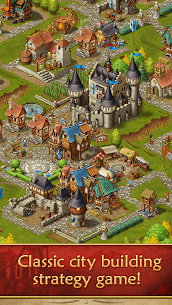
Townsmen Premium puts you in charge of a medieval settlement where every farm, mine, and marketplace must work together inside a deep production chain that connects each building on your map. This walkthrough is written for beginners and returning players who want a clear, structured path through the game’s systems. By the end, you will understand production chains, seasonal disasters, the military system, sandbox mode, and how to keep your villagers working at full productivity.
What Is Townsmen Premium and How Does It Work
Townsmen Premium is a medieval city-building and economy simulation game developed and published by HandyGames. Players start with a small backwater settlement and must grow it into a grand empire. The game runs on a continuous loop of resource extraction, production, distribution, and taxation.
The experience combines two separate challenges: building an efficient economy and keeping villagers happy enough to stay productive. Every decision you make — where to place a farm, when to build a tavern, whether to invest in soldiers — ripples outward through the entire town.
How the medieval city-building core mechanic works
The core mechanic in Townsmen Premium is the production chain. Raw materials extracted at mines and farms flow into processing buildings, which turn them into goods. Those goods then travel to the marketplace, where your inhabitants collect them as part of their daily routines.
Each building needs workers assigned to it. However, workers are a limited resource. Because every building competes for the same pool of inhabitants, placement decisions matter enormously. Placing a carpenter’s workshop too far from the sawmill means workers spend more time walking than producing.
The setting, tone, and medieval empire premise
The game is set entirely in the medieval period. There are no futuristic upgrades or modern technology shortcuts. Players manage ore mines, crop farms, jousting fields, taverns, and statues using the tools and logic of a feudal economy.
The tone is light and approachable. Inhabitants have their own daily routines and move visibly around your town. The visual style uses bright colours and animated characters. However, underneath that cheerful surface sits a surprisingly demanding economy simulation.
How Townsmen Premium compares to City Island 6 and SimCity BuildIt on mobile
City Island 6 and SimCity BuildIt are the two most prominent mobile city builders competing directly with Townsmen Premium in this genre. City Island 6 uses a multi-island expansion model. Players build on one island, then unlock adjacent islands using currency earned from completing tasks. By contrast, Townsmen Premium keeps all progression on a single map, which makes production chain management more visible and more tactical.
SimCity BuildIt focuses on modern infrastructure — roads, utilities, and residential zones. Townsmen Premium removes that layer entirely and replaces it with medieval production logic. Additionally, SimCity BuildIt includes heavy social and competitive features. Townsmen Premium keeps the experience single-player and offline-friendly. For players who want a self-contained medieval economy without multiplayer pressure, Townsmen Premium offers a distinctly different experience.
How Townsmen Premium Gameplay and Controls Work
Townsmen Premium uses a top-down view of your settlement. Players tap to select building plots, tap again to choose which building to construct, and then assign workers from the available pool. The game updates in real time, so production is always visible on screen.
Controls are fully optimised for touchscreen play. Pinching zooms the camera in and out, which is important because production chains span large parts of the map. The game also supports tablets with a full-screen layout that gives more room to manage a growing empire.
How production chains connect buildings and workers
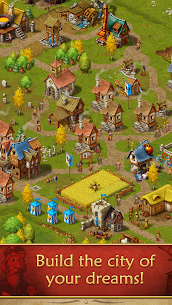
Every production chain starts with a raw resource building. A forester’s hut produces logs. A quarry produces stone. A farm produces grain. These raw materials sit in the building’s storage until a worker from a connected processing building comes to collect them.
That processing building turns the raw material into a finished good. A sawmill turns logs into planks. A mill turns grain into flour. The finished good then moves to the marketplace or to a consumption building that uses it. Therefore, the physical distance between each step in the chain directly affects how fast goods reach their destination.
How the economy system manages resources and taxes
Tax collection forms the foundation of your income in Townsmen Premium. Your castle collects coins from residents at regular intervals. However, the tax rate depends on villager happiness. Happier villagers pay more reliably, so entertainment buildings like taverns and jousting fields are not optional luxuries — they are economic tools.
The marketplace also allows buying and selling goods. However, buying and selling the same resource at the same time creates a deficit, because purchase and sale prices differ. The trade guild building, added in a later update, allows players to set up automatic trade rules to stabilise supply without constant manual intervention.
What happens when scenario objectives or sandbox quests complete
Completing a scenario objective earns coins, production bonuses, or unlocks the next task in the sequence. Each completed objective moves your town closer to satisfying the scenario’s final goal, which typically involves reaching a specific population or economy threshold.
In sandbox mode, completing quests rewards you with building unlocks and prestige points. These points contribute to your town’s overall rating. Additionally, finishing quests in sandbox mode opens up new map areas, giving your empire more room to expand without the constraints of a fixed scenario objective.
How Production Chains Power Your Medieval Economy
Production chains are the structural backbone of Townsmen Premium. Every entertainment building, military structure, and residential amenity relies on goods that your production network must supply. A chain that breaks at one point affects every building downstream.
The most important early chain involves food. Villagers need to eat. A functioning food chain — farm to mill to bakery — must operate continuously before players invest heavily in anything else. Similarly, the ore chain — mine to smelter to blacksmith — provides the tools workers need to operate at full efficiency.
Which raw resource buildings start every successful chain
The three raw resource buildings every new settlement needs are the farm, the mine, and the forester’s hut. Each produces one category of material: food crops, ore, and timber. These three categories feed into nearly every other production building in the game.
Players should place raw resource buildings close to their natural resource tiles. Mines work best near rock formations. Farms work best on fertile soil tiles. Forester’s huts do not need a specific tile type, but they benefit from open space because the hut plants and harvests trees in the area around it.
How processing buildings convert raw goods into finished products
Processing buildings sit in the middle of every chain. The mill converts grain from the farm into flour. The bakery then converts flour into bread. The smelter converts ore from the mine into metal bars. The blacksmith converts metal bars into tools or weapons.
Each processing building has its own storage capacity. If that storage fills up because downstream consumption is too slow, the building stops producing. Therefore, balancing the speed of each step is as important as placing the buildings correctly. Many beginners upgrade raw resource buildings too early, flooding processing buildings and creating a production backlog.
How the marketplace distributes goods across your town
The marketplace is the central distribution hub in Townsmen Premium. Workers assigned to the marketplace collect finished goods from production buildings and carry them to residential and consumption buildings across the map.
Upgrading the marketplace increases the number of workers it can support and the efficiency of each worker’s delivery route. A level 2 marketplace with five workers outperforms a level 1 marketplace with five workers significantly, because the upgrade multiplies the number of goods each worker handles per trip. Prioritising the marketplace upgrade early prevents the distribution bottlenecks that slow most beginner towns.
How Seasonal Weather and Disasters Affect Your Town
Townsmen Premium includes a full seasonal cycle — spring, summer, autumn, and winter — each with distinct weather conditions. Seasons are not cosmetic. They directly affect farm output, worker movement speeds, and the likelihood of certain disasters occurring.
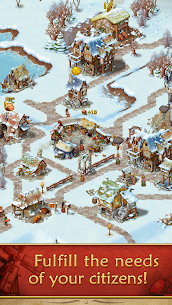
Winters bring blizzards that slow workers and reduce crop yields. Summers bring drought conditions that threaten food production. Each season requires a different response, and players who ignore seasonal changes often find their production chains stalling at the worst possible moments.
What disasters threaten your medieval town and how to respond
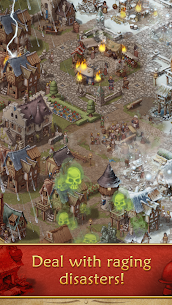
Disasters in Townsmen Premium include fire, disease, drought, blizzards, lightning strikes, avalanches, and large-scale bandit raids. Each disaster targets different parts of your town. Fire spreads from building to building, so spacing structures with gaps reduces how far a blaze travels. Disease reduces worker availability, slowing the entire production network.
The fastest response to fire is having enough idle workers to act as firefighters. Disease requires players to ensure food supply remains strong throughout the outbreak, because well-fed villagers recover faster. Drought raises trade prices for food resources at the marketplace, so maintaining a food surplus before summer begins is one of the most valuable habits a player can build.
How seasons change production output and worker behaviour
Spring and summer produce the strongest farm yields. Workers move at normal speed, and production chains run at full capacity. Autumn begins to slow outdoor production slightly, and players should use this time to stockpile food and materials before winter arrives.
Winter blizzards reduce worker movement speed. Workers take longer to travel between buildings, which means production chains slow even if every building is fully staffed. Additionally, outdoor resource buildings like farms may pause entirely during extreme weather. Building a food reserve during spring and summer is therefore not optional — it is the only way to avoid a hunger crisis during winter.
How drought raises food trade prices at the marketplace
When drought hits, the marketplace’s trade prices for all food resources increase. Buying food at the market during a drought costs significantly more than during normal conditions. Players who rely on purchasing food as a backup during difficult seasons will find that strategy becomes expensive precisely when they need it most.
The practical solution is a stockpile strategy. Before summer, players should build extra farm capacity and let surplus food accumulate in storage. When drought arrives and farm yields drop, the stockpile covers the gap without requiring emergency market purchases. This one habit separates players who sail through disaster events from those who collapse under them.
How the Military System Protects Your Empire
The military system in Townsmen Premium is optional. Players who prefer a pure city-building experience can ignore bandits entirely in sandbox mode. However, in scenario mode, bandit raids become more frequent and more damaging as your empire grows, and ignoring defense eventually costs more than building it.
The military layer never overwhelms the economic focus of the game. It sits alongside the production chain system rather than replacing it. Players who enjoy both building and defending will find the balance satisfying.
When to build barracks and guard towers
The right time to build a barracks is when your economy can support the worker cost without pulling staff from critical production buildings. Soldiers consume resources just like any other worker. Therefore, building military infrastructure before your food and production chains are stable is a common mistake that weakens both your defense and your economy simultaneously.
Guard towers extend the defensive perimeter around your town without requiring assigned workers. They act as fixed defenses that slow or stop bandit raids from reaching your production buildings. Place guard towers on the outskirts of your settlement, along the routes bandits most frequently use to enter the map.
How soldiers and bandits interact in Townsmen Premium
Bandits spawn outside your settlement’s boundaries and move toward populated or high-value buildings. Soldiers assigned to a barracks will intercept bandits before they reach their targets. The more soldiers you have, the faster bandits are neutralised.
However, each soldier costs worker population and ongoing resource consumption. A town with too many soldiers and too few production workers will struggle to maintain supply chains. The optimal approach is a small standing military — two to three soldiers supported by well-placed guard towers — rather than a large army that drains your economy.
How the optional military feature balances with economic growth
The military system is designed to scale with your empire rather than dominate it. In the early game, bandits are infrequent and weak. One or two soldiers and a pair of guard towers provide adequate protection while your economy grows. As your settlement becomes larger and more prosperous, bandit raids increase in frequency and size, which naturally signals when to expand your military capacity.
Because military buildings require the same building materials as production buildings — stone, timber, and tools — they compete with economic expansion for the same resources. This creates genuine strategic tension between growing your economy and protecting it, which is one of the more interesting design decisions in the game.
How Scenarios and Sandbox Mode Differ in Townsmen Premium
Townsmen Premium offers two distinct ways to play. Scenario mode presents structured challenges with defined objectives. Sandbox mode removes those constraints entirely and lets players build freely across open maps with optional quests as direction.
Both modes use the same underlying production chain mechanics and disaster systems. However, the experience of playing each is fundamentally different, and choosing the right mode for your playstyle makes a significant difference to how enjoyable the game feels.
How scenario objectives structure your early city progression
Scenario mode guides new players through the game’s systems by assigning concrete tasks. A scenario might require reaching a specific population, producing a set quantity of goods, or surviving a series of disasters without losing more than a fixed number of buildings. These objectives create a natural learning progression.
Each scenario uses a specific map with fixed resource tile locations. Because players cannot choose their starting conditions, scenarios demand adaptation. The available resource tiles on the map determine which production chains are easy to build and which require extra worker investment, adding a layer of strategic constraint that sandbox mode does not impose.
How sandbox quests give unrestricted creative freedom
Sandbox mode in Townsmen Premium places players on an open map with no mandatory objectives. Players can build in any direction, prioritise any production chain, and expand at whatever pace suits them. Optional sandbox quests appear throughout the session and offer rewards for completing them, but ignoring them carries no penalty.
The reworked sandbox mode added a larger quest pool, new map varieties, and prestige point rewards that track long-term progress. These additions give sandbox play a sense of direction without restricting creative freedom. Players who want to build an aesthetically arranged medieval empire with statues, gardens, and jousting fields alongside a functional economy will find sandbox mode the better fit.
How the happiness system affects villager productivity in both modes
Villager happiness in Townsmen Premium is not a static number — it fluctuates based on how well you supply food, entertainment, and security. Happy villagers work faster and pay higher taxes. Unhappy villagers slow production and pay less, which reduces your income at exactly the moment you need resources most.
Entertainment buildings — taverns, jousting fields, fairgrounds, and juggler camps — each contribute to the happiness meter. Building one of each type early provides broader happiness coverage than building multiple copies of the same structure. This applies in both scenario mode and sandbox mode, so understanding the happiness system is one of the most transferable skills in the game.
Best Townsmen Premium Tips and Tricks for Beginners
Starting well in Townsmen Premium means understanding which decisions compound over time and which mistakes become expensive to undo. The production chain system punishes poor placement permanently, because relocating buildings costs resources you rarely have to spare in the early game.
These three tips address the three most common points where new players stall or fail.
How to prioritise raw resource buildings before placing entertainment structures
The most common early mistake in Townsmen Premium is building entertainment structures before the food chain is stable. Taverns and jousting fields improve happiness, but happy villagers still need to eat. A functioning farm-to-bakery chain must operate continuously before any entertainment investment makes sense.
Build one farm, one mill, and one bakery as your first three production buildings. Then assign enough marketplace workers to distribute food reliably. Only after food supply is stable should you place the first tavern. This sequence keeps villagers fed, employed, and gradually happier without creating a food crisis in the first winter.
How to keep production chains from stalling during seasonal weather shifts
Seasonal weather shifts are the most common reason production chains stall in Townsmen Premium. When a blizzard hits, workers slow down, delivery times increase, and storage buildings fill up because goods cannot move fast enough. The entire chain backs up from the processing stage to the raw resource stage.
The fix is over-staffing the marketplace before winter arrives. Assigning two or three extra marketplace workers in autumn means your distribution capacity increases precisely when worker movement speeds decrease. The surplus staffing compensates for the blizzard slowdown and keeps chains flowing even during the worst winter weather events.
How to prevent bandit raids from destroying a production building mid-chain
Bandits in Townsmen Premium prioritise high-value buildings, and production buildings qualify. A bandit raid that destroys your smelter mid-chain halts every downstream building that depends on metal bars — the blacksmith, the armoury, and any building using tools. Rebuilding costs time and resources that mid-game economies rarely have in surplus.
Place guard towers at two or three entry points on the map’s perimeter before your economy grows large enough to attract frequent raids. This early placement means soldiers have tower support before raids escalate in intensity. Additionally, keeping at least one soldier active at all times provides a mobile response option that static guard towers cannot offer.
Frequently Asked Questions About Townsmen Premium
Is Townsmen Premium available on Android and iOS?
Yes. Townsmen Premium is available on both Android via Google Play and iOS via the App Store. The Premium version is a paid release with no in-game advertising. HandyGames also offers a free version of Townsmen supported by ads and optional in-app purchases for players who want to try the game before buying.
How long does it take to build a full medieval city in Townsmen Premium?
The time varies significantly based on mode and play style. In scenario mode, individual scenarios take between one and three hours to complete depending on difficulty. Sandbox mode has no defined endpoint. However, most players reach a fully developed medieval city with all major production buildings, military structures, and entertainment venues after approximately six to ten hours of active play.
Does Townsmen Premium work offline without an internet connection?
Yes. Townsmen Premium is fully playable offline. The game does not require a persistent internet connection. Google Play game services, which support achievements and leaderboards, require a connection to sync, but all core gameplay — including both scenario mode and sandbox mode — runs entirely offline on your device.
Why Townsmen Premium Is Worth Playing for City-Building Fans
Townsmen Premium is one of the most complete medieval city-building experiences available on mobile. The production chain system rewards careful planning without punishing casual play, and the seasonal disaster mechanic adds genuine strategic depth that most mobile builders in this genre do not attempt. After spending extended time with both scenario mode and sandbox mode, I found the production chain decisions consistently satisfying — there is always a meaningful choice to make, and the game is honest about the consequences when you get one wrong. This title is best suited to players who enjoy slow-burn strategy with visible cause-and-effect mechanics. If you want a medieval city builder that takes your decisions seriously, Townsmen Premium earns its place on your device.
Images

Download links
ℹ️ Download link not working? Please refresh the page and try again.
Developer's apps





Related apps




What's new
- Updated Unity ads to ensure they keep working in the future
New Apps
Most Played Mobile Games


