
Soccer Tycoon MOD APK (Free Shopping)

Description
Soccer Tycoon: Football Game puts you in the boardroom — not on the pitch — as the sole owner of a football club with 750 clubs to buy across nine European countries and 64 trophies on the line. This post is written for beginners and early-game owners who feel overwhelmed by the transfer market, staff management, and financial system. Here you will find a full breakdown of the ownership loop, the transfer database, stadium development, staff roles, and the most common mistakes that send new owners bankrupt before the second season.
What Is Soccer Tycoon Football Game and How Does It Work
Soccer Tycoon: Football Game is a mobile sports ownership simulation from developer Top Drawer Games Limited, available on iOS and Android. You are not a coach selecting formations. You are a business owner buying clubs, managing finances, and competing for silverware across nine European football nations. The game is built around one central question: how do you turn a struggling lower-division club into a continental powerhouse?
How the club ownership loop works — buy, build, and sell
The club ownership loop is the defining mechanic. You start with enough money to purchase a small club in one of the nine available countries. From there, you build the club’s value by investing in players, staff, and facilities. Once the club is worth significantly more than you paid for it, you have two choices. You can sell it, bank the profit, and use those funds to buy a bigger, better club further up the leagues. Or you stay with your original club and push it all the way to European glory.
This loop makes Soccer Tycoon feel more like running a business than playing a game. Every decision — when to buy, when to sell, when to invest — has a direct financial consequence. That tension between short-term profit and long-term ambition is what separates it from standard football management titles.
The football tycoon setting and competitive structure across 9 countries
The game covers England, Spain, Germany, Italy, France, Russia, Portugal, Turkey, and the Netherlands. Each country has its own realistic league pyramid and cup competitions. Together, these 9 nations contain 750 clubs and 64 trophies. However, you own one club at a time. So every trophy you chase comes with a specific financial context — the resources of the club you currently own.
That structure matters because it shapes your entire strategy. A small Turkish second-division club requires a very different financial approach than a top-flight English side already competing in Europe. The game builds that distinction naturally through club valuation and available transfer budgets.
How Soccer Tycoon compares to MadFut 26 and Soccer Manager 2026 on mobile
The most important distinction between Soccer Tycoon and competitors like MadFut 26 or Soccer Manager 2026 is what you are actually managing. MadFut 26 focuses on team selection, tactics, and daily training — you are a coach. Soccer Manager 2026 adds a 3D match engine and deep tactical layers. Soccer Tycoon removes those elements almost entirely. Your manager selects the squad for each match. You control transfers, staff appointments, facilities, and finances. The result is a game that rewards business thinking over tactical knowledge — a meaningful difference for players who want the boardroom, not the dugout.
How Gameplay and Club Control Work in Soccer Tycoon
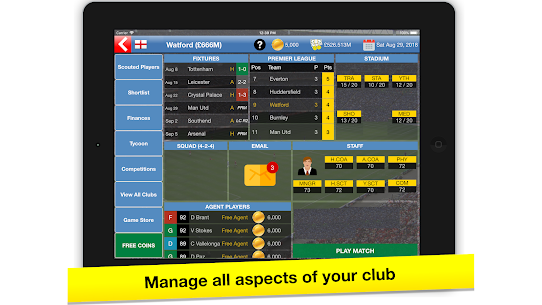
The club dashboard is the centre of every session. From here, you access the transfer market, staff panel, facilities, finances, and fixture list. The interface is streamlined for mobile — most key decisions take a few taps. However, new players often feel overwhelmed in the first few hours because the dashboard presents many options at once without a clear priority order.
How players navigate the club dashboard and make ownership decisions
Each section of the dashboard handles a different layer of club management. The finance screen shows incoming and outgoing cash. The squad screen shows your current players, their ratings, and their contract values. The fixtures screen shows upcoming matches and results. You review each area regularly and make decisions based on available funds, scout reports, and league position.
The key habit to build early is checking your monthly financial balance before making any transfer moves. Because the game does not generate large match-day revenue automatically in the lower divisions, overspending on wages is the fastest way to lose control of a club.
How the transfer market and scouting system operate
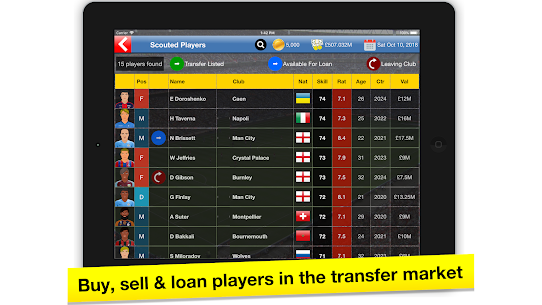
Your Head Scout and Youth Scout generate regular player reports. These reports show available players at various price points, with ratings that indicate their quality. You review the report, make an offer to buy or loan a player, and then negotiate both the transfer fee and the personal contract terms. The game gives you control over both sides of that deal.
Scouting is not instant. Reports arrive over time, which means you build a picture of the transfer market gradually. Therefore, investing in a quality Head Scout early is not optional — it directly controls the speed and quality of information you receive about the 17,000-player database.
What happens when your club wins promotion or a trophy
Winning promotion moves your club up a division within your chosen country’s league pyramid. That brings stronger opponents, higher wage expectations, and larger potential transfer fees. It also increases your club’s overall value. Similarly, winning a domestic cup or league title generates a value increase that makes your club worth more when you eventually choose to sell.
Trophy wins also unlock access to continental competition depending on your league finish. Reaching European competition opens up the highest-value matches and, consequently, the largest revenue opportunities in the game.
How to Use the Transfer Market and 17,000-Player Database
The transfer market is where most ownership decisions play out. With 17,000 players in the database, the volume of choice is significant. However, you only see a portion of those players at any given time — the ones your scouts have identified and reported on. Building a strong scouting setup is therefore the prerequisite for using the transfer market effectively.
How scouts generate player reports and how to read them
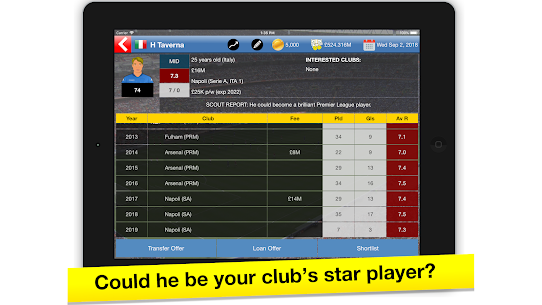
The Head Scout and Youth Scout each send reports on players they have found. Each report includes the player’s current rating, age, club, and an estimated transfer value. Younger players with high potential ratings represent longer-term investment. Older players with high current ratings are more expensive but deliver immediate quality.
Reading those reports well means understanding what your club actually needs at this moment. If your squad is short on defenders rated above 70, you prioritise that position in your scout briefings. If you are close to promotion and need one strong attacking midfielder to push over the line, that becomes the focus.
How to negotiate transfer fees, loan deals, and personal terms
When you identify a target, you submit an offer. The selling club responds with a counter-offer. You accept, reject, or revise. Once the transfer fee is agreed, you then negotiate the player’s personal terms — wage, contract length, and signing bonus. Both sides of this negotiation draw on your available budget.
Loan deals are a powerful tool in the early game. Loaning a high-rated player costs no transfer fee and provides immediate quality. The wage cost is still a factor, but loans let you punch above your financial weight while your club’s value is still growing. Many experienced players use the loan market heavily in their first two or three seasons.
When to sell your star player and when to hold
Selling your best player is tempting when a big offer arrives. However, that decision depends on your current league position and trophy ambitions. If you are in contention for promotion or a cup final, losing your top-rated player during the season can cost you the silverware — and the associated club value increase.
The smarter approach is to reject in-season offers on star players and only accept during transfer windows when you have time to reinvest the proceeds. Additionally, if you plan to sell the entire club soon, keeping your best player raises the overall club valuation rather than cashing out early for a smaller individual gain.
How to Manage Backroom Staff in Soccer Tycoon
Seven staff roles operate alongside your playing squad. The Manager, Head Coach, Academy Coach, Physio, Head Scout, Youth Scout, and Commercial Manager each contribute to different areas of club performance. Hiring the right person at the right time is as important as signing the right player.
What each of the seven staff roles does for your club
The Manager is the most critical hire. Your manager selects the squad for each match and directly influences on-pitch results. A poor manager means losses. Losses mean lower club value, lower league position, and weaker transfer leverage. The Head Coach works alongside the manager to improve player performance over time.
The Head Scout and Youth Scout generate the transfer market reports described in the previous section. The Physio handles player fitness and injury recovery. The Academy Coach develops players in your Youth Academy into future first-team assets. The Commercial Manager increases the club’s revenue-generating capacity. Each role has a direct impact on a specific financial or performance metric, so ignoring any of them has a measurable cost.
How to identify when a staff member is underperforming
The clearest signal is results. If your club is consistently losing matches despite a strong squad, the manager is likely the problem. If your Youth Academy is producing players at a slower rate than expected, the Academy Coach may need replacing. The game provides performance data that makes these patterns visible, but you need to check them regularly rather than waiting for a crisis.
Firing a staff member costs money. Therefore, timing is important. Replace underperforming staff when your finances are stable — not when the club is already running at a monthly loss.
When hiring the Academy Coach and Youth Scout pays off
The Academy Coach and Youth Scout become valuable in the mid-game, once your club has reached at least the second tier of its national league. At that point, the Youth Academy can produce players with ratings high enough to contribute to or enhance your squad. Before that stage, the return on investment is slow.
Prioritising the Head Scout and Manager in the early game is the more efficient approach. However, once you decide to stay with a club long-term rather than sell it, investing in youth development compounds over multiple seasons and reduces your reliance on expensive transfer market purchases.
How to Develop Your Stadium and Facilities in Soccer Tycoon
Five facilities are available to expand: the Stadium, Training Ground, Youth Academy, Medical Centre, and Club Shop. Each upgrade costs money and takes time to deliver results. However, facility investment is one of the most sustainable ways to increase your club’s long-term value and performance.
Which facility to expand first for maximum club growth
The Stadium should be the first major investment for most owners. A larger stadium increases match-day revenue, which directly improves your monthly financial balance. In the lower divisions, this revenue boost can be the difference between running at a profit and running at a loss — which, as noted earlier, is the most common reason new owners fail.
After the Stadium, the Training Ground is the next priority. An upgraded Training Ground improves your existing players’ ratings over time. That means your squad becomes more competitive without the cost of additional transfers, which is a significant efficiency gain.
How the Youth Academy and Training Ground affect squad quality
The Training Ground affects your first-team players directly. Regular use of an upgraded facility produces gradual but measurable rating improvements across your squad. Over a full season, this improvement can lift several players into a higher rating bracket — making them more valuable if you choose to sell them and more competitive on the pitch.
The Youth Academy produces young players over a longer timeframe. Its output depends on the quality of your Academy Coach. A well-invested Academy with a strong coach produces players with high potential ratings who can develop into first-team regulars or generate significant transfer fees when sold.
What expanding the Club Shop and Medical Centre unlocks
The Club Shop expands your commercial revenue. A higher-level Club Shop generates more income from merchandise, which supplements match-day revenue and reduces pressure on your transfer budget. It is a slower return than Stadium expansion but compounds well over multiple seasons.
The Medical Centre reduces player recovery time after injuries. At higher league levels, where squad depth becomes a critical factor, a well-funded Medical Centre ensures your key players return to fitness faster. That reduces the impact of mid-season injuries on your league and cup campaigns.
All Trophies and Leagues Available in Soccer Tycoon
Soccer Tycoon contains 64 trophies across its 9 European countries. These span domestic league titles, national cup competitions, and continental competitions. Competing for all 64 is the game’s longest-range objective and the measure of true ownership mastery.
How many trophies each of the 9 countries offers
Each country contains multiple trophies based on its real league and cup structure. England, Spain, Germany, Italy, and France each feature multi-tier leagues and prestigious domestic cups. Russia, Portugal, Turkey, and the Netherlands add further league systems and cup competitions. No single country holds all the prestigious silverware — so chasing every trophy requires owning and competing with clubs across all nine nations.
The buy-and-sell ownership loop makes this achievable. You can build a club in England, win its available trophies, sell it, then reinvest in a Spanish or German club and begin again. Each new country resets the trophy challenge with a fresh competitive context.
How domestic cups and continental competitions are structured
Domestic cups run alongside the league season. These offer a second silverware opportunity each year and are often more accessible for mid-table clubs than the league title itself. Continental competition access depends on your final league position. Finishing in the top positions of a national league earns your club a place in European competition.
Continental competition brings the most prestigious trophies and the highest-value matches in the game. Winning a continental title is the peak objective for owners who choose to stay with one club rather than sell. It also produces the largest single increase in club value of any in-game outcome.
What completing a full trophy collection in one country requires
Winning every available trophy in a single country requires your club to dominate its domestic league across multiple seasons, win the national cup at least once, and reach and win the continental competition. That demands consistent financial management, strong squad quality, experienced staff, and fully upgraded facilities.
No shortcut achieves it. The path is cumulative — each promotion, each trophy, each facility upgrade builds toward the complete set. Players who try to rush through by overspending on transfers typically create financial instability that prevents the sustained dominance needed to clear a full trophy collection.
What New Owners Get Wrong — Common Soccer Tycoon Mistakes
Most mistakes in this game trace back to one root cause: spending before understanding the financial system. The club ownership loop rewards patience. However, new owners often treat it like a standard football game and throw money at the transfer market immediately, which creates problems that compound quickly.
How overspending on transfers destroys early club finances
The financial system in Soccer Tycoon does not generate large automatic revenue in the early game. Match-day income is modest at lower division levels. Wages, however, are a fixed monthly cost regardless of results. So when new owners sign multiple high-rated players on large contracts, the wage bill overtakes income within two or three months.
The result is a monthly deficit that drains the club’s reserves faster than any transfer sale can recover. Once you are in a negative financial spiral, you face a choice between selling your best players at below-market value or watching the club deteriorate further. Avoiding this spiral means signing players with manageable wages first, then reinvesting transfer income before upgrading the wage structure.
Why ignoring the Head Scout stalls your transfer market progress
The Head Scout is the engine of your transfer market activity. Without regular, high-quality scout reports, you cannot identify the players you need at the price points you can afford. New owners sometimes deprioritise the Head Scout hire to save money — but this false economy limits your ability to improve the squad effectively.
A stronger Head Scout generates more reports, covering more of the 17,000-player database. That means more options at every position and better value per transfer. The cost of a quality Head Scout is typically recovered within one or two successful transfer deals.
How selling your club too early limits your path to European glory
Selling a club is a legitimate strategy, but timing matters. Owners who sell immediately after winning their first domestic cup often leave significant value on the table. The club’s valuation increases with each trophy, facility upgrade, and squad improvement. Selling too early means exiting before the compound effect of those investments reaches its peak.
Additionally, a club that has just reached the top division of its national league is worth substantially more than one in the second tier. Holding for one additional season of top-flight football — even without a title — can increase the sale price enough to buy a far stronger club in a more competitive country.
Best Soccer Tycoon Football Game Tips and Tricks for Beginners
How to protect your club’s cash flow in the early transfer window
Check your monthly financial balance before making any transfer offer. Set a personal rule: your total wage bill cannot exceed 70 percent of your projected monthly income from the start. Use loan deals rather than permanent signings to strengthen positions where you need short-term improvement. Sell players whose contract value exceeds their contribution to league position before their wages create a deficit. These four habits keep the financial system under control during the most vulnerable stage of any new ownership campaign.
How to use the buy-and-sell ownership loop to climb to bigger clubs faster
Treat your first club as a project, not a long-term home. Buy low, invest in the Stadium and Training Ground first, win one or two trophies to raise club value, then sell at the peak. Reinvest the full sale proceeds into a club one or two divisions higher than your previous starting point. Each cycle of this ownership loop places you in a more competitive environment with a larger starting budget. Three well-executed buy-and-sell cycles can move you from a lower European division to a top-flight club faster than grinding through promotions with one club.
How to time your manager hire to avoid poor on-pitch results tanking your finances
Hire your Manager before the first fixtures of a new season, not during it. Mid-season manager changes cause performance disruption even when the new appointment is an upgrade. Poor results in the first half of a season damage your league position in ways that are difficult to recover from, particularly if you need a top-four finish for continental qualification. Budget for your manager hire during pre-season financial planning so it is never delayed by a cash shortfall.
Frequently Asked Questions About Soccer Tycoon Football Game
Is Soccer Tycoon Football Game free to download on iOS and Android?
Soccer Tycoon: Football Game is free to download on both the App Store (iOS) and Google Play (Android). The game includes in-app purchases for coins used to accelerate certain features. The core ownership gameplay — buying clubs, managing transfers, developing facilities, and competing for trophies — is accessible without spending real money, though some progression elements move faster with purchases.
How many players and clubs are in Soccer Tycoon Football Game?
Soccer Tycoon: Football Game contains 750 clubs available to own across nine European countries and a transfer database of 17,000 players. Your scouts and manager provide regular reports on available players. You can make transfer offers, negotiate loan deals, and manage sales from within that 17,000-player pool throughout every ownership campaign.
Can you develop stadium facilities in Soccer Tycoon Football Game?
Yes. Soccer Tycoon: Football Game allows you to expand five facilities: the Stadium, Training Ground, Youth Academy, Medical Centre, and Club Shop. Each upgrade increases your club’s capacity, squad quality, or revenue generation. Stadium expansion delivers the fastest return in the early game by increasing match-day income, which stabilises your monthly finances.
Why Soccer Tycoon Football Game Is Worth Your Time as a Mobile Football Fan
Soccer Tycoon: Football Game is the right choice for players who want the business side of football — not the coaching side. If tactics and team selection are what you enjoy, Top Eleven or Soccer Manager 2026 will serve you better. But if you want to build an empire from nothing, negotiate transfers, develop infrastructure, and chase 64 trophies across nine countries on a mobile device, this is one of the few games that actually delivers that experience cleanly.
After playing through the ownership loop myself, the buy-and-sell mechanic is the most addictive part — there is a genuine satisfaction in watching a club you rebuilt from nothing sell for three times what you paid. The financial tension in the early game is real and punishing if you ignore it, but deeply rewarding once you understand it. This game suits patient, business-minded players who think in seasons, not matches. Start small, manage your cash, and the path to European glory is genuinely achievable.
Images


Download links
ℹ️ Download link not working? Please refresh the page and try again.
Related apps





What's new
* Improved stability on newer Android devices and general bug fixes.
New Apps
Most Played Mobile Games


