
Exile Wasteland Survival PRO MOD APK (Free Shopping)

Description
Exile Wasteland Survival PRO throws players into a primitive desert world where a dying bonfire can end your run faster than any enemy attack. This post is written for new survivors and returning players who want to spend less time dying and more time building. Here you will find sections covering the crafting system, base building, boss encounters, the Survivor’s Diary progression path, and the most common early mistakes.
What Is Exile Wasteland Survival PRO
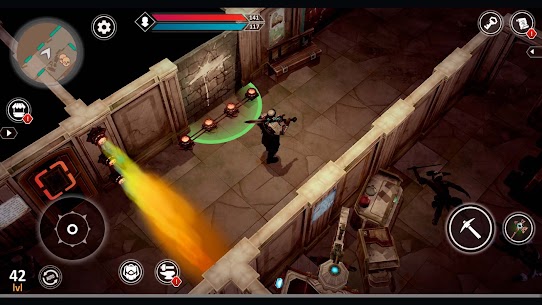
Exile Wasteland Survival PRO is a mobile survival RPG developed by GemJam LLC. Players take on the role of a Conan warrior dropped into a post-apocalyptic desert wasteland. The goal is simple: stay alive. However, the systems that work against you are anything but simple. Hunger, thirst, dangerous wildlife, tribal enemies, and equipment that degrades with every swing all stack against the player from the first minute of gameplay.
The game is free to download on both Android and iOS. It includes a freemium model with optional IAP resource packs, a Premium subscription tier that provides gold and daily bonuses, and optional ad rewards. Players can progress entirely through grinding, though the stamina-gated travel system means patience is a real currency in this title.
The open world craft-and-build survival system
At its core, this is a resource gathering and crafting game. Players move between locations, collect materials, and return to their Home base to craft weapons, armor, tools, and building upgrades. The crafting system sits at the center of everything. Without crafted gear, players cannot fight effectively. Without fighting, they cannot clear locations. And without clearing locations, they cannot unlock new areas or earn better materials.
The open world here is not seamless. Instead, the game presents a location map where each node costs stamina/energy to visit. That energy system forces players to plan their runs carefully. Rushing too many locations back to back drains stamina fast, leaving the Conan warrior stranded with no way to retreat safely.
Ancient Civilization lore and post-apocalyptic setting
The story behind the wasteland involves a Great Ancient Civilization that collapsed after reaching the peak of its development. Global warming turned the entire world into a desert, destroying all remaining heritage of the Ancients. Players explore remnants of this civilization throughout the game, including the City of the Ancients, a multi-floor dungeon packed with increasingly powerful enemies and unique rewards.
The tone is dark and primitive. Players scavenge in a world that has reverted to a brutal survival era. The bonfire serves as both a narrative and a mechanical symbol. Keeping it burning represents holding civilization together. Letting it die represents failure. That detail gives the setting genuine weight beyond just being a backdrop for combat.
How Exile PRO compares to Last Day on Earth and Grim Soul on mobile
Last Day on Earth: Survival by Kefir! is the most direct comparison. Both games use a top-down perspective, feature crafting-heavy progression, and gate locations behind an energy system. However, Exile PRO distinguishes itself with the bonfire preservation mechanic. Last Day on Earth does not use a persistent bonfire as a survival condition. Exile PRO does, and it changes how cautiously players must manage every run.
Grim Soul: Dark Fantasy Survival also by Kefir! sits in the same genre. Grim Soul leans into dark fantasy with knights and dungeons, while Exile PRO focuses on a desert post-apocalyptic world with a more primitive aesthetic. The character customization system in Exile PRO, including ancient body patterns and naming your warrior, is more personally expressive than what Grim Soul offers at an equivalent stage of progression.
How Crafting and Combat Work in Exile PRO
Crafting is the backbone of survival in this game. Before players can fight anything seriously, they need gear. Before they can gear up, they need materials. That loop drives every session. Players gather wood, stone, animal hides, and food from the environment, then process those materials at their workbench back at the Home location. Weapons and armor are crafted in tiers, with each tier requiring rarer materials from harder locations.
Combat itself is straightforward. Players tap enemies to attack, use equipped weapons to deal damage, and can choose to flee if a fight turns against them. The game rewards tactical retreats. Dying in a harder location can mean losing the resources collected during that run. However, clearing a location fully rewards the player with better loot drops and progression points.
Gathering resources and crafting weapons at the workbench
Resource gathering works differently depending on the tool equipped. Players need a hatchet to chop trees, a pickaxe for stone, and a hunting weapon for animals. Because weapons degrade quickly, players need to bring the right tool for the right task. Carrying a combat weapon into a resource run and using it to gather will burn through its durability with nothing to show for it.
The workbench crafting menu organizes recipes by tier. Early weapons include stone-tipped spears and basic bows. Mid-tier options include crossbows, which the Processing table can later be used to scrap for materials when they break. Crafting queue times exist on some items, so planning what to craft before logging out saves significant real time.
Armor durability and the equipment degradation system
Armor degrades just like weapons. A full set of cloth armor doubles in durability compared to earlier versions following a quality-of-life update from GemJam. However, cloth armor still degrades fast in locations with multiple skull-tier enemies. Players who enter a two-skull location expecting their armor to hold through the entire run will find themselves in trouble by the second room.
The solution is to craft in batches. Before leaving for a hard location, players should have at minimum two full sets of armor and two copies of their main weapon ready in their inventory. That way, swapping mid-run is possible without cutting the trip short. This batch-crafting approach is the single biggest gap between players who progress steadily and those who feel stuck.
What happens when you clear a wasteland location
Clearing a location means defeating all enemies in that area during one run. The game rewards full clears with bonus loot drops. Some locations also contain chests that only spawn after all enemies are gone. Players who fight through a zone but leave before finishing miss out on the best resource nodes.
Additionally, cleared locations eventually respawn enemies, so the same zones remain farmable over time. Daily events sometimes feature specific location challenges. Completing those events provides gold and rare materials not easily earned through standard grinding alone.
Base Building in Exile Wasteland Survival PRO
Base building starts immediately. The Home location is the player’s first safe zone, and improving it is as important as anything else in the early game. The Home base contains the workbench, storage chests, the bonfire, and eventually decorative items that grant passive bonuses. A well-built base is not just a place to store gear. It is a functional upgrade to the Conan warrior’s capabilities.
Building structures requires wood, stone, and processed materials. Players unlock more building pieces as they advance through the crafting tier system. The base is also where the pet system activates. Players can adopt a lion companion at their Home location, raising it into a combat partner that helps in fights. The pet system adds a meaningful reason to invest in the Home base beyond pure utility.
Laying out your shelter structure and storage chests
Storage is the first bottleneck new players hit. Inventory space at the start of the game is very small. Players constantly run out of room mid-location and must choose what to drop. The Home location provides additional chests for overflow storage, but those chests need to be built first. Prioritizing chest construction early removes that frustration.
The shelter structure itself determines how many floors and rooms a player can access. The City of the Ancients dungeon features multiple floors with an elevator, and the Home base follows a similar philosophy of vertical expansion. Building the second and third floors of a shelter opens new crafting station slots and decoration placements that grant energy or chest capacity bonuses.
Upgrading your Home location with decors for stat bonuses
Decors are a feature many players ignore early on. However, placed correctly, they provide real mechanical benefits. Certain decorative items increase the maximum energy limit, which directly extends how many locations a player can visit before needing to rest. Others expand the total number of chests the base can hold.
Because decors are craftable and do not require premium currency, they represent excellent free progression. Players who skip decors and head straight to combat upgrades often plateau faster. The energy cap increase from a few early decors can mean one additional location visit per session. That adds up to significantly more resources over a week of daily play.
Defending your base against tribal giants and predators
The game presents the base as something that needs active protection. Tribal giants and predators can threaten the Home location. Players need to build walls and defensive structures to slow enemy approaches. A base with no walls is a base that burns resources on repairs instead of upgrades.
Craft weapons stored in the base are always available for emergency defense. The game also places the bonfire centrally, meaning any base defense strategy needs to keep the bonfire accessible. Players who wall off too tightly can accidentally trap themselves away from the bonfire during a base assault.
Wasteland Enemies and Boss Encounters
Enemy variety is one of the stronger elements of this wasteland survival RPG. Players face scorpions, predatory hyenas, tigers, spiders, and tribal giants during standard location runs. Each enemy type moves and attacks differently. Scorpions have quick burst attacks from close range, while tigers close distance fast but can be kited with ranged weapons. Understanding how each enemy type behaves saves more armor durability than any other single skill.
Boss encounters represent a harder tier of combat. Bosses appear in named locations and require specific preparation. Going into a boss fight with degraded gear is one of the fastest ways to lose a full inventory of hard-earned resources. Preparation and gear condition matter far more in boss rooms than combat skill alone.
Standard enemies — scorpions, hyenas, tigers, and tribal giants
Scorpions appear frequently in early desert zones. They deal moderate damage but move slowly enough for players to manage with medium-range weapons. Hyenas and tigers are faster and more aggressive. They close distance quickly and punish players who stand still. Tribal giants are the most dangerous standard enemy. They hit hard, have significant health, and appear in groups in later zones.
Because tribal giants often appear in pairs or trios, players who fight them without adequate armor will find their equipment at critical durability within two or three fights. The most effective approach against giants is to use the environment to break line of sight, engage one at a time, and withdraw to repair between fights.
Named bosses — Butcher, Big Brother, and Cannibal Warchief
The Butcher appears at Butcher’s Slaughterhouse. He is one of the game’s earlier boss encounters and hits with heavy melee attacks. Players should have mid-tier armor ready before attempting this location. Big Brother appears at the Forgotten Tavern. He is described as being full of surprises, which in practice means he uses unexpected attack patterns that punish players who approach him the same way as standard enemies.
The Cannibal Warchief appears at Warchief’s Hall. He is a returning enemy with a new identity, appearing after earlier versions were retired in an update. All three bosses reward rare loot. Therefore, clearing them once is not enough. Players should plan to farm each boss location multiple times as their gear tier improves.
City of the Ancients multi-floor dungeon and the Copper Golem
The City of the Ancients is the most complex single location in Exile PRO. It spans multiple floors connected by an elevator. Each floor increases in difficulty, and the third floor was added in a later update. The Copper Golem is the newest boss added to this dungeon. He uses crushing blows that deal heavy burst damage. Players who try to fight him the same way as a standard enemy will be knocked out quickly.
The City of the Ancients ties directly into the game’s lore. It is a remnant of the collapsed Ancient Civilization and contains technology and enemy designs that feel distinct from the open wasteland. Completing dungeon floors awards unique rewards not available through standard resource farming.
Progression and the Survivor’s Diary System
Progression in Exile PRO works on multiple tracks at the same time. Combat ability improves through gear upgrades. Crafting ability unlocks through recipe progression. Location access expands through the energy travel system. Each track feeds the others. Players who focus too narrowly on one track, like only grinding combat without investing in the base, will hit walls where they lack the resources or structures to advance.
The game also runs daily events that provide additional progression boosts. Participating in events consistently is one of the most efficient ways to earn gold and rare materials outside of boss farming. Players who only grind standard locations miss a significant portion of the available progression content.
How skill progression works through crafting and combat
Skills in this game improve through use. Crafting more items advances crafting-related abilities. Fighting more enemies improves combat efficiency. The game does not use a traditional XP-and-level system for skills. Instead, the act of performing the skill is what builds it. This means players who spend sessions only running locations without crafting back at base are leaving skill progress on the table.
The most efficient sessions alternate between crafting runs at the Home location and combat runs into the wasteland. Craft a full gear set, run a location, return to repair or replace gear, craft the next set, then run again. That rhythm keeps all skill tracks progressing simultaneously rather than letting any one fall behind.
Survivor’s Diary chapters and their rewards
The Survivor’s Diary is a structured tutorial and reward system added in a later game update. It presents players with educational tasks organized into chapters. Completing each task earns a unique reward not available through standard gameplay. Early chapters cover crafting basics and base building. Later chapters introduce more advanced tasks tied to boss encounters and dungeon floors.
New players who skip the Survivor’s Diary are giving up free resources and progression items. The diary also functions as an unofficial progression roadmap. Players unsure of what to do next should check which diary chapter task they have active. The diary essentially asks players to progress through the game in the intended order, rewarding them for doing so.
Unlocking new locations and the energy travel system
Each location on the map costs energy/stamina to visit. Energy regenerates over time. Players with a higher energy cap from decor upgrades can visit more locations per session. New locations unlock after players meet certain crafting tier or progression requirements. The game does not allow free travel across the entire map from the start.
This design means players cannot simply run to a high-tier location early on. The energy gate and unlock requirements act as a built-in difficulty curve. Players who feel locked out of new zones should check their decor upgrades first. An expanded energy cap is almost always the missing piece for players who feel they cannot cover enough of the map in a single session.
Common Wasteland Mistakes That End Your Run Early
Most early deaths in this game come from three predictable failure points. They are not about combat skill. They are about resource management, planning, and attention to the core survival systems. Players who understand these three patterns avoid the most frustrating part of the early game.
Letting the bonfire go out and why it kills your Conan warrior faster than any enemy
The bonfire is not decorative. It is a core survival mechanic. In Exile PRO, a dying bonfire exposes the Conan warrior to conditions that drain health and stamina even without enemy contact. Players who sprint through locations and forget to check fuel levels return to a cold base and a deteriorating character.
Keeping the bonfire stocked requires regular fuel additions before leaving on any location run. The rule is simple: always fuel the bonfire before leaving the Home location, not after returning. Players who refuel on return forget to do it when they log out mid-session, and they come back to a dead fire. The bonfire is the single most important survival condition the game enforces.
Overloading your inventory before unlocking the next bag tier
Inventory weight is the second most common progression blocker. The starting inventory is very small. Players who run a location and collect every item they see will fill up within minutes. Then they face a choice between dropping valuable materials or cutting the run short. Neither option feels good.
The better approach is to prioritize high-value materials and leave low-tier resources behind on early runs. Stone and basic wood are available almost everywhere. Rare animal hides and crafting components are not. Players who understand what to prioritize can complete longer runs without hitting the inventory wall. Chest upgrades at the Home base should be built as early as possible to expand total storage capacity.
Rushing locations before your equipment durability can handle the threat level
Equipment durability is not a soft limit in Exile PRO. It is a hard stop. A weapon that degrades to zero stops working. Armor that breaks leaves the Conan warrior unprotected mid-fight. Players who rush into two-skull or three-skull locations with gear that has already been used in previous runs will find their equipment failing at the worst possible moment.
The fix is preparation. Check gear durability before every location run. If anything is below half durability, repair it or replace it before leaving. Going into a fight with half-broken gear is the equivalent of going in with no gear at all. Batch-crafting replacement copies before a hard location run is the most reliable way to avoid being caught without functional equipment.
Best Exile Wasteland Survival PRO Tips and Tricks for Beginners
Always craft multiple weapon copies before leaving your bonfire zone
Because weapon durability drains so quickly, one weapon per run is never enough for any location beyond the first tier. Craft two copies of your best available weapon before every location run. If both copies degrade to zero before the run ends, that is useful data: the location is too hard for the current gear tier. Retreat and upgrade before trying again. Players who bring only one weapon have no fallback when it breaks.
Additionally, ranged weapons like bows and crossbows preserve armor durability better than melee weapons because they allow players to attack without entering enemy melee range. However, arrows require materials to craft. So, plan arrow stock alongside weapon copies before any location run.
Use the Processing table to scrap broken gear into usable materials
The Processing table allows players to break down worn-out weapons and armor into base materials. This system prevents gear from becoming pure waste. Crossbows, in particular, can be scrapped at the Processing table, which is a specific mechanic added by GemJam in an update. Players who delete broken gear instead of scrapping it are throwing away resources.
Scrapped materials feed directly back into the crafting queue. So, the correct workflow is: craft gear, use it, scrap the broken pieces, craft again. That loop keeps the resource economy moving without requiring constant location farming to top up materials. New players who do not know about the Processing table often feel resource-starved unnecessarily.
Prioritize the Survivor’s Diary chapters before spending gold on shop items
Gold is the premium-tier currency in Exile PRO. Players earn small amounts through gameplay and more through the Premium subscription. The shop offers gear bundles, resources, and convenience items for gold. However, most new players should resist spending gold on shop items until they have completed the early Survivor’s Diary chapters.
The diary rewards include unique items and resources that can substitute for several shop purchases. By completing chapters first, players establish a stronger resource base before spending gold. After the diary chapters are done, gold is better spent on energy refills during daily events rather than on one-time item packs. That approach extends daily play sessions at the moments that generate the best rewards.
Frequently Asked Questions About Exile Wasteland Survival PRO
Is Exile Wasteland Survival PRO available on iOS and Android?
Exile Wasteland Survival PRO is available on both Android and iOS. The Android version on Google Play is the primary version with the longest update history. The iOS version, published by GemJam LLC, is available on the App Store and requires iOS 13.0 or later. Mac users with Apple M1 chips or later can also download it through the App Store.
Is Exile Wasteland Survival PRO hard for beginners?
Exile Wasteland Survival PRO is moderately challenging for new players. The early game is unforgiving because of equipment durability draining quickly and the bonfire mechanic requiring constant attention. Most new players struggle with inventory limits and gear management before combat difficulty becomes a real factor. Following the Survivor’s Diary chapters reduces the learning curve significantly.
Does Exile Wasteland Survival PRO receive regular updates?
Yes, GemJam LLC updates Exile Wasteland Survival PRO regularly. Recent updates added the Copper Golem boss in the City of the Ancients, the female character option, a pet companion system with a lion, shelter decors with stat bonuses, and the Survivor’s Diary chapter system.
Who Should Play Exile Wasteland Survival PRO
Exile Wasteland Survival PRO is best suited for players who enjoy survival crafting games with a strong loop and do not mind managing multiple systems at once. The game rewards patience. Players who prefer fast progression or minimal resource tracking will find the stamina gates and inventory limits frustrating. However, anyone who has enjoyed Last Day on Earth or Grim Soul and wants a desert fantasy alternative with a distinctive bonfire survival mechanic will find real depth here.
Having spent time with this title, the base building and boss progression systems are where Exile PRO genuinely stands out among mobile survival games. The Survivor’s Diary is a smart onboarding tool that other games in the genre lack. The crafting loop feels satisfying once the batch-crafting approach clicks. Players who give it past the first few sessions will find a survival RPG with more personality than its store screenshots suggest.
Images


Download links
ℹ️ Download link not working? Please refresh the page and try again.
Developer's apps



Related apps





What's new
Bug fixes
New Apps
Most Played Mobile Games


