
Egypt: Old Kingdom MOD APK (Free Shopping)

Description
Egypt: Old Kingdom is one of the few mobile strategy games built on a foundation of genuine historical research. You are not managing a fantasy city — you are rebuilding Memphis, navigating the first six dynasties of pharaohs, and wrestling with the divine conflict between Horus and Seth across thousands of years of real history. This post covers everything you need to know about Egypt Old Kingdom gameplay — from city building and resource management to pyramid construction, god worship, expeditions, and strategies for keeping your kingdom alive through its most turbulent periods.
What Is Egypt Old Kingdom — The Historical Setting — Memphis and the Six Dynasties
Egypt: Old Kingdom places you in Memphis, the ancient capital of Egypt, during one of the most formative periods in human history. The game spans 3500 to 2140 years BC — the era of the first six pharaoh dynasties. This is the period when Egypt transformed from a collection of competing regional tribes into a unified, centralized kingdom capable of constructing the most iconic monuments in the ancient world.
The setting is not decorative. Every major challenge in the game reflects real historical pressures that the Old Kingdom faced — resource scarcity along the Nile, political tension between Upper and Lower Egypt, external threats from neighboring cultures, and the eventual collapse into the First Intermediate Period. Because of this historical grounding, every decision you make carries weight that goes beyond typical mobile strategy mechanics.
Memphis itself serves as your primary base of operations. It is the city you build, expand, and protect across the full arc of the game. Its growth mirrors the real development of one of the ancient world’s most significant urban centers.
Your Role as Horus Alongside the Pharaohs
Your character in Egypt: Old Kingdom is not a single ruler. Instead, you play as one of the many incarnations of Horus — the divine force that exists alongside and guides the pharaohs throughout Egypt’s history. This framing gives the game a unique perspective. You are simultaneously a divine entity and a practical administrator, fighting against Seth while managing the day-to-day survival of the kingdom.
Seth is the central antagonist force in the game’s narrative structure. He unleashes disasters, crises, and external pressures designed to destabilize the kingdom at every phase of growth. Overcoming these disruptions requires both strategic foresight and responsive decision-making. The conflict between Horus and Seth therefore works as both a mythological story and a gameplay tension system.
This dual role — divine protector and practical leader — gives Egypt: Old Kingdom a tone that feels grander than most mobile strategy titles. You are not just placing buildings. You are shaping the course of a civilization against forces that are actively working against you.
The Free Trial and Full Version Explained
Egypt: Old Kingdom on Android offers a structured free trial before requiring any purchase. New players can play the first 53 turns completely free. This is generous by mobile strategy standards. Those 53 turns cover enough of the early game to give a genuine sense of the city-building systems, resource chains, and god worship mechanics before any financial commitment is required.
After the trial ends, the full version unlocks the complete game including all campaigns and modes from the PC version. The mobile release is not a stripped-down port. It includes the full content package, which means players coming from the PC version will find everything they expect on mobile. Additionally, the game does not require an internet connection to play — the full experience is available offline after purchase.
How to Play Egypt Old Kingdom — Building and Developing Memphis From the Ground Up
Memphis starts as a modest settlement and grows through deliberate construction choices. Each building you place serves a specific function within the city’s economy or social structure. Granaries store food. Workshops produce crafted goods. Temples maintain divine favor. Housing supports population growth. Because every structure uses space and resources, placement decisions matter from the very first turn.
The city building system rewards players who think in terms of supply chains rather than individual structures. A farm produces grain — but that grain needs storage, distribution, and eventually workers fed by it to keep production running. Each layer of the economy connects to the next. Therefore, building in isolation without thinking about the downstream effects leads to shortfalls that compound quickly.
Memphis also serves as the political and cultural center of the kingdom. As you expand your territory outward, all roads effectively lead back to the capital’s administrative capacity. Keeping Memphis strong and well-supplied is the foundation everything else rests on.
Resource Management — Farming, Crafting, and Supply Chains
Egypt: Old Kingdom uses a multi-tier resource system. Raw materials come from farming, quarrying, and gathering. Craftsmen convert raw materials into refined goods. Those refined goods support further construction, trade, and social stability. Managing this flow across all three tiers simultaneously is the core economic challenge of the game.
Food is the most critical resource in the early game. Without sufficient grain production and storage, population growth stalls and worker output drops across every other sector. However, over-investing in farming at the expense of other resources creates a different imbalance. Crafted goods are required for construction, trade, and military readiness. Because of this, balancing the ratio between food production and craft output is one of the first real strategic decisions the game puts in front of you.
Resource scarcity becomes more pronounced during crisis events triggered by Seth. Floods, droughts, and political instability can interrupt supply chains at key moments. Building surplus reserves rather than operating at minimum viable production levels is therefore a risk management strategy as much as an economic one.
Political Decisions and the Ancient Society Simulator
Egypt: Old Kingdom describes itself as an ancient society simulator — and that description is accurate. Beyond building placement and resource tracking, you are regularly asked to make political decisions that affect the social structure of the kingdom. These range from resolving disputes between farmers and craftsmen to making high-level calls about territorial expansion, military action, and diplomatic relations with neighboring cultures.
Each decision has consequences that ripple forward. A choice that stabilizes one region may create tension in another. Prioritizing one social class’s needs can generate unrest among others. Because the game models an entire society rather than just an economy, the decision system has more layers than typical city builders.
These political moments are presented as event cards that appear at specific turns or when certain conditions are met. Reading them carefully and thinking about second-order effects before committing to a choice is consistently more valuable than reacting instinctively.
The Gods of Egypt Old Kingdom — Horus and Seth — The Central Divine Conflict
The conflict between Horus and Seth is not just narrative background — it is an active gameplay system. Seth continuously works against the kingdom by sending disasters, crises, and hostile events at unpredictable intervals. These disruptions range from agricultural failures to military threats and political instability. Your role as Horus is to counteract these forces through worship, good governance, and strategic preparation.
Horus represents order, prosperity, and divine protection. When your kingdom maintains strong worship practices and stable governance, Horus’s influence is stronger. This manifests in fewer disasters, more favorable event outcomes, and better responses from the population during crises. Neglecting the divine side of the game — even when economic pressures make it tempting to divert resources — weakens this protection and allows Seth’s disruptions to hit harder.
The Horus-Seth dynamic gives the game a rhythm that alternates between growth phases and crisis management phases. Experienced players learn to read the early warning signs of an incoming Seth disruption and prepare accordingly.
How Worshipping Gods Affects Kingdom Prosperity
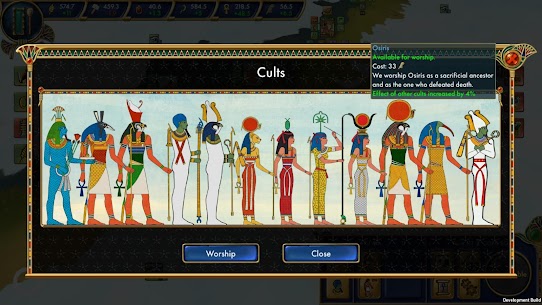
Worship in Egypt: Old Kingdom operates through temple construction, resource offerings, and event decisions that align with divine will. Building and maintaining temples dedicated to the major gods of the Egyptian pantheon provides ongoing bonuses to specific aspects of the kingdom. However, temples require resources to build and upkeep. Therefore, integrating worship into the economy rather than treating it as a separate system is essential.
Each god governs a specific domain. Aligning your worship investments with your current strategic priorities amplifies their benefit. For example, prioritizing agricultural deities during expansion phases that rely heavily on food production creates a multiplying effect on output. Conversely, neglecting worship during high-growth periods because resources feel scarce tends to invite exactly the kind of crisis that slows growth further.
The god system also responds to event decisions throughout the game. Choosing options that show respect and gratitude to the gods in event cards reinforces divine favor over time. These decisions accumulate, so consistent behavior matters more than any single dramatic gesture.
Balancing Devotion With Economic Demands
New players frequently treat worship as a secondary priority — something to address after the economic foundation is stable. This approach backfires consistently. Because Seth’s disruptions scale with how neglected the divine balance is, ignoring worship during the early turns often means the first major crisis arrives without enough stability to absorb it.
The most effective approach is to integrate temple construction into the first wave of city building alongside economic structures. A modest temple built early costs far less than the disruption recovery costs from a neglected worship system later. Additionally, regular small offerings are more sustainable than large emergency offerings made during a crisis.
Balancing devotion with economic demands becomes easier once the resource supply chain stabilizes. However, even in the mid and late game, sudden expansion phases can create temporary worship neglect. Monitoring the divine balance indicator and addressing drops early keeps the kingdom’s stability more consistent across all phases.
How to Build the Great Pyramids in Egypt Old Kingdom
Pyramid construction does not become available immediately. It requires reaching a specific point in the campaign progression where the game’s economic and political systems have developed enough to support the enormous resource demands involved. Rushing toward pyramids before that foundation is in place creates severe economic strain that typically collapses the kingdom’s stability.
The unlock occurs as part of the natural story progression rather than as a separate tech tree requirement. However, arriving at that point in a strong position requires deliberate preparation. Players who have maintained healthy resource reserves, stable worship practices, and solid political relationships are in a significantly better position to begin construction without triggering a crisis simultaneously.
Recognizing the signs that pyramid construction is approaching — specific event cards, narrative prompts, and political milestones — gives you enough lead time to start building reserves specifically for the construction phase.
Choosing Design, Materials, and Investment Scale
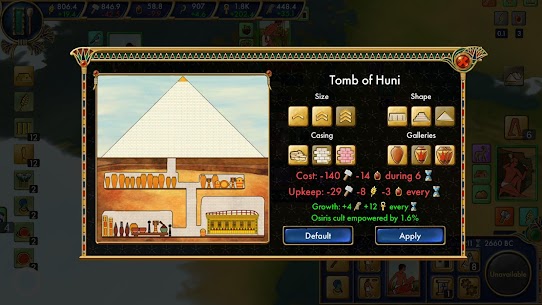
When pyramid construction begins, you face a series of decisions about design and materials. These choices affect both the resource cost and the finished pyramid’s impact on the kingdom. More elaborate designs require higher-quality materials and greater labor investment. However, they also generate larger stability bonuses and more significant divine approval upon completion.
Materials come from the existing resource supply chain — stone from quarries, refined materials from workshops, and labor from the population base. Because pyramid construction runs concurrently with all other city functions, it competes directly with regular resource demands. Therefore, scaling the investment level to what your supply chain can sustain without shortfalling other sectors is a critical judgment call.
A pyramid that stretches the economy to its limits during construction can trigger the exact political and divine instability it is meant to prevent. Choosing a scale that is ambitious but sustainable produces better long-term outcomes than aiming for maximum scale and collapsing the economy halfway through.
Why the Pyramids Are Essential for Peace and Order
The Great Pyramids in Egypt: Old Kingdom are not optional monuments. They serve a functional role in maintaining peace and order within the kingdom. Completing a pyramid generates significant stability bonuses that reduce internal unrest, improve the population’s relationship with the pharaohs, and strengthen divine approval for a sustained period after completion.
The political logic mirrors real historical understanding — pyramid construction was as much a social and religious project as an architectural one. It employed large portions of the population, demonstrated the pharaoh’s divine connection, and reinforced the central authority of Memphis over the broader kingdom. The game reflects this accurately.
Moreover, the stability provided by completed pyramids creates breathing room for the next phase of expansion. Players who complete pyramids efficiently often find the subsequent turns significantly easier to manage because the kingdom’s internal pressures are lower. Conversely, players who delay or skip pyramid construction face compounding instability that becomes harder to address over time.
Expeditions and Ancient Maps in Egypt Old Kingdom
Expeditions allow you to send representatives of the kingdom beyond Egypt’s established borders. Each expedition requires resources to fund and a time investment measured in turns before results return. The information, materials, and diplomatic outcomes that come back from an expedition are not always predictable — but the general category of reward aligns with the destination you choose.
Expeditions are not passive activities. You make active decisions about where to send them, how many resources to invest, and what objectives to prioritize. Higher investment generally improves outcomes but creates short-term resource pressure. Lower investment reduces risk but may return less valuable results. Because of this tradeoff, expedition management is part of the broader resource allocation strategy rather than a separate mini-system.
The expedition interface presents the ancient world map with available destination regions highlighted as your knowledge of the surrounding geography expands. Early expeditions cover nearby territories. Later expeditions reach farther destinations with greater potential rewards and greater uncertainty.
Where to Send Expeditions and What Each Region Offers
Different regions around Egypt offer different types of returns. Trade-focused destinations bring back materials not available locally — specific goods that improve crafting options or provide economic value through exchange. Military-adjacent destinations provide intelligence about hostile neighbors or opportunities to neutralize threats before they become active problems. Cultural expeditions return with knowledge that feeds into the technology research system.
The Sinai Peninsula and the Levant are accessible relatively early and provide trade goods useful in the mid-game economic expansion. Nubia to the south offers different resources and represents both a trade partner and a potential threat depending on how the relationship develops. Punt — referenced in real Egyptian historical records as a distant trade destination — appears in the game as an ambitious late-game expedition target with correspondingly valuable returns.
Matching expedition destinations to your kingdom’s current priorities is the most efficient approach. If resource shortfalls are the primary concern, trade destinations take priority. If political stability and border security are the main issues, intelligence-gathering expeditions provide the most immediate value.
Expanding Egypt’s Borders Through Exploration
Exploration and expansion are linked systems in Egypt: Old Kingdom. New territories become available through a combination of military action, diplomatic engagement, and expedition outcomes. Expanding borders increases the kingdom’s resource base and population potential — but also increases the administrative and military demands on Memphis.
Unifying Lower and Upper Egypt is one of the central long-term objectives of the game. This mirrors the real historical process that defined the early dynasties. Achieving unification requires sustained diplomatic and military effort across multiple campaign chapters. However, the stability and resource benefits that come from full unification make it the foundation for the later pyramid-building and crisis-management phases.
Expanding too aggressively before the core economy is stable spreads resources thin across too many fronts simultaneously. Because each new territory requires ongoing resource investment to hold, the timing of expansion is as important as the direction. Controlled, deliberate expansion with consolidation phases between major moves consistently outperforms rapid territorial grab strategies.
Best Strategy for Egypt Old Kingdom Beginners
The first priority in Egypt: Old Kingdom is establishing a food surplus in Memphis before attempting any significant expansion. Grain production needs to consistently exceed consumption before adding new construction projects or expanding the population base. Without that surplus buffer, any disruption — weather event, Seth disaster, or population spike — immediately triggers a food crisis.
After food stability, the next priority is diversifying the craft production base. Having at least one functioning workshop for each primary material type before the mid-game ensures the resource chain can support both construction demands and trade opportunities simultaneously. Build the supply chain horizontally before scaling any single element vertically.
Early turns also set the diplomatic tone with neighboring groups. Engaging neighbors diplomatically rather than militarily in the opening phase builds relationships that reduce border pressure during the economically fragile early chapters. Conflict with neighbors is expensive in resources and attention. Therefore, deferring military confrontations until Memphis is stable produces significantly better outcomes.
Managing Hostile Neighbors and Neighboring Tribes
Hostile neighbors operate on their own timelines. They will eventually probe the kingdom’s borders regardless of your actions. Because of this, building at least a minimal defensive capability alongside economic development is necessary — purely economic strategies leave the kingdom vulnerable to disruptions that arrive at the worst possible moment.
The most effective approach to hostile neighbors in the early game is a combination of diplomatic engagement and defensive positioning. Completing expeditions that gather intelligence on nearby tribes gives advance warning of hostile activity. Positioning military units along vulnerable border zones deters low-level probing without requiring active combat. Direct military campaigns against organized neighbors are expensive and should be reserved for moments when the economic foundation can absorb the cost.
Some hostile neighbors can be turned into neutral or allied groups through the political decision system. When event cards appear that offer diplomatic resolution with a hostile neighbor, evaluating the long-term cost of ongoing conflict against the short-term cost of a diplomatic concession usually favors the concession.
Technology Research and Unlocking New Capabilities
The technology research system in Egypt: Old Kingdom unlocks new building types, production improvements, and capability expansions across multiple domains. Research requires specific resources and turn investment. Because research options compete with other resource demands, prioritizing the right technologies at the right time is one of the more nuanced strategic layers in the game.
Agricultural technologies provide the highest early-game return because they amplify food production — the resource that everything else depends on. Completing agricultural research in the first campaign chapter before investing in other tech branches creates a compounding advantage that carries through the mid-game.
Construction technologies become the priority once pyramid building approaches. Unlocking more efficient building methods and better material processing reduces the per-turn resource cost of pyramid construction significantly. Players who reach pyramid construction with relevant technology already researched complete it faster and with less economic disruption than those who attempt it with only basic construction capabilities.
Common Mistakes New Players Make in Egypt Old Kingdom
The most consistent mistake in Egypt: Old Kingdom is treating expansion and worship as competing priorities and consistently choosing expansion. Fast territorial growth feels productive — more land, more resources, more population. However, each expansion phase that neglects temple maintenance and offering schedules weakens the divine balance and creates a vulnerability that Seth exploits reliably.
The compounding effect is the real problem. One neglected worship cycle generates a minor divine approval drop. Two or three consecutive cycles of neglect create a significant deficit that triggers larger Seth disruptions. By the time the crisis arrives, the expanded territory is too large to stabilize quickly with the available administrative resources. Pulling back from that position is significantly harder than maintaining balance from the start.
Treating worship investment as a fixed cost — a set percentage of resources dedicated to temples and offerings regardless of economic pressure — is more sustainable than treating it as variable spending to cut when things get tight.
Mismanaging Resources Before the First Crisis Hits
Egypt: Old Kingdom signals that a crisis is coming through event cards and narrative prompts before Seth’s disruptions hit full force. New players frequently miss these signals because they are focused on city building and read event cards quickly without absorbing the implications. As a result, the first major crisis arrives with no reserves and no preparation.
The correct response to a crisis warning is immediate reserve building. Reduce construction, slow expansion, and redirect resources into stockpiling food, materials, and defensive capacity for the turns immediately before the disruption lands. This preparation window is more valuable than any incremental construction progress made during it.
After the first crisis, experienced players build permanent reserve thresholds into their resource management. Operating with a minimum buffer of several turns’ worth of food and key materials at all times absorbs most disruptions without requiring emergency responses.
Ignoring Political Decisions Until It Is Too Late
Political event cards in Egypt: Old Kingdom have timers. Some require a decision within a specific number of turns before the default outcome activates automatically. New players often defer political decisions while focused on construction and resource management, then find that the default outcome — usually the worst available option — has already triggered.
Reading and resolving political event cards promptly is therefore a critical habit to develop early. Not every decision requires immediate action, but ignoring the queue entirely means missing time-sensitive choices that affect kingdom stability for many turns afterward.
Moreover, political decisions interact with each other. A choice made in one event card can affect the options available in a later one. Players who engage carefully with the political system build a reputation and relationship network across clans, tribes, and social classes that makes subsequent decisions easier and more favorable. Players who ignore it find that the same challenges keep returning with fewer good options available each time.
Frequently Asked Questions About Egypt Old Kingdom
Does Egypt Old Kingdom require an internet connection to play?
No. Egypt: Old Kingdom does not require an internet connection to play. The full game runs completely offline after download. This makes it well-suited for mobile play sessions without reliable connectivity.
How many turns does the free trial include?
The free trial includes the first 53 turns of gameplay. This covers a substantial portion of the early game and gives a thorough introduction to the city building, resource management, and god worship systems before any purchase is required.
Does the mobile version include all PC campaigns and modes?
Yes. The mobile version of Egypt: Old Kingdom includes all campaigns and modes from the PC version. It is a complete port rather than a reduced mobile edition, meaning players get the full content package on Android.
Final Verdict on Egypt Old Kingdom for Mobile
Egypt: Old Kingdom earns its place as one of the most substantive strategy games available on mobile. The historical accuracy, multi-layered economy, divine conflict system, and pyramid construction mechanics give it a depth that most mobile titles do not attempt. The 53-turn free trial is generous enough to make the purchase decision an informed one rather than a gamble.
Players who enjoy deliberate, historically grounded strategy will find Egypt: Old Kingdom consistently rewarding. The game punishes reactive play and rewards patience, planning, and careful resource management — qualities that make each successful kingdom feel genuinely earned. The mobile version’s offline capability and complete PC content parity make it an easy recommendation for strategy fans looking for something with real weight on their phone.
Images



Download links
ℹ️ Download link not working? Please refresh the page and try again.


Related apps





What's new
Bug fix: Restored fullscreen/immersive mode on Android. The status bar (battery, time, signal) no longer covers the in-game UI.
New Apps
Most Played Mobile Games


