
Drift Fanatics MOD APK (Unlimited Money)

Description
Drift Fanatics car build choices start with a stock E30 and end with forged pistons, full ethanol, and a roll cage bolted inside. New drifters who keep spinning out after every engine upgrade will find the build order that keeps a car controllable. The cheapest early gain is weight reduction, not power, because a lighter car holds angle longer and heats its brakes less.
How to Play Drift Fanatics: Freestyle Drift Simulator Basics
Drift Fanatics is a free drift simulator for Android and iPhone where you pick a car, build it in the garage, and slide it freely around open tracks. There are no fixed racing lines, so you play by holding long drifts, earning cash, and spending it on upgrades.
Profi-Soft Games built it, and it has passed roughly 1.9 million installs on Google Play. Its rating sits around 4.1 stars, which is solid for a niche car game.
That staying power comes from depth in the garage rather than a long career ladder. Every session revolves around freestyle drifting across 5 tracks, while the cars themselves carry all the personality.
What Freestyle Drifting Means on Open Track Spots
Freestyle drifting is the heart of the game. Most tracks are wide spots instead of narrow circuits, so you choose your own line and your own corners. No checkpoint tells you where to go, and no timer pushes you along.
In practice, the skill is holding drift angle, not chasing a lap time. I spent my first sessions linking two or three corners on one spot until the car stayed sideways without spinning.
Once a linked sequence feels clean, the next upgrade makes far more sense. You can actually feel what the new part changed, because you know that corner by heart.
The Garage-to-Track Loop Behind Every Session
Each session follows the same simple loop. You set the car up in the garage, take it out, drift, and then come back with cash for the next part.
The loop rewards patience. A car with Stage 1 parts and a sensible ride height often feels better than a rushed Stage 3 build, and one lap shows the difference. Some player reviews also point out that it is a solo experience, so progress depends entirely on your own sessions.
How Drift Fanatics Compares With CarX Drift Racing 2
CarX Drift Racing 2 is the biggest name in mobile drifting, with online play and a deep tuning menu. Drift Fanatics is smaller in scope. However, its staged engine upgrades read like a real build sheet instead of abstract stat bars.
Real Drift Car Racing, on Android since 2014, leans toward realistic handling on set tracks. Drift Legends goes the other way with an arcade feel and a much larger player base. By contrast, Drift Fanatics sits between them, pairing open freestyle spots with parts lists that car fans will recognize instantly.
How Dynamic Tyre Smoke and Brake Disc Glow Work
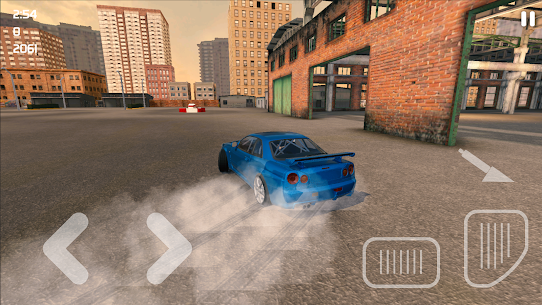
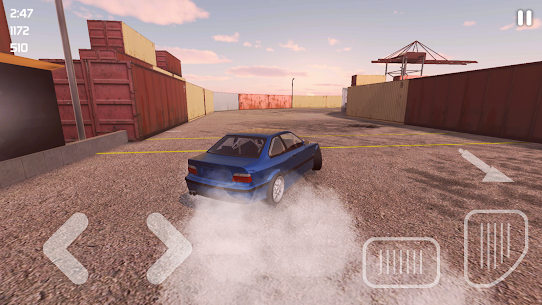
The dynamic tyre smoke system in Drift Fanatics changes the amount of smoke based on your speed and drift angle, while brake disc glow turns the discs red as braking load builds. Both effects respond to real inputs, so they double as live feedback on how hard you are driving.
The developers rebuilt the smoke system from the ground up. As a result, smoke no longer just puffs from the wheels at a fixed rate.
Brake glow is a smaller touch that depends on speed and car weight. Neither effect is pure decoration, and both reward smooth throttle control. Reading them takes a few sessions, though, especially during night drifting, when the glow stands out most.
Holding Drift Angle Through Long Sweepers
Long sweepers show the smoke system at its best. Hold a steady angle at speed and the cloud thickens, but drop speed or straighten up and it thins right away. That change tells you more than any gauge on screen.
I treat thin smoke as a warning sign. It usually means I lifted too early or lost angle, so the next corner starts from a weaker entry.
Reading Brake Disc Glow After Hard Braking
Brake disc glow depends on the load the discs take, which comes from speed and weight. Stamp the brakes from high speed in a heavy car, and the discs light up red within a corner or two.
For that reason, the glow works as a heat gauge. If the discs stay red into the next braking zone, I am braking too hard or too often. Smoother entries usually fix it. Lighter cars also glow less under the same braking, which ties straight into weight reduction.
What a Clean Drift Session Pays Back
Drifting earns the cash that goes back into the garage. Player reviews describe the same cycle: drift on the tracks, earn money, then upgrade the car.
So the payoff for a clean run is never a trophy screen. Instead, it is the next upgrade stage, a fresh set of wheels, or a step closer to another car. That keeps every reward tied directly to what you build next.
All 14 Drift Fanatics Cars From the AE86 to the 911
Fourteen cars appear in the Drift Fanatics roster, even though the store text promises 13, and the extra entry is the Police Patrol Car. Every car can be built the same way, with staged weight reduction, staged engine upgrades, full suspension tuning, rims, and its own paint job.
That 13 versus 14 gap matters if you plan your spending. Counting the police car, you face 14 separate builds, each with 3 weight stages and 3 engine stages to fund.
The roster leans on BMW and Japanese drift legends. However, it also mixes in American muscle, a German rear-engine icon, and a Ford that rally fans will know. Nearly all of them follow the classic rear-wheel drive recipe that drifting depends on.
Japanese Drift Icons: AE86, RX7, S14, Skyline, 350Z and MX5
Six of the 14 cars come from Japan. The AE86 and MX5 are the light, low-power choices. Meanwhile, the S14, Skyline, and 350Z bring more weight and more room for boost. The RX7 sits in between, with a short wheelbase that rewards quick hands.
The Skyline and 350Z are the heavy hitters of the group. They feel planted at speed and suit a full engine build later on.
BMW Lineup: E30, E36, E46 and E46 Compact
BMW gets four entries, which says a lot about the game’s European drift roots. The E30 is the classic small chassis, the E36 and E46 step up in size, and the E46 Compact puts a shorter body on the newer platform.
Because these four share a family feel, one setup idea often carries across them. Even so, each needs small suspension changes, since the E46 is a larger car than the E30. The Compact, in my runs, rotates a little quicker than the full E46.
Mustang, Sierra, 911 and the Police Patrol Car
The Mustang brings American muscle, and the Sierra adds a boxy Ford with rally history. Then the 911 gives the roster its rear-engine oddball. Each one asks for a different driving style than the Japanese and BMW cars.
Then there is the Police Patrol Car, the entry most coverage skips because the store text only counts 13 cars. It is a fun change of pace on night tracks. Still, it rarely makes sense as a serious first build.
How to Unlock Stage 3 Weight Reduction and the Roll Cage
You unlock Stage 3 weight reduction in Drift Fanatics by working through the weight reduction stages in the garage for that car, and the final stage also equips a roll cage. The developers call weight reduction the easiest and most cost-effective upgrade, and every car offers the same 3 stages.
Most coverage treats the cage as decoration. In this game, though, it arrives as part of the last weight stage, so the car gets lighter and looks like a competition machine in one purchase.
A lighter chassis also connects to the physics systems. Since brake load comes from speed and weight, every stage you strip out cools the brake disc glow on hard stops. It also helps the car hold drift angle, which makes weight the foundation of any drift build.
What Stage 1 and Stage 2 Weight Reduction Change
Stage 1 and Stage 2 are the quiet upgrades. The car does not look much different, yet it turns in faster and recovers from a slide with less effort.
Because the developers describe weight reduction as the cheapest path, these early stages are my first purchase on every new car. On a heavy car like the Skyline, the change is easy to feel within one lap. The rear steps out more willingly, and catching it takes less steering.
Why Stage 3 Bundles a Cage With the Weight Cut
Equipping Stage 3 weight reduction automatically adds a roll cage. That mirrors real drift builds, where a stripped interior and a cage often go in together.
For players, the bundle is a handy shortcut. You get the look of a proper competition car without hunting for a separate part, and the cage shows through the windows on every lap. It is also the quickest way to spot which cars in your garage are fully stripped.
How a Lighter Car Changes Brake Heat and Entry Speed
A stripped car glows less under the same braking. In my runs, a Stage 3 car could brake noticeably later into a corner before the discs turned red.
That later braking point adds up. Because you carry more speed into the drift, the tyre smoke also builds thicker, since it scales with speed. One weight purchase therefore improves two systems at once, which is the strongest reason to buy it before power.
How to Unlock All Three Engine Stages in Drift Fanatics
Bolt-on parts, then E85 with forced induction, then full ethanol with forged internals: that is the 3-stage engine path in Drift Fanatics. You buy each stage per car in the garage, and each one adds wheel horsepower while asking for more throttle control.
The steps follow a real tuner’s path. Stage 1 wakes up a stock engine, Stage 2 adds boost carefully, and Stage 3 builds the bottom end for maximum boost.
Stage 2 is the stage most players underrate. The game runs it at the lowest boost level on purpose, for engine reliability, yet it still delivers serious power. For many cars, that balance makes Stage 2 the sweet spot for everyday drifting.
Stage 1: Exhaust, Race Cams, Throttle Bodies and ECU Tune
Stage 1 replaces the restrictive factory exhaust, adds race cams, improves the intake, fits individual throttle bodies, and upgrades the injectors. A custom ECU tune then ties it all together.
The part everyone notices first is the sound. The tune adds exhaust pops and backfires on lift-off, which makes even a slow AE86 feel alive. Power gains are small here, so Stage 1 is the safest engine stage to pair with a light chassis.
Stage 2: E85 Mix, Forced Induction and Low Boost
Stage 2 switches to an E85 mix, adds forced induction, and runs a more aggressive ECU tune. The turbo sits at its lowest boost level, so the engine stays reliable.
Even at low boost, the jump in wheel horsepower is obvious the first time the turbo spools mid-drift. From this point, the car wants smoother inputs, because power arrives in a rush rather than a steady climb. Stage 2 still stays forgiving enough for long freestyle runs. I keep most of my cars here for weeks.
Stage 3: Full Ethanol, Max Turbo Boost and Forged Internals
Stage 3 runs full ethanol and the highest turbo boost the game allows. To survive that pressure, the engine gets forged internals, including forged pistons and forged connecting rods.
This is the stage that turns a street car into a real race car. Consequently, it suits heavier cars like the Skyline, Mustang, and S14, which have the weight to put that power down. In a light MX5, the same build can feel like a handful on the tighter parts of a track.
How to Set Ride Height, Wheel Offset and Camber
Drift Fanatics lets you set ride height, wheel offset, and camber on every car, then test the change right away on track. Lower ride height steadies the car, offset changes how wide the wheels sit, and camber changes how the tyres meet the road at full lock.
Real drift builds live or die on these three numbers, and the game treats them the same way. A small camber change can turn a car that pushes wide on every entry into one that holds a slide.
Every car needs its own suspension setup, because a light AE86 and a heavy rear-wheel drive Mustang react very differently to the same values. Start from the default, change one setting at a time, and run the same corner after each change. That habit keeps your drift build honest.
Ride Height for a Stable Slide
Ride height sets how low the car sits. Dropping it lowers the center of mass, which calms weight transfer when you flick the car into a drift.
Go too low, though, and the car can feel nervous over bumps and curbs. I usually settle slightly above the lowest setting. Then I adjust only after the camber feels right, since camber changes how the drop behaves.
Wheel Offset and Stance Width
Offset changes how far the wheels sit from the hub, which widens or narrows the stance. A wider stance adds stability mid-slide, while a narrower one makes the car quicker to change direction.
I run a slightly wider stance on heavier cars like the Mustang and Skyline. By contrast, I keep the AE86 narrower so it stays quick to flick between corners. Offset also decides whether a new set of wheels sits flush or tucked, so it shapes the look as much as the handling.
Camber Angle for Grip at Full Lock
Camber tilts the top of the tyre in or out. Negative camber on the front helps the tyre bite at full steering lock, which is exactly where a drift car spends its time.
Too much negative camber on the rear works against you, however. The rear needs to slide predictably, and heavy rear camber can make the loss of grip sudden. Mild front camber with near-flat rear camber is the setup I return to on almost every car. That pairing gives steering bite up front and a calm, readable rear.
How Drift Fanatics Progression and Customization Work
Every upgrade, car, and cosmetic in Drift Fanatics runs on cash you earn by drifting on its tracks. You spend that cash in the garage on engine and weight stages, new cars, wheels, and paint, so progression is simply turning drift time into a better drift build.
Progress shows up in the garage itself. Stock cars slowly turn into stripped, boosted machines on custom wheels, and that visual change is the real reward.
Comfort matters too, so the game adds 7 garage styles to make the space your own. Additionally, a huge wheel catalogue covers every single car, which means each of the 14 cars can carry its own look.
Earning Cash From Drift Sessions
Cash comes from drifting. In my runs, longer linked drifts tend to pay better than short, broken slides. Because the tracks are open, you also choose exactly where to earn it.
I like to pick one spot with a long sweeper and run it repeatedly while saving for a big purchase. Weather and time of day shift between sessions, so even a repeated spot never quite feels the same.
Rims and Paint for Every Car
The wheel catalogue is large enough that two players rarely end up with matching cars. Paint finishes the look, and every car takes its own paint job.
Neither purchase changes power or weight. Instead, rims, paint, and the offset setting work together to give a car its stance and character. That trio is where most players spend their time once a build feels fast enough.
Seven Garage Styles to Make the Space Yours
The game offers 7 garage styles, and each changes the room your cars sit in between sessions. It is a small touch, but you spend a lot of time in that menu tuning and buying parts.
Picking one of the garage styles to suit your main car makes the build feel more personal. It also gives the garage-to-track loop a sense of place, which many mobile drifting games skip entirely.
All 5 Drift Fanatics Tracks and 20+ Random Weather Conditions
With 5 tracks, each playable by day or night, and more than 20 random weather conditions, Drift Fanatics rarely serves up the same session twice. Most tracks are large open spots, so each layout works like a playground rather than a fixed circuit.
The developers built the tracks around freedom, letting you drift wherever you wish. That design suits freestyle drifting far more than tight lap racing.
Night drifting deserves special mention, because darkness makes the smoke and brake glow far easier to read. Combine that with random weather, and five tracks start to feel like many more.
Big Open Spots Built for Freestyle Runs
Because most tracks are big spots, there is no wrong way to drive them. You can link a hairpin into a long sweeper, loop back, and try the same pair from the other direction.
Open layouts also mean the track never forces a car choice on you. A short-wheelbase RX7 can thread tight gaps, while a heavy Skyline uses the wide areas to stretch a slide. Both feel at home on the same map.
Day Versus Night Drifting on Every Track
Every track runs in both day and night versions. Daylight shows the surface and surroundings clearly, which helps while a track is still new to you.
Night is where the visual systems shine. Smoke catches the light differently, and the red brake glow is easy to spot, so you get instant feedback on heat. I save night drifting for cars that are nearly finished, simply because it shows off the build.
How Random Weather Changes Each Session
The game rolls from more than 20 random weather conditions, in both day and night. Because the pick is random, you cannot plan around it. The same track can feel calm one session and moody the next.
I treat weather as part of the challenge rather than a nuisance. It breaks up the routine of grinding one spot. It is also a big reason the 5-track list does not feel thin after weeks of play.
Common Drift Fanatics Build Mistakes New Players Make
Most early frustration in Drift Fanatics comes from build order, not driving skill. The game lets you buy power, looks, and handling in any order you like, and that freedom makes it easy to spend cash in the wrong place.
I made every one of these errors on my first car, a Mustang I rushed toward full boost. It spun on almost every entry until I went back and fixed the weight and the suspension setup.
None of these mistakes lock you out of anything, since you can always buy the right parts later. Still, each one wastes sessions of cash that could have gone into a car you enjoy driving.
Buying Stage 3 Engine Before Any Weight Reduction
Stage 3 power on a stock-weight car is the most common trap. The extra turbo boost arrives in a heavy chassis that cannot change direction quickly, so the rear snaps instead of sliding.
Furthermore, the heavy car loads the brakes harder, so the discs glow red early and entries get messy. Strip the weight first, and the same engine suddenly makes sense.
Copying One Suspension Setup Across All 14 Cars
A setup that works on the E30 rarely works on the Mustang or the 911. Each car carries its weight differently. The 911 in particular puts its engine behind the rear axle, so it swings harder once the rear lets go.
Copying values saves time but costs control. Spend one short session per new car adjusting ride height and offset before chasing cash with it.
Chasing Rims Before Performance Parts
The wheel catalogue is tempting, especially on a car you love the look of. Yet rims add nothing to grip or power, so a stock car on new wheels still drives like a stock car.
Buy the weight stages and the Stage 1 engine first. Then reward the car with wheels and paint once it actually holds a slide, because a fast plain car beats a slow pretty one on every track.
Best Drift Fanatics Tips and Tricks for Beginners
Beginners in Drift Fanatics progress fastest when they start in a light car, finish one build at a time, and treat Stage 3 power with respect. None of that needs fast reflexes, only patience in the garage and steady throttle control.
Each habit comes from the game’s own systems: the staged upgrades, the open tracks, and the live feedback from smoke and brake glow. Together they turn early sessions from frustrating spins into useful practice.
The exhaust pops from a Stage 1 ECU tune are often the first reward a new player hears, and they make a good milestone. From there, every purchase should make the car easier to hold sideways, not harder.
Start in the AE86 or MX5 Before the Skyline
Low power is a gift when you are new. The AE86 and MX5 make it easy to feel how throttle and steering hold a slide, because nothing happens too fast.
Once you can link corners in one of them, the heavier cars become far less scary. In my runs, the jump from an MX5 to a Stage 2 S14 felt natural after about a week of short sessions.
Finish One Car’s Weight and Engine Stages First
With 14 cars and 6 performance stages each, spreading cash thin leaves you with a garage of half-built cars. Pick one car and take it through all 3 weight stages and at least Stage 2 engine before moving on.
A finished car also earns cash faster, because it holds longer drifts. That extra income then funds the next build sooner than a scattered approach would. I followed this rule after my Mustang mess, and my second car was finished in about half the time.
Feather the Throttle When Stage 3 Power Arrives
Spinning out right after the Stage 3 upgrade is the most common complaint from new drifters. Full ethanol and forged parts deliver a big jump in wheel horsepower, and a flat-out throttle simply overwhelms the rear tyres.
Use partial throttle through the middle of a drift and open it fully only on exit. Watch the smoke, too, because a sudden thin cloud means the tyres have stopped sliding cleanly. A few sessions of that habit turn the Stage 3 car from a menace into the best car in your garage.
Frequently Asked Questions About Drift Fanatics
Is Drift Fanatics available on Android and iPhone?
Yes. Drift Fanatics is free on Google Play and the App Store. The Android version needs Android 9.0 or later, while the iPhone version needs iOS 10.0 or later and takes up roughly 800 MB of storage, so clear some space before installing it on an older phone.
Does the game have online multiplayer?
No online play appears in the game, so every session is a solo freestyle run. Some player reviews ask for multiplayer, which shows real demand. If racing other people matters most, CarX Drift Racing 2 covers that need, while this title suits players who prefer building cars at their own pace.
When did the game come out, and does it still get updates?
The game launched in October 2017, so it has been around for many years. The Android version has kept receiving updates since launch, while the iPhone listing has changed far less. That gap means Android players usually see the newest fixes first.
Who Should Build a Drift Car in Drift Fanatics
Drift Fanatics suits players who care more about the build than the race. If stripping an E30, adding a cage, and stepping from E85 to full ethanol sounds fun, this is an easy recommendation. Players who want online battles or a long career ladder should look elsewhere. After many sessions, my honest verdict is that the garage is the star, and the moment a Stage 3 car finally holds a clean slide through a night track is genuinely rewarding. Start light, build one car properly, and the game repays every hour you give it.
Images


Download links
ℹ️ Download link not working? Please refresh the page and try again.
Related apps


What's new
-High FPS update (fps cap depends on your screen refresh rate)
New Apps
Most Played Mobile Games


