
Tiny Room Stories Eclipse MOD APK (Unlocked)

Description
Tiny Room Stories Eclipse drops a former soldier at Mile 257 with a backpack, a task list, and a fire lookout tower he has never seen. Newcomers who keep tapping every drawer and still stall on the first code lock will find the working order here. The camera holds only ten photos at a time, and treating those slots as a budget changes how smoothly the whole story runs.
How to Play Tiny Room Stories Eclipse on Android
Tiny Room Stories Eclipse is a point-and-click adventure where you spin small 3D dioramas, gather clues, and open code locks to push a forest mystery forward. You control Jack, a former soldier posted to a lookout above Alone Mountain, and every level is a sealed set of rooms with one exit condition.
Kiary Games ltd built and published it from Limassol, Cyprus. The mobile release landed in August 2026 with a prologue and six main chapters, so there is a real story arc waiting rather than a loose pile of rooms.
Nothing here runs on reflexes except one short climb. Instead, the whole mystery adventure rewards patience, careful looking, and a habit of turning objects over. Jack carries a task book that lists what the game currently expects from him.
What Rotatable 3D Dioramas Do in Every Scene
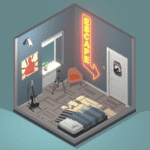
Each location renders as a small isometric box you can drag to spin. Because the front face hides at least one panel, one drawer, or one symbol, the rotation is not decoration. It is the search itself.
The shed behind the tower shows this best. From the front, the door is locked and the scene looks finished. However, turning the view reveals barrels, a wooden pallet, and a small window Jack can climb through.
Jack, Alone Mountain, and the Fire Lookout Premise
Jack is ex-military, and he takes the ranger post expecting quiet shifts. The forest around Alone Mountain has other plans, with missing people, fenced-off ground, and tunnels running under the slope.
Two of the seven released levels take place inside his memories rather than the forest. As a result, the story keeps cutting between a man watching trees and a man who clearly saw something years earlier. That structure gives the escape room puzzles a reason to exist.
How It Stacks Up Against Other Mobile Escape Room Titles
The Room: Old Sins is the obvious Android rival, and it wins on tactile polish. Its puzzle boxes feel heavier under a finger. This title trades some of that shine for scale, since a single chapter can hold a cabin, an attic, a yard, and a shed.
Rusty Lake: Roots takes the other extreme, leaning into surreal storytelling over mechanical locks. By contrast, the forest mystery here stays grounded, and its clues usually resolve into a number or a symbol you can act on. Players who finished Tiny Room Stories: Town Mystery will recognise the interface immediately.
Android Version vs the Windows Version
Google Play lists the game on Android and on Windows through Google Play Games. The Windows build uses the same content, so a bigger screen mostly helps with small symbols on the backs of cans and posters.
Touch still suits it better. Dragging to rotate a diorama with a thumb feels natural, while a mouse adds a small step to the same motion. Progress does not sync automatically between the two, so pick one device and stay there.
Gameplay Mechanics, Camera Tool, and Touch Controls
Every scene responds to two inputs: a tap to interact and a drag to spin the diorama. That pair covers roughly everything, from opening a drawer to lining up a dial on the radio receiver.
Jack also carries three interface tools. A camera icon sits in the top right corner, a book icon tracks goals, and the inventory holds anything he picks up. The camera stores a maximum of 10 photos at a time.
One-handed controls are a genuine design choice rather than a marketing line. Nothing asks for a pinch, a swipe combination, or a two-finger gesture. Because of that, the whole mystery adventure works on a bus with a coffee in the other hand.
Tapping, Rotating, and One-Handed Controls
Tapping an object either picks it up or zooms into it. Zoomed views are where most code locks live, and a second tap backs out cleanly.
Rotation carries no cost and no limit. For example, spinning the tower base three full turns before touching anything is a reasonable opening move. Most missed items sit on the face you never looked at.
The 10-Photo Camera and the Task Book
The camera exists because clues sit far from their locks. Jack sees a symbol on a noticeboard, then meets that symbol on a red supply box several screens later, and the photo bridges the gap.
Ten slots fill faster than new players expect. Photographing decorative posters, wall art, and every scrap of paper leaves no room for the marking that actually matters. The task book is the safety net, since it restates the current objective in plain words whenever the trail goes cold.
Inventory Items and Combining Parts
Items rarely work in the state Jack finds them. The walkie-talkie from the bedside drawer stays silent until an antenna from a mug in the kitchen drawers gets attached.
Open the inventory and inspect items directly. Rotating an item there often exposes a switch, a serial number, or a slot. Therefore, treat every collected object as a small diorama of its own.
How to Unlock the Fire Lookout Tower in the Prologue
The prologue, called Arrival, ends only after Jack refuels the generator, restores power, unlocks the tower door, and reports in over the walkie-talkie. Every step depends on a clue found somewhere else in the same forest stretch, so the prologue doubles as the tutorial for the entire chain of logic.
It opens on a truck ride along the highway. Jack collects a backpack from the truck bed and a sheet of notes from the driver, and those notes list the tasks he owes his employer.
Three locked things stand between him and bed: a red supply box, a shed, and the tower door. Each one has an answer sitting in plain sight nearby.
The Mile 257 Supply Box and the Signpost
The driver drops Jack at Mile 257 on the highway. That number is the answer to the red supply box further down the path, and the noticeboard by the path entrance carries the matching symbol.
After the box opens, Jack takes the key inside. At the crossroads that follows, a yellow sign board lies on the ground behind a tree. Fitting it onto the empty post points the correct way forward.
Fuel, the Generator, and the Two-Row Power Panel
Inside the shed, a can of fuel sits on the floor near the back wall. Dragging it onto the generator outside refuels the machine, but the power still will not run.
Above the generator, a panel holds two rows of five buttons. The clue lives on the backs of the cans on the shed shelves, which Jack can turn one by one. Photograph that marking, because the panel sits on a different screen.
Radio Frequency 813 and the Walkie-Talkie Call
Upstairs in the tower, the desk holds a radio receiver. Flip the switch on the left, then turn the dial to frequency 813 from the notes, and press the button marked 3 for Tower 3.
The walkie-talkie needs its own setup. Attach the antenna, flip the side switch, move the yellow selector to channel 2, then hold the large red button. If the task list is complete, the voice on the other end tells Jack to start work tomorrow.
How to Unlock the Dream Chapters and Later Locations
Dream chapters arrive twice in the released story, and both swap the forest for a facility full of electronics. Chapter 2 Dream follows Cabin in the Woods, while Chapter 5 Deeper in the Dream follows the campground rescue, so the dreams are earned rather than selected.
Progression is strictly linear. Finishing the tasks of one level opens the next, and there is no branching path or optional side room to unlock separately.
Locations shift steadily across the six chapters, moving from a wooden cabin to a campground, then underground. Each new area introduces one fresh lock type before reusing the old ones, which keeps the escape room puzzles from settling into a pattern.
Cabin in the Woods and the Attic Horseshoe Clue
Chapter 1 sends Jack to a cabin with a stubborn chimney. Handles on the chimney need setting in a specific order, and nothing in that room states the order.
The attic holds the answer in the form of five horseshoes. Read their arrangement, photograph it, then return downstairs and match the handles. This is the first puzzle that punishes players who never climb the ladder.
The Security Camera Grid Inside the Dream
A security camera blocks progress inside the dream, and Jack uses a code-breaking device on it to start a grid puzzle. Five codes appear along the top, and the goal is to find and tap all five in the grid below.
The catch makes it interesting. Each tap deletes the entire row and column of the tile you chose, so a careless order erases codes you still need. Work out the shared rows first, then commit.
Campground, The Rescue, and Investigation
Chapter 3 Campground opens up a wider outdoor space with caravans and scattered gear. And Chapter 4 The Rescue then centres on saving a stranded tourist, and one laptop code hides on a window inside a caravan.
Chapter 6 Investigation closes the current release. By that point the puzzle density rises sharply, and the story stops pretending the missing hikers are a coincidence. Anyone who rushed the earlier levels will feel the difficulty step here.
How Chapter Progression, Ducks, and Achievements Work
Seven playable levels sit in the chapter list today, and each one stays locked until the previous chapter ends. Chapter progression therefore doubles as the story order, with no way to jump ahead to a favourite location.
Two collectible threads run underneath all of it. Hidden yellow rubber ducks sit tucked inside the scenery, and crows perch where players rarely look. Both feed the achievements list rather than any gameplay reward.
None of this gates the main story. A player can finish every chapter without touching a single duck. Completionists, though, get a second reason to rotate scenes they have already solved.
How Chapter Unlocking and the Task Book Fit Together
The task book updates as Jack completes objectives, so it acts as the progress meter for the current level. When the list empties, the chapter closes and the next one opens.
Reading it early saves real time. For example, a player hunting for a fuel can while the book asks for a key is searching the wrong half of the map. Check the book before every new sweep of a scene.
Where the Hidden Yellow Rubber Ducks Sit
Ducks are deliberately placed in containers that hold nothing else useful. Drawers you never need, boxes off the critical path, and corners behind furniture all qualify.
That placement is the trick. Since the game trains players to open only what the puzzle requires, duck hunting means breaking that habit on purpose. Sweep each room once after the exit unlocks, not before.
Crows, Achievements, and Completion Rewards
Crows appear in outdoor scenes, and tapping one shoos it away. Achievements track how many you have scared off across the story.
The rewards stay cosmetic and statistical rather than mechanical. No duck or crow hands Jack an item or a shortcut. Some players ignore both entirely, and the ending does not change.
What Arrives After Chapter 6
The current release stops after Investigation, and the mystery is not resolved at that point. Kiary Games has Chapter 7 planned for October 2026, with Chapter 8 and an Epilogue planned for December 2026.
That schedule is worth knowing before you start. Anyone who hates unfinished stories should wait for the epilogue, while anyone happy with episodic releases can play now and return later. Saves persist between updates.
Common Mistakes That Stall New Fire Lookout Rangers
Players lose more time to save behaviour than to hard puzzles in this escape room adventure. Several reviewers report that closing the app partway through a chapter can drop them back at the chapter start, especially around the cabin.
Two other habits cost almost as much progress. Filling the 10 photo slots with scenery leaves no space for the marking on the cans. Rotating a diorama only once leaves whole faces of a scene unsearched.
None of these are difficulty problems. They are process problems, and fixing them costs nothing. Jack’s failures usually trace back to information he never recorded rather than logic he could not follow.
Quitting a Chapter Mid-Solve and Losing Progress
Finish a chapter in one sitting where you can. Since a level runs roughly thirty to fifty minutes, that is a realistic ask on most evenings.
If you must stop, stop at a chapter boundary rather than mid-puzzle. Players who exited during Cabin in the Woods have described restarting the same level more than once. Treat the chapter end screen as your real save point.
Filling the Photo Slots With the Wrong Clues
Photograph symbols, number sequences, and diagrams only. Posters with art, ordinary furniture, and scenery are safe to skip, because the game never asks you to reproduce them.
Delete freely once a lock is open. A photo of the horseshoe order has no value after the chimney handles are set. Keeping the camera near half empty means the next real clue always has a slot waiting.
Under-Rotating Scenes and Missing Back Panels
Make a full turn of every new scene before touching anything. Hidden objects here sit on rear faces far more often than under obvious lids.
The prologue shed teaches this lesson cheaply. Its front looks like a dead end, yet the back holds the pallet, the barrels, and the window. Later chapters hide switches the same way, only with less patience for guessing.
Best Tiny Room Stories Eclipse Tips and Tricks for Beginners
Good first runs in this diorama puzzler start with the camera, not with the code locks. Jack’s clues almost always sit on a different screen from the lock they open, so recording beats remembering.
Three habits carry the most weight. Photograph symbols the moment you see them, consult the task book before searching, and treat timed sequences as pattern reading rather than speed tests.
Each one targets a real failure point in this specific forest mystery. None of them require extra items, purchases, or outside help.
Photograph Every Symbol Before Touching a Code Lock
The Mile 257 box sets the template for the whole story. Its symbol appears on the noticeboard minutes earlier, and players who walked past it have to backtrack.
Build the habit early. Whenever a marking looks deliberate, snap it, and only then walk on. Because the supply box, the power panel, and the chimney all follow this pattern, the habit pays out four or five times per chapter.
Read the Task Book Before Duck Hunting
Collectibles are tempting the moment you notice the first duck. Chasing them mid-puzzle, however, scatters your attention across rooms you have not solved yet.
Clear the task book first, then sweep for ducks and crows on the way out. This order also protects your photo slots, since a solved chapter needs no more clue storage. Achievements are still there after the exit opens.
Beat the Timed Cliff Climb Without Panic Tapping
The cliff before the tower is the only sequence in the prologue with a timer. Jack climbs by tapping roots and rocks, and each step needs the correct handhold.
Look at the route before the timer matters. Panic tapping picks wrong holds and wastes the attempt, while a calm read of the rock face usually shows one clean line. Failure costs a retry, not progress, so a second attempt is normal.
Is Tiny Room Stories Eclipse Free? Ads and Offline Play
You pay nothing to install this title on Android or iOS, because Kiary Games funds it with advertising and optional in-app purchases. The Google Play listing carries both a “Contains ads” tag and an “In-Game Purchases” tag, and the store shows 4.5 stars from 485 ratings across more than 10,000 installs.
Ads are the main trade. They appear around chapter transitions and around hint prompts rather than mid-puzzle.
Offline play is the other half of the deal. Once the game is on the device, no connection is needed to solve a single room. Only the ad breaks and the hint prompts care about a signal.
What the Free Version Includes
The install covers the prologue and all six released chapters at no charge. There is no paywall sitting between Cabin in the Woods and Investigation.
Purchases target convenience instead of content. Players who dislike interruptions can spend, and players who accept ads can finish the same story without spending. That structure is friendlier than the season pass model the earlier Town Mystery used.
How Ads and Optional Purchases Appear
Video ads back the hint prompts, so watching one is the usual price of a nudge. Some players have reported crashes around those ad breaks in earlier builds, with progress lost on the affected chapter.
A recent update improved stability, and the store page shows frequent maintenance releases. Even so, finishing a chapter before letting an ad play is still the safer routine.
Offline Play, Storage Size, and Device Needs
The Apple build weighs roughly 887.9 MB and needs iOS 15.0 or later, which rules out very old iPhones. Android devices with a spare gigabyte handle it comfortably.
Airplane journeys suit it well. Since the story runs entirely offline and one-handed controls need no extra space, a chapter fits neatly into a flight, a train ride, or a queue.
Frequently Asked Questions About Tiny Room Stories Eclipse
Is Tiny Room Stories Eclipse free to play?
Yes. Tiny Room Stories Eclipse installs for nothing on Google Play and the App Store, and ads fund it. Google Play rates it 7+, while Apple rates the same release 13+ for fear themes and references to weapons. English is currently the only supported language.
How long does it take to finish?
Most players finish the seven released levels in roughly six to eight hours. Each chapter runs about thirty to fifty minutes, so it fits short sessions well. The pace slows in the underground sections, where a single lock can eat fifteen minutes on its own.
Will there be more chapters?
Yes. Kiary Games has two more main chapters and an epilogue planned, and the studio posts dates on its Facebook and X accounts rather than inside the app. Save files carry forward, so a finished run picks up where it stopped when the next level lands.
Who Should Add This Forest Mystery to Their Phone
Slow, methodical players get the most from this one. Fans of point-and-click adventure design, detective stories, and mechanical locks will feel at home, while anyone who wants fast action will not. I played it in evening chunks with the camera half empty on purpose, and the prologue clicked for me the moment I stopped hunting objects and started reading symbols. My honest verdict is that the writing carries the puzzles further than I expected from a free release. Install it if you enjoy a mystery that trusts you to notice things.
Images


Download links
ℹ️ Download link not working? Please refresh the page and try again.
Developer's apps





New Apps
Most Played Mobile Games


