
TerraGenesis MOD APK (Free Shopping)

Description
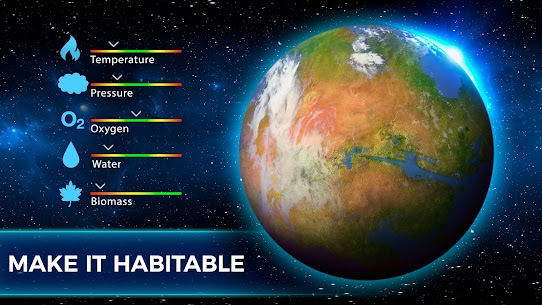
TerraGenesis Space Settlers puts real NASA planetary data into your hands and asks you to turn a barren rock into a living world, one oxygen level at a time. This post is written for beginners and returning players who want to stop losing colonies to runaway temperatures or depleted credit reserves. Below, you will find coverage of faction mechanics, the Stats Summary Page, resource management, asteroid defense, and the Culture Points independence system.
What Is TerraGenesis Space Settlers
TerraGenesis Space Settlers is an idle planet building simulator developed by Edgeworks Entertainment and published by Tilting Point. The game uses real data from NASA to model planetary environments and tasks players with transforming hostile worlds into habitable civilizations. Every facility players build, every stat players adjust, and every decision players make about oxygen, temperature, and sea level is grounded in real space science.
The game sits at an unusual intersection of idle simulation and real-time strategy. Players do not tap continuously. Instead, they place facilities, monitor the Stats Summary Page, and make key decisions about when to expand cities and when to stabilize a runaway stat. Because the world keeps changing in real time, the game rewards thoughtful planning over fast reflexes.
How the Real-Time Terraforming Mechanic Works
The core loop in TerraGenesis centers on four planetary stats: oxygen, air pressure, temperature, and sea level. Each facility players build pushes one or more of these stats up or down. The challenge is keeping all four within the habitability range at the same time, which is harder than it sounds because adjusting one stat almost always moves another.
Players use the Stats Summary Page to track what each facility contributes per minute. This dashboard is the most important tool in the game. However, new players often skip past it, and that is exactly when colonies start to spiral. The faster players get comfortable reading change-per-minute rates, the more control they have over a planet’s future.
The Setting, Tone, and Civilization-Building Premise
TerraGenesis takes place across a vast universe that includes real planets from the solar system, fictional alien worlds, and the TRAPPIST-1 system. The tone is calm and scientific. Players are not fighting enemies in real time. Instead, they are watching a world slowly come to life through their resource management decisions. Random events add tension, from asteroid strikes to cultural milestones, and these events keep each session from feeling routine.
The civilization-building premise gives the game its depth. Players are not just adjusting numbers. They are establishing colony independence by accumulating Culture Points, choosing a faction that shapes their values and victory goals, and expanding cities across a planet’s surface. Each successful terraforming run feels earned rather than handed over.
How TerraGenesis Compares to Space Frontier 2 and Alien Invasion on Android
Space Frontier 2 by Ketchapp focuses on quick, session-based rocket launches with arcade-style gameplay. TerraGenesis, by contrast, is a long-form idle sim where a single planet can take days to fully terraform. The pacing, depth of science, and faction system in this mobile title have no real parallel in Space Frontier 2.
Alien Invasion: RPG Idle Space by CrazyLabs LTD shares the idle format, but its combat-driven progression differs significantly from TerraGenesis’s stat-management loop. TerraGenesis rewards patience and planning over gear upgrades. Players who enjoy watching systems evolve in real time will find TerraGenesis a far richer experience than either competitor.
TerraGenesis Gameplay Mechanics and Controls
The controls in TerraGenesis are minimal by design. Players tap to place outposts, select facility types, assign governors, and monitor stats. There are no complex gestures. However, the decisions behind each tap carry real weight because the game simulates planetary science in the background at all times.
The game is built around a satisfying feedback loop. Players place a facility, watch its contribution appear on the Stats Summary Page, monitor how the stat shifts over hours, and then respond by adding or disabling facilities to maintain balance. This loop never fully disappears, even on planets players have terraformed before, because each world starts with different baseline stats.
Managing the Four Core Planetary Stats
Oxygen, air pressure, temperature, and sea level are the four stats that determine whether a planet can support life. Each one affects the others. For example, placing an Ice Launcher lowers temperature but raises sea level as ice caps melt. Players need to anticipate these reactions rather than simply chasing the highest individual number.
Facilities are tiered. Tier 1 options like the Oxygen Plant and Habitation Unit are available early and cost 500 Credits per level per minute to maintain on higher difficulties. Tier 2 and Tier 3 facilities cost progressively more but push stats faster. Balancing maintenance costs against stat output is the central financial challenge of every planet run.
Building Facilities and Unlocking the Research Tree
The research tree determines which facilities players can build. Players use Credits and Genesis Points to speed up research, but patience is often enough. Each research unlock opens a new facility type that gives players another tool for steering planetary stats in the right direction.
Governors also play a role here. Each governor assigned to a city brings a specific bonus, such as increased warmth, faster population growth, or reduced facility maintenance. Choosing the right governor for the right city makes a real difference in how smoothly a planet develops. However, governors are tied to the faction system, so faction choice affects which governors players access.
What Happens When a Planet Reaches Full Habitability
When all four core stats sit within the habitable range, the planet becomes capable of supporting surface life without domes. Population begins to grow without the constant support of Habitation Units. The game signals this milestone, and it represents a shift from survival management to cultural development. Players then focus on accumulating Culture Points toward the 20-point independence threshold.
Reaching independence is the primary victory condition for most factions. However, the Horizon Corporation requires players to hit one billion Credits in addition to independence. Therefore, the end goal is not the same for every player, and faction choice made at the start has a lasting impact on how the final stretch of a planet run feels.
Faction System and Culture Points in TerraGenesis
The faction system is one of the most underexplained features in TerraGenesis. Many players pick a faction at the start based on the description alone, without understanding how deeply that choice affects their financial growth, research speed, and available culture values throughout the entire run.
There are five factions: Daughters of Gaia, Sons of Hephaestus, UNSA, Horizon Corporation, and the Far-Future Institute. Each one represents a different philosophy about how humanity should approach planetary colonization. The choice is not cosmetic. Each faction sets hard limits on which culture values players can access and determines the bonus stats their governors carry.
How Faction Choice Shapes Your Victory Condition
The UNSA focuses on democracy and education, giving players a slower but well-rounded financial and research path. Horizon Corporation gives players 30% financial growth but cuts research speed by 30% and requires reaching one billion Credits to win. The Far-Future Institute prioritizes scientific discovery, which suits players who want to unlock the full research tree quickly.
Daughters of Gaia and Sons of Hephaestus sit on opposite sides of the terraforming debate. Daughters want a garden paradise and are best for players focused on full habitability. Sons support minimal terraforming and colony independence without altering the planet. Neither approach is wrong. They simply produce different colony styles and different late-game challenges.
What Culture Points Do and How to Earn Them
Culture Points represent the social and political development of a colony. Players spend them to shift culture values such as wealth, knowledge, and population priorities. Accumulating 20 Culture Points is the shared independence requirement across all factions. However, the culture stats players can access are faction-locked, so players cannot freely move every value.
Culture revenue increases as cities grow and trade routes develop. The League event, which fires when players have more than five cities, gives a simultaneous boost to culture revenue across all cities. Players who expand city count early benefit significantly from this event when it triggers. Additionally, certain governors offer culture bonuses that stack with city revenue.
Which Faction Works Best for First-Time Players
UNSA is widely considered the best starting faction for new players. It provides balanced bonuses across wealth, knowledge, and population without locking players out of key culture values. Because it does not require a special financial milestone to win, new players can focus on learning the terraforming mechanic rather than managing a credit threshold.
Horizon Corporation is better suited to experienced players who already understand how to build efficient Spaceport revenue networks. The +30% financial growth is powerful, but the research speed penalty slows facility unlocks at a stage where new players still need access to all the tools they can get.
Planets, Moons, and Alien Worlds in TerraGenesis
TerraGenesis offers one of the most varied planet rosters in mobile gaming. The base game includes Mercury, Venus, Earth, Mars, and the Moon as free terrestrial worlds. Beyond that, players can purchase access to the moons of Jupiter, Saturn, Neptune, and Uranus, the TRAPPIST-1 system, and the Random Planet Generator, which creates unique worlds with procedurally generated starting stats.
Each planet starts with different baseline values for all four core stats, which means no two planets play identically. Mars is cold and thin-aired with relatively gentle starting conditions. Venus is crushingly pressurized and searingly hot. Earth runs in reverse mode, where players watch a thriving planet decay unless they intervene. The variety forces players to rethink their facility strategy with each new world.
Which Planets Are Free and Which Require Purchase
The five terrestrial planets, Mercury, Venus, Earth, Mars, and the Moon, are all available to free players. These worlds alone provide dozens of hours of content. Players who want to terraform the moons of the outer planets or jump into the alien worlds of the TRAPPIST-1 system will need to purchase those planet packs from the in-game store.
The Random Planet Generator is also a paid addition. It creates replayability for players who have finished the free worlds and want new challenges without a fixed starting point. None of these purchases are needed to complete the game’s core experience. However, they extend the available content significantly for players who want more variety.
How Alien Life Encounters Work and What They Affect
Some planets in TerraGenesis feature indigenous alien populations. When players encounter alien life, they face a binary decision: make peace or conquer. Each choice triggers a different set of follow-up missions and affects the colony’s culture stats. Making peace can boost certain culture values. Conquering unlocks a different mission branch.
These encounters are not random in timing. They appear as part of the planet’s event system once specific habitability thresholds are crossed. Players who ignore their alien strategy lose access to entire mission chains. Because missions contribute to credit revenue and culture development, alien encounter choices carry real consequences for the overall run.
What the TRAPPIST-1 System and Random Planet Generator Offer
The TRAPPIST-1 system gives players seven exoplanets with NASA-derived data. Each one has unique atmospheric and thermal conditions that require different facility combinations. The system is ideal for experienced players who want the scientific authenticity of the base game applied to worlds beyond the solar system.
The Random Planet Generator takes a different approach. It creates planets with unpredictable starting stats, which means players cannot rely on pre-learned strategies. This mode tests whether players truly understand the terraforming mechanic rather than memorizing a sequence of moves for a specific world. It is the closest TerraGenesis gets to a true challenge mode for veterans.
Biospheres, Alien Life, and the Genetic Engineering System
The Biospheres mode sits on top of the core terraforming loop as an optional system that adds significant depth. Players who turn it on gain access to a genetic engineering simulator with 26 starting phyla and 64 unique genes. From these building blocks, they construct organisms that inhabit the planet alongside the human colony.
Biospheres is not a distraction from terraforming. The organisms players create affect planetary biomass, which is one of the key stats tied to habitability. Therefore, building a functional food chain is not just creative play. It becomes part of the resource management challenge that defines the whole game.
What Biospheres Adds to the Core Terraforming Loop
With Biospheres active, players need to manage both the physical environment and the living organisms within it. A food chain that is too aggressive can strip biomass faster than facilities restore it. A chain that is too passive fails to support the population growth the colony needs. Getting the balance right requires the same kind of stat awareness that the rest of the game demands.
The mode also adds aquatic lifeforms, which interact with sea level and biomass in ways that differ from terrestrial organisms. Players who invest time in Biospheres gain a richer simulation experience, but they also take on more variables to track. For new players, it is generally better to complete one full terrestrial run before activating Biospheres.
How to Build a Food Chain From Scratch Using Genes
Players start with a set of phyla and assign genes to create organisms with specific traits. Genes control an organism’s diet, reproduction rate, habitat preference, and tolerance for temperature extremes. Because each planet has different baseline conditions, the same gene combination that thrives on Mars may fail on Venus.
The key principle is diversity. A food chain with only one predator and one prey species is fragile. Players should build two or three trophic layers with multiple species at each level. This redundancy prevents a single random event from collapsing the entire food chain and wiping out the biomass contribution organisms provide.
Managing Aquatic and Terrestrial Lifeforms Together
Aquatic organisms depend on sea level being within a viable range. As players raise sea levels to hit habitability thresholds, aquatic species flourish. However, if sea level drops due to a temperature correction, aquatic populations collapse. Players need to sequence these changes carefully when both Biospheres and terraforming targets are active simultaneously.
Terrestrial organisms, meanwhile, are sensitive to oxygen and temperature ranges. The two ecosystems interact through shared biomass values. Getting both to thrive at once is the most complex resource management challenge in the game. Players who succeed gain a planet that feels genuinely alive in a way that the standard mode does not fully replicate.
Common Terraforming Mistakes and How to Avoid Them
New players in TerraGenesis tend to share the same three failure points. They under-use the Stats Summary Page, they ignore the asteroid defense network until it is too late, and they build facilities faster than their credit revenue can support. Each of these mistakes is avoidable once players understand how the systems connect.
The good news is that the game does not punish permanent failure in the traditional sense. Players can pause a volatile world, disable expensive facilities, and rebalance their approach. However, without knowing what to watch for, most beginners hit the same walls in the first few hours.
Ignoring the Stats Summary Page Until It Is Too Late
The Stats Summary Page is not a passive report. It is an active management tool. Players who check it only when something goes wrong are already reacting to a problem rather than preventing it. The change-per-minute display tells players exactly where a stat is heading over the next several hours, which is the information needed to act before conditions become critical.
Additionally, tapping a facility on the Stats Summary Page navigates directly to the city where that facility sits. New players who do not know this feature waste time hunting through cities manually. Using the page as a navigation tool cuts session time significantly and keeps players focused on the decisions that matter.
Letting Asteroid Threats Run Without a Defense Network
The asteroid defense network is a mid-game priority that many players treat as optional. It is not. Giant asteroids are a recurring event type, and without a detection and interception system in place, a single impact can destroy facilities, collapse population figures, and undo hours of terraforming progress.
Players should build their first planetary defense satellite as soon as the research tree makes it available. The network requires maintenance but costs far less than rebuilding a city after an uncontested impact. On Expert difficulty, worldkiller events make this mistake especially costly. Even on Normal mode, ignoring defense is the fastest way to lose a colony that was otherwise on track.
Misreading Credit Revenue and Draining Your Treasury Early
Credits drain faster than new players expect. Tier 1 facilities cost 500 Credits per level per minute in maintenance. A city with four Tier 1 facilities at Level III each costs 6,000 Credits per minute to run. Without a reliable income source, that drain empties a treasury before players have time to notice.
Spaceports generate passive credit revenue and are the most reliable income facility in the game. Players should prioritize building and upgrading Spaceports early, even if doing so delays other facility unlocks. Coral Reefs are a secondary revenue source that also boost biomass, making them doubly useful once sea levels are stable. Balancing income before expanding city count prevents the most common financial collapse scenario in TerraGenesis.
Best TerraGenesis Space Settlers Tips and Tricks for Beginners
These tips are written specifically for the systems that make TerraGenesis different from every other mobile simulator. None of them apply to any other game. Each one directly addresses a decision point that catches new players off guard in their first several planet runs.
Start on Mars to Calibrate Your Pressure and Oxygen Instincts
Mars is the recommended starting planet for a reason. Its low starting pressure and thin oxygen levels are challenging enough to teach the core terraforming mechanic without overwhelming new players with multiple simultaneous stat crises. Venus starts players in a situation where pressure and temperature are both dangerously high at once, which requires a level of multi-stat management most beginners are not yet ready for.
Starting on Mars lets players practice the pressure-oxygen relationship in relative isolation. Players learn that raising oxygen too fast before stabilizing pressure creates its own problems. Once Mars is successfully terraformed, players take those instincts to every harder planet in the roster.
Build Spaceports Early to Unlock Passive Credit Revenue
The Spaceport is the most important revenue facility in TerraGenesis. Unlike mines, which deplete over time, Spaceports generate a steady income tied to the colony’s population size. Therefore, building Spaceports before the population grows means the revenue scales up automatically as settlers arrive, rather than players having to scramble for funds mid-run.
On Normal difficulty, the income from multiple Spaceports removes the credit anxiety that kills most early colonies. Players who build at least two Spaceports in their first city before expanding to a second city almost always have an easier mid-game experience than players who delay. The maintenance cost of a Spaceport is also low relative to the revenue it generates at scale.
Watch the Stats Page Change-Per-Minute Rate Before You Sleep
TerraGenesis runs in real time, even when the app is closed. That means overnight, planetary stats continue changing based on whatever facilities were active when players last logged out. A stat that was stable during the session may reach a crisis point by morning if the change-per-minute rate was trending in the wrong direction.
Before ending any session, players should open the Stats Summary Page and check the direction and speed of every stat. If oxygen is rising faster than pressure is following, the imbalance will be worse the next morning. A few seconds spent reading change-per-minute rates before closing the app prevents the kind of recovery sessions that waste an entire play period fixing a preventable problem.
Frequently Asked Questions About TerraGenesis Space Settlers
Is TerraGenesis Space Settlers free to play?
TerraGenesis Space Settlers is free to play on iOS and Android. The base game includes five terrestrial planets at no cost. Genesis Points, the premium currency, can be earned by watching optional ads. Additional planet packs, including the moons of the outer planets and the TRAPPIST-1 system, are available as optional purchases but are never required to complete the core experience.
What is the goal of TerraGenesis Space Settlers?
The goal in TerraGenesis is to achieve colony independence by accumulating 20 Culture Points on any given world. Players do this by terraforming the planet, building cities, growing their population, and developing culture through facilities and faction-specific events. Some factions, like the Horizon Corporation, add a financial milestone on top of the standard independence requirement.
Does TerraGenesis Space Settlers have offline progress?
Yes, TerraGenesis Space Settlers runs in real time whether the app is open or not. Facilities continue producing output, planetary stats continue shifting, and random events can still trigger while players are away. This means a colony that was stable when players last logged out may have changed significantly by the time they return, so checking the Stats Summary Page on login is always a good habit.
TerraGenesis Space Settlers Is Worth Your Time – Here Is Why
TerraGenesis Space Settlers offers something rare in mobile gaming: a simulation that respects the player’s intelligence. The faction system, the Stats Summary Page, the Biospheres genetic engineering layer, and the NASA-grounded terraforming mechanic all reward players who engage with them fully rather than skipping past the details.
Beginners who take the time to understand Credits, pressure, and faction choice early will find the mid-game far more rewarding than those who rush into city expansion without a financial plan. After spending time with several planet runs across Mars, the Moon, and alien worlds in the TRAPPIST-1 system, the clarity of the stat management system stands out as the game’s strongest quality. If you enjoy simulation games where every decision carries real weight, TerraGenesis is a mobile title that earns a permanent place in your rotation.
Images




Download links
ℹ️ Download link not working? Please refresh the page and try again.
Mod Info
- when you enter the game, select one of the locked planets, when you press the buy button, press the ” Full Access Ticket (50% discount) ” button from the window that opens, the game may close, when you open it again all planets will be unlocked. The game may freeze, just close and open it again.
Developer's apps


Related apps




What's new
Bug fixes and backend optimizations.
New Apps
Most Played Mobile Games


