
Rovercraft MOD APK (Unlimited Money, Diamonds)

Description
RoverCraft drops players onto the hills of distant planets inside a fully assembled rover they built themselves, with a realistic physics engine that makes every slope a fresh test of engineering judgment. This post is written for beginners and returning players who want to build smarter, last longer on each run, and perform well in the daily multiplayer tournaments. Below, this post covers vehicle crafting, planet progression, upgrade priorities, tournament structure, and the most important tips for surviving the steepest alien terrain.
How RoverCraft Racing Works
RoverCraft is an arcade-style vehicle builder and hill climber set across a galaxy of alien worlds. Players assemble a rover from parts — engines, wheels, reactors, and turbo boosters — and then drive it across the uneven, often brutal terrain of 14 different planets. The physics engine is the heart of everything. It simulates how weight, momentum, and component placement interact with each surface, which means no two rovers perform identically on the same hill.
The game runs across three modes: Planets, Challenges, and Tournaments. Planets mode is the main campaign. Players work through each alien world in sequence, collecting coins and trophies as they push further across the surface. Challenges add variety with specific objectives and time-limited scenarios. Tournaments pit players against each other daily, with global rankings and reward tiers.
What the vehicle crafting mechanic is and how it drives gameplay
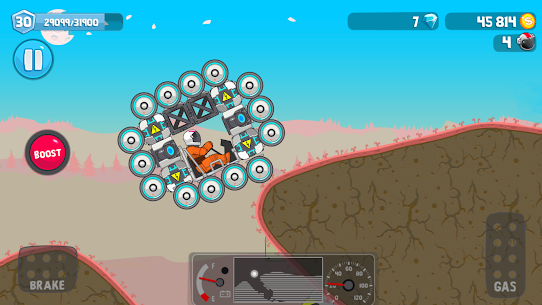
The vehicle crafting mechanic sits at the centre of every session. Players choose a chassis and then attach components to it — jet engines for thrust, super-wheels for grip, reactors for sustained power, and turbo units for short bursts of speed. Each component adds weight and changes the rover’s centre of gravity. A rover loaded with engines at the rear will rear up on steep inclines. One that is too heavy in the front will dig into soft terrain and stall.
This crafting loop is what separates this title from simpler hill-climbing games. Players are not just driving — they are iterating on an engineering problem. Each failed run provides real data. A rover that topples on a left-side slope has a weight or wheel placement issue. Because the physics engine models these variables accurately, fixing the problem feels satisfying rather than arbitrary.
The galaxy setting, tone, and planet-hopping premise
The premise is simple: a lone pilot navigates their rover across alien planets, aiming to reach the mothership at the end of each run. The tone is colourful and arcade-friendly. However, the underlying challenge is serious. Each planet introduces new hazards. The pilot can suffer a torn space suit. The rover can lose wheels mid-run. Fuel depletion ends a run instantly regardless of how well the build is performing.
The 14 planets span recognisable names like Earth, Mars, Mercury, Venus, and Neptune alongside fictional worlds like Pandora, Cyber931, Steamcraft, and Comet. Each planet has distinct HD visuals that reflect its real or imagined geography. This variety keeps long sessions visually engaging and ensures that mastering one planet does not guarantee success on the next.
How RoverCraft compares to similar racing titles
Most hill-climbing mobile games offer a fixed vehicle with upgrade slots. RoverCraft gives players a blank chassis and a parts inventory instead. That shift in design produces a fundamentally different experience. In Hill Climb Racing, for example, players purchase better versions of preset vehicles. In this game, players engineer their own solution from the ground up. The physics consequences of those choices are immediate and specific.
The multiplayer tournament layer also distinguishes it from most competitors in the genre. Daily tournaments create a live competitive context that single-player hill climbers lack. Players are not just beating a distance record. They are posting scores against real opponents across global leaderboards, which adds meaningful replay value.
How Vehicle Building and Crafting Work
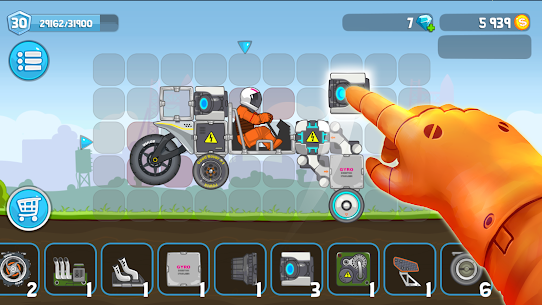
The build screen presents a chassis grid and a component library. Players drag parts into position. The game provides visual feedback on balance as components are placed. A rover with too much mass on one side will visibly tilt in the preview, giving players a chance to correct the design before committing to a run. This feedback loop makes the crafting system accessible even to players with no engineering background.
Components fall into several functional categories. Engines provide forward thrust. Reactors extend operational time before the power system degrades. Super-wheels improve grip on loose or uneven terrain. Turbo units give short bursts of acceleration for clearing sudden steep sections. Each category has multiple tiers. Higher-tier components cost more coins but deliver meaningful performance improvements.
How engines, reactors, and turbo components attach to your rover
Engines attach to the rear or mid-section of the chassis. Their position affects how thrust is distributed across the vehicle. A rear-mounted engine creates a natural push that helps with forward momentum on flat terrain. However, on steep inclines it can cause the front of the rover to lift. Placing a second engine lower or towards the front counterbalances this tendency. Reactors slot alongside engines and extend the duration of each run by maintaining power output longer.
Turbo components work differently. They do not provide sustained thrust. Instead, they fire in short bursts, which players can time to crest a hill or recover from a near-stall. Positioning turbo units high on the chassis amplifies their lifting effect, which is useful on extreme slopes but risky on flatter sections where excess lift causes rollovers.
How wheel selection and placement affect hill climbing performance
Wheels are the most critical component for survival on alien terrain. Standard wheels perform adequately on smooth surfaces but lose grip quickly on rubble, sand, or the sharp inclines found on planets like Charon and Polaris. Super-wheels provide stronger grip and resist terrain-induced spin-out. However, they are heavier. Adding four super-wheels to a small chassis creates a sluggish rover that struggles to accelerate.
Placement matters as much as type. Wide wheel spacing improves lateral stability, which helps on uneven ground where the rover risks tipping sideways. Narrow spacing increases forward speed but reduces the margin for error on rough terrain. Most experienced players run super-wheels at the rear for grip and standard wheels at the front to keep total weight low.
What happens when your rover loses a wheel or runs out of fuel
Losing a wheel is one of the most common run-ending events in this game. When a wheel detaches — usually from a hard impact with a rock or a failed landing — the rover’s handling changes instantly. Steering becomes asymmetrical. The rover pulls toward the side that lost the wheel. In most cases, players cannot recover from a single wheel loss on steep terrain and the run ends.
Fuel depletion is the other primary run-ender. The fuel gauge is visible at all times. Players who push too hard for distance without managing acceleration drain fuel faster. Reactors help extend fuel duration, which is why experienced players prioritise reactor upgrades early in their progression.
How Planets and Environments Work in RoverCraft
The 14 planets represent the core progression structure of the game. Each planet unlocks sequentially, with earlier worlds serving as training grounds for the physics scenarios players will face later. Earth and Mars feature relatively predictable terrain. Later planets like Steamcraft, Cyber931, and Comet introduce surfaces that interact unpredictably with the physics engine, forcing players to rethink builds that performed well earlier.
The visual design of each planet reinforces its mechanical identity. Neptune’s terrain is slippery and steep. Pandora uses bright, organic shapes that disguise its difficult slope angles. Enceladus features icy surfaces that reduce wheel grip. Each planet is therefore not just a visual location — it is a set of mechanical constraints that require a specific build response.
How terrain type changes driving difficulty per planet
Terrain type is the primary variable that determines difficulty. Rocky terrain causes wheel impacts that can detach components. Sandy terrain slows forward momentum and requires more engine power to maintain speed. Icy terrain reduces friction, making steering corrections slower and oversteer more likely. Cliff-style terrain — common on later planets — requires precise speed management because hitting the base of a cliff at high speed often destroys wheels.
Each planet also has a gradient profile. Some planets are consistently hilly. Others have flat stretches between sudden steep climbs. Players who study the terrain before committing to a build tend to last significantly longer. The physics engine rewards players who match their component choices to the specific challenge ahead.
Which of the 14 planets are available and what makes each unique
The 14 planets are: Earth, Mercury, Venus, Mars, PSO318, Charon, Uranus, Neptune, Cyber931, Pandora, Polaris, Steamcraft, Enceladus, and Comet. Real solar system planets appear early in the progression. Fictional planets fill the later stages. PSO318 is a rogue planet with extreme surface instability. Steamcraft has a mechanical aesthetic that changes how impacts behave. Comet features low gravity, which makes controlling airborne rovers particularly difficult.
New maps arrive in updates, which means the total planet count has the potential to grow beyond 14. Players who complete the current planet list unlock higher-tier tournaments and access to additional challenge variants.
How the physics engine responds differently across planet surfaces
The physics engine models gravitational force, surface friction, and component mass simultaneously. On low-gravity planets like Comet, the rover becomes airborne far more easily. A turbo burst that would simply accelerate the rover on Mars will send it into the air on Comet. This means builds optimised for high-gravity planets often perform poorly in low-gravity environments.
Surface friction also changes the effective grip of each wheel type. Super-wheels on icy terrain still outperform standard wheels, but the gap narrows compared to rocky surfaces. Players who understand how the physics engine responds to friction coefficients can tune their wheel selection precisely instead of defaulting to the heaviest available option.
How Multiplayer Tournaments and Daily Rewards Work
Tournaments run daily. Each day, a new tournament event opens and players compete by posting run scores within the event window. Global rankings update in real time. Players who reach the top tiers of each tournament earn higher-value reward packages. This structure gives daily play sessions a competitive purpose beyond simply beating personal records.
The tournament system also acts as a pacing mechanism. Daily events encourage consistent play without forcing it. Players who miss a day simply re-enter the next day’s event without losing progression. This design makes RoverCraft more sustainable as a long-term game compared to titles that use energy systems to restrict play.
How daily tournament matchmaking works
Tournament matchmaking groups players by performance tier. Beginners compete against other players with similar trophy counts and vehicle upgrade levels. This prevents new players from facing opponents with fully maxed builds. As players earn trophies and climb the tier system, their matchmaking pool shifts to include stronger competitors.
Each tournament has a specific challenge parameter — longest distance, most coins collected, fastest time across a target section, or survival on a particular planet. The varying objectives ensure that different build styles can excel depending on the weekly format. A speed-optimised rover may dominate a time trial but struggle in a survival run where fuel conservation matters more.
How the daily spin wheel delivers gifts and bonuses
The daily spin wheel provides a free reward once every 24 hours. Rewards include coins, rare components, upgrade materials, and occasional rare items not available through standard in-game purchase. Players who spin daily accumulate a compounding advantage in their build inventory. Missing spins means missing resources.
The wheel outcome is randomised, but the reward pool shifts based on player level. Higher-level players have access to a different pool that includes higher-tier components. This means the spin wheel remains relevant at all stages of progression. It also gives free-to-play players a reliable path to rare items without requiring direct purchases.
What trophies and achievements unlock through tournament play
Trophies are earned by completing specific milestones within tournament events. Common trophy triggers include reaching a new distance record, winning a tier, or completing a planet for the first time. Trophies serve as both a progression marker and a social signal — players can share trophy counts with friends to compare progress.
Achievements layer on top of the trophy system. Achievements reward unusual actions, such as completing a run after losing a wheel, or reaching a specific planet without using turbo. These achievements require intentional play and push players to experiment with unconventional builds. Completing achievement sets unlocks permanent upgrades that improve baseline rover performance.
What Most Players Get Wrong About RoverCraft Physics
The most common mistake is treating the physics engine as a passive background system. Most beginners simply attach as many high-power components as possible and expect performance to improve linearly. However, because the physics engine models mass, gravity, and friction simultaneously, overloading a chassis with components can degrade performance rather than enhance it. Adding too much weight to a small chassis makes the rover slower on climbs and more prone to rolling over on impacts.
A second common error is ignoring the interaction between component placement and terrain angle. Players who always mount engines at the same position regardless of the planet surface are leaving performance on the table. The physics engine rewards builds that are tuned to specific terrain scenarios, not generic maximum-power configurations.
Why vehicle weight distribution decides hill climbing success
Weight distribution determines whether the rover maintains traction on steep inclines. A rear-heavy rover will lift its front wheels off the surface on sharp climbs, losing steering control and grip. A front-heavy rover will dig into soft terrain and lose momentum. The ideal distribution places the heaviest components as close to the centre of the chassis as possible, with wheels spaced far apart to maximise the contact footprint.
Players who experiment with component positioning — rather than simply upgrading to higher tiers — often outperform higher-level players on steep terrain. The physics engine does not reward raw power. It rewards the correct placement of that power relative to the surface conditions.
Why engine placement matters more than engine power alone
Engine power determines peak thrust output. Engine placement determines how that thrust is applied to the terrain. A high-power engine mounted at the rear top of the chassis creates significant rotational torque on steep climbs. The rover rotates backward rather than climbing forward. Moving the same engine lower and closer to the wheel axle reduces this torque and converts more thrust into forward movement.
This principle extends to turbo placement as well. Turbo units mounted high amplify lift. Units mounted low amplify forward acceleration. Players who understand this axis of control can tune their builds precisely for the scenario each planet presents.
How to read terrain before committing to a slope
Every run begins with a short flat section before the terrain becomes challenging. Experienced players use this section to observe the upcoming slope profile. A gradual slope rewards momentum — players accelerate before the incline and carry speed through it. A sudden sharp cliff requires a different approach: reduced speed before impact and a timed turbo burst at the base of the cliff.
The game does not provide a terrain preview screen. However, players who replay the same planet multiple times develop a reliable mental map of the hazard sequence. Memorising the first three major obstacles on each planet dramatically improves survival rates, particularly for the later planets where single mistakes end runs immediately.
Best RoverCraft Tips and Tricks for Beginners
New players often focus on collecting the most expensive parts as quickly as possible. However, the more effective early strategy is to understand how each component category affects run behaviour before spending coins on tier upgrades. A well-placed standard engine outperforms a poorly placed high-tier engine. Therefore, the best investment at the start is learning placement principles first and upgrading components second.
Coins are the main currency for progression. Players earn them through every run, but the fastest accumulation happens in Challenges mode. Challenges often have specific objectives that deliver higher coin payouts than standard planet runs. Completing three or four challenges per session generates significantly more upgrade resources than spending the same time on open planet runs.
How to balance your rover for steep terrain
Start with a symmetric build. Place components on both sides of the chassis rather than loading one side. Symmetric builds behave predictably on uneven terrain. Once a symmetric baseline is working reliably, players can begin adjusting specific components to address the weaknesses that appear on more difficult planets.
Add wheels before adding engines when expanding a build. Wheels determine contact with the surface. More contact points improve stability. An engine upgrade on an unstable chassis often makes instability worse by increasing the torque forces acting on an already unbalanced vehicle. Wheels first, then power.
Which upgrades extend fuel and distance most
Reactor upgrades deliver the most consistent distance improvement for early-stage players. Reactors extend the duration of the power system, which directly translates to longer runs without fuel-related cutoffs. A player with a reactor-upgraded rover consistently outlasts a player with a higher-power engine rover that burns fuel in half the time.
Super-wheel upgrades are the second priority. They prevent the wheel-loss events that end runs prematurely. Wheel loss on steep terrain is one of the most common run-ending causes in the early game. Upgrading to super-wheels removes this failure mode for most standard terrain scenarios, freeing players to focus on distance rather than damage avoidance.
What to do when your rover gets stuck mid-run
Getting stuck mid-run usually means the rover has stalled on a slope with insufficient thrust to continue forward. The first option is to use a turbo burst if one is available. This can break the stall if the rover still has forward traction. However, if the rover has lost a wheel or is tilted beyond recovery, the turbo burst will simply rotate it further off-axis.
The second option is to accept the run result and use the coins earned to upgrade before the next attempt. Getting stuck is not wasted time. It identifies exactly which terrain scenario is defeating the current build. Players who treat each stuck run as diagnostic data improve their builds faster than players who retry without analysis.
Frequently Asked Questions About RoverCraft
What platforms is RoverCraft available on?
RoverCraft is a universal mobile app available on both iOS and Android devices. Players can download the game for free from the App Store and the Google Play Store. The game supports cross-platform play in its daily tournament mode, meaning iOS and Android players compete in the same global leaderboard events.
How long does it take to complete all planets in RoverCraft?
Reaching the final planet requires substantial progression through the upgrade and trophy systems. Most players reach the mid-game planets within the first week of regular play. Completing all 14 planets typically takes two to four weeks for players who engage with daily challenges and tournaments consistently. The game also receives new map updates, so the total content available continues to expand.
Does RoverCraft have an ending or is it endless?
RoverCraft does not have a fixed story ending. The game is designed for ongoing play, with daily tournaments, regular challenge rotations, and new map additions providing continuous content. Each planet run has a natural endpoint when the rover can no longer continue, but the progression system through trophies, coins, and upgrades has no final ceiling. The game rewards long-term players rather than offering a single completion milestone.
Why RoverCraft Racing Rewards Builders Who Think Before They Drive
RoverCraft delivers a satisfying combination of vehicle engineering and arcade hill climbing that holds up across dozens of hours of play. Beginners will find the crafting system approachable and the early planets forgiving enough to build confidence. However, returning players and competitive types will find genuine depth in the physics engine, the planet-specific terrain challenges, and the daily tournament structure. After spending significant time with the build mechanics and testing configurations across multiple planets, the game most rewards players who treat each run as an engineering iteration rather than a simple drive. If building something that works is as satisfying to you as the run itself, this title consistently delivers on that promise.
Images



Download links
ℹ️ Download link not working? Please refresh the page and try again.
Mod Info
- Unlimited Money
- Unlimited Diamonds
Developer's apps


Related apps





What's new
Several bugs fixed
New Apps
Most Played Mobile Games


