
Lichtspeer APK (FULL GAME)

Description
Lichtspeer puts you in the role of a divine champion hurling a glowing pink spear at Penguin Vikings and Wurst Zombies across 60+ levels of fast, brutal arcade action. This post is written for beginners and returning players who want a clear, level-headed approach to the game’s mechanics, upgrade path, and boss fights. You will find coverage of the core lightspear-throwing mechanic, the Lichtpowers upgrade system, Uber Boss Battle tactics, and the most common mistakes that send players back to level one.
What Is Lichtspeer and How Does It Play
Lichtspeer is a 2D arcade action game developed by Polish studio Lichthund and published by Noodlecake. Players stand in a fixed position on the left side of the screen and hurl a glowing spear of light at waves of enemies advancing from the right. The goal is simple: clear every enemy before they reach you. However, the enemies grow faster, more varied, and more numerous with each stage.
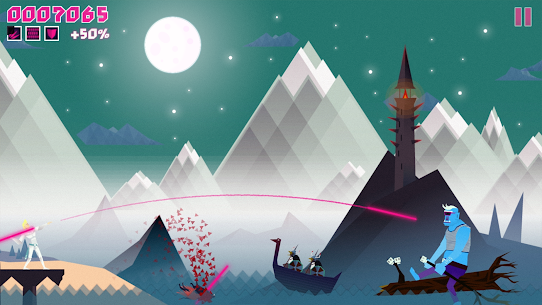
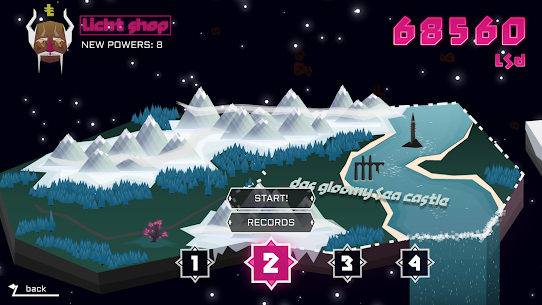
The game spans 60+ levels organised into themed worlds. Each level breaks into multiple short sections. After clearing a section, the game checkpoints your progress — a small mercy given how quickly things can overwhelm new players. The art style channels pure 1980s neon psychedelia, with hot pinks, electric blues, and surreal backdrops that feel unlike almost anything else in mobile gaming.
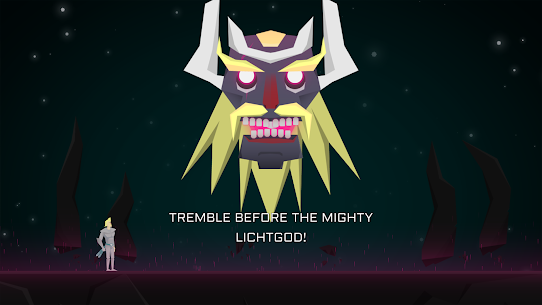
The tone is deliberately absurd and self-aware. Enemies include Wurst Zombies shuffling in from the right, Penguin Vikings waddling forward in formation, and Hipster Ice Giants who require multiple hits to take down. The Lichtgods summon the player to fight for their amusement. That framing sets the mood perfectly — brutal, silly, and strangely compelling.
How the lightspear-throwing mechanic works on mobile
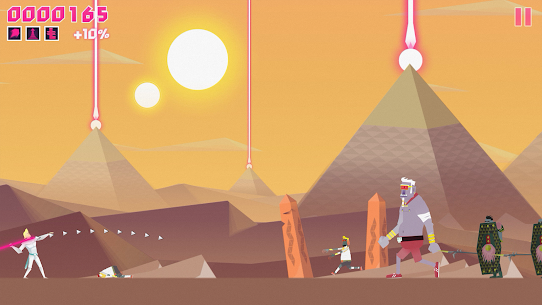
The core of this game is the lightspear throw. Players touch the screen to set an aim angle, and a dotted trajectory arc appears. Releasing the touch fires the spear. The arc accounts for gravity, so longer throws need a higher launch angle. Most of the challenge comes from reading enemy speed and adjusting the arc in real time while new threats appear simultaneously.
The mobile controls use a single-touch system. You hold and drag to aim. The longer you hold, the longer you have to adjust. Fast enemies demand a quick read of their position before release. That rhythm — aim, read, release — is what the game trains from level one.
The ancient Germanic future setting and Lichtgods story
The setting blends ancient Germanic mythology with retro-futurist laser aesthetics. The Lichtgods rule over a world of Techno Pyramids, Wurstland Wildwoods, and interplanetary Disco Expresses. They grow bored and summon a champion — the player — to kill things in increasingly absurd ways. That story never takes itself seriously, and it doesn’t need to.
Each themed zone introduces new enemy types and visual styles. The world feels layered despite the simple premise. Because the game moves so fast, most of the story lives in the visual design rather than cutscenes. Players absorb the lore through what they see charging at them.
How Lichtspeer compares to Drag’n’Boom and Bowmasters on Android
The closest mobile comparisons are Drag’n’Boom and Bowmasters, both available on Android. Drag’n’Boom uses a similar projectile-combat loop but adds movement and aerial dodging. Bowmasters involves direct one-on-one bow duels against AI or real opponents. Lichtspeer differs from both in one critical way: the player never moves. That fixed-position design removes dodging entirely and shifts all the challenge into precision targeting and arc management.
Bowmasters rewards power and wind calculation. Drag’n’Boom rewards spatial awareness and flight paths. Lichtspeer rewards pattern reading and quick aim adjustment under pressure. The Nein penalty mechanic — where three consecutive missed throws freeze the character — has no equivalent in either competitor and creates a uniquely punishing rhythm that defines the game’s difficulty.
How Lichtspeer Controls Work on iOS and Android
New players often struggle with the touch controls in the early levels. The game feels more demanding than typical mobile arcade titles because aim precision matters far more than in swipe-based alternatives. Understanding exactly how each input works saves a lot of early frustration.
The controls break into two distinct systems. The primary system handles spear throwing. The secondary system handles Lichtpowers — the special abilities players unlock as they progress. Both run simultaneously, which is where much of the control tension originates.
Despite what some reviews suggest, the control system becomes natural with practice. Players who put ten or fifteen minutes into the first few levels report a significant improvement in throw accuracy. The key is learning to trust the trajectory arc rather than guessing angles instinctively.
How to aim and release your spear using the touch trajectory line
Touch anywhere on the right side of the screen to begin aiming. A dotted arc appears showing exactly where the spear will travel. Drag your touch point up or down to adjust the angle. Release to fire. The arc updates in real time as you adjust, so players can compensate right up until the moment of release.
Short-range enemies, like slow Wurst Zombies, need a flat arc and a low aim point. Tall enemies or flying targets need a higher launch angle. Because the arc shows the full trajectory, there is no guessing — players simply need to move fast enough before the enemy closes in.
How the Lichtpowers ability system activates during combat
Lichtpowers are special abilities assigned to a separate touch zone on the left side of the screen. Players tap the left zone to trigger the currently selected Lichtpower. Each Lichtpower has a cooldown after use, so timing matters. Activating a bubble shield too early wastes it. Triggering a spear cluster split against a single slow enemy is equally inefficient.
A common mistake for beginners is accidentally tapping the left zone while adjusting aim across wide angles. This fires a Lichtpower unintentionally. The solution is deliberate: keep aim adjustments on the right side of the screen only and reserve left-side taps for intentional ability use.
What happens when you clear all enemies in a level section
Clearing all enemies in a section triggers a brief pause and then advances the level to the next segment. The game saves a checkpoint at this moment, so if the player dies in the next section, they restart from the most recent cleared segment rather than the start of the full level.
This checkpoint system is important to understand because it removes the pressure to play perfectly from the very beginning. Players can treat each section as a short standalone challenge. However, the Rage Quit difficulty mode removes all checkpoints — something only very experienced players should attempt.
How the Enemy Waves and Level Structure Work
Every level in this game is structured as a wave sequence. Enemies advance from the right in a set order, but the speed and number of enemies increases dramatically as players push deeper into the 60+ level roster. Early levels introduce single enemy types. Later levels mix fast runners, flying units, and armoured giants into the same wave simultaneously.
Each level splits into five sections. Clearing one section saves progress and opens the next. The pacing is relentless — there is no rest between individual enemies within a section. Players need to throw continuously, reading each enemy’s distance and type before the previous spear has even landed.
Understanding enemy type priority — which threats to target first — is the most important skill in the game. Getting that order wrong is the primary reason players stall at mid-game levels.
How Wurst Zombies, Penguin Vikings, and Hipster Ice Giants differ
Wurst Zombies are slow and walk in a straight line. They are the training enemy of the early levels. Because they move predictably, they teach players to nail the flat-arc throw at low angles. However, fast Wurst Zombie variants appear later and move at roughly double the base speed, requiring a more urgent response.
Penguin Vikings advance in loose groups and are shorter than most enemies, meaning the aim angle sits lower than players expect. Missing a group of Penguin Vikings in quick succession is a common trigger for the Nein penalty. Hipster Ice Giants, meanwhile, need multiple hits. They are slow but require the player to land two or three spears before the kill registers, which takes precious seconds away from dealing with faster threats nearby.
How flying enemies like Pegahunds change your aim angle strategy
Pegahunds are flying enemies that travel on a diagonal path across the screen. They require a high-angle throw timed to intersect with the enemy’s flight path rather than its current position. This is the single biggest skill jump in the game — shifting from flat-arc throws for ground enemies to predictive arc throws for aerial targets.
Players who struggle with Pegahunds often aim at where the enemy is rather than where it will be when the spear arrives. The solution is to fire slightly ahead of the flight path. A higher launch angle combined with a lead aim point is the correct approach. Most players develop this instinct around level 8 to 10.
How darkness and environmental obstacles affect each level
Certain levels introduce partial darkness, obscuring sections of the screen. This does not change the core mechanic but forces players to track enemy positions using movement cues rather than clear visuals. Audio cues become more useful in these stages. The banger soundtrack drops subtle rhythmic changes during darker segments that experienced players use as timing signals.
Some later levels also introduce obstacles between the player and the enemies, requiring specific arc heights to clear the obstacle while still landing the spear on target. These design elements keep the mechanic fresh across all 60+ levels without adding entirely new control systems.
How Uber Boss Battles Work in Lichtspeer
The six Uber Boss Battles are the defining challenge moments of the game. Each one ends a major themed zone and requires a fundamentally different approach from the standard wave-clearing gameplay. Lichtpowers are completely disabled during boss fights, which removes the safety net players rely on in normal levels.
The absence of Lichtpowers means every boss fight is a pure test of throw accuracy and pattern recognition. Players who have been heavily relying on the bubble shield or the cluster split will feel exposed immediately. Bosses have large health pools. They also attack in patterns — sequences of movements or projectiles that the player must throw through or over to land hits.
Most deaths during boss fights happen in the first few attempts simply because players do not yet know the attack pattern. Each death teaches the sequence. By the third or fourth attempt, the pattern becomes readable. The challenge then shifts from understanding the pattern to executing throws quickly enough within the attack windows.
What makes Uber Boss Battles different from standard waves
Standard waves require continuous throwing at a stream of enemies. Boss battles shift the rhythm entirely. Instead of constant output, bosses demand bursts of precision within narrow attack windows. The boss moves, attacks, and then briefly exposes a vulnerable hitpoint window. Players must land spears during that window before the boss moves again.
Missing the window does not trigger the Nein penalty because the target is live — the spear simply misses. However, each missed window costs time, and some bosses have time-limited phases that restart if the player takes too long. Understanding that boss fights reward patience over speed is the core mindset shift required.
How to read each boss attack window and time your throws
Every boss telegraphs its attack before executing it. There is a brief visual cue — a movement, a charge animation, or a specific pose — immediately before the attack launches. The attack window for a spear hit opens right after this telegraph. Players who react to the telegraph rather than the attack itself will land consistent hits.
The trajectory arc is still available during boss fights. However, because the target is moving, players need to account for the boss’s speed rather than aim directly at the current position. The same predictive aiming principle that applies to Pegahunds in standard levels carries directly into boss encounters.
What completing an Uber Boss Battle unlocks
Finishing an Uber Boss Battle clears that zone and opens the next. Additionally, boss completion awards a substantial LSD payout — the in-game currency used to unlock and upgrade Lichtpowers. This makes boss fights the single most efficient source of upgrade currency in the game. Players who consistently complete bosses can fully upgrade their preferred Lichtpowers several levels ahead of players who skip or fail boss attempts.
Defeating all six bosses also contributes to achievement progress. Some achievements specifically require completing bosses under particular conditions, such as finishing without using specific abilities — though those are strictly for experienced players.
How Progression, Lichtpowers, and Achievements Work
The progression system in this arcade title runs on LSD — Licht Standard Denomination — earned by completing levels and defeating Uber Bosses. LSD funds the upgrade of 10 distinct Lichtpowers, each providing a unique combat ability. Players choose which powers to invest in based on their own play style and the challenge they currently face.
There is no passive levelling or experience point system. Progress is entirely driven by completing levels and spending LSD strategically. Players who spread LSD evenly across all 10 Lichtpowers often find themselves under-powered for the mid-game. Focused investment in two or three core abilities produces significantly better results.
The achievement system adds a secondary layer of long-term goals. Achievements track specific performance metrics across levels — headshot counts, boss completion, gold medal runs, and more. Chasing achievements extends the game’s lifespan well beyond the initial 60+ level clear.
How LSD currency works and when to spend it
LSD drops after every completed level section and scales with performance. Better accuracy and fewer misses produce a higher LSD reward. Players who take extra care in early levels to land clean, accurate throws accumulate significantly more currency by mid-game than those who spam throws carelessly.
The best time to spend LSD is before entering a new themed zone. Each zone introduces harder enemy types and a tougher boss. Spending currency immediately after clearing a zone — while preparing for the next — ensures the relevant Lichtpower upgrades are in place before the difficulty spike arrives. Hoarding LSD and spending it mid-zone typically means players face the hardest sections underpowered.
Which Lichtpowers to upgrade first for survival in early levels
Two Lichtpowers stand out as the highest priority for early upgrading. The bubble shield, which temporarily blocks incoming enemies from reaching the player, extends survival time when waves become overwhelming. The cluster split, which divides one spear throw into six smaller projectiles, clears tight groups of Penguin Vikings and Wurst Zombie clusters in a single activation.
Upgrading both of these to tier two before investing in any other Lichtpower is the most effective early-game approach. Later game powers — including the trance ability — are less effective in the early and mid-game sections. The trance restricts the full throwing angle range, which makes it almost useless against enemies approaching from steep vertical angles.
What achievements exist and how to unlock them
The achievement list in Lichtspeer covers a broad range of performance goals. Headshot achievements require landing throws on an enemy’s head specifically, registering a higher-damage hit. Gold medal achievements require clearing a level section without missing a single throw — the most demanding standard challenge in the game.
Boss-specific achievements track completion of all six Uber Boss Battles under standard conditions. Completing the game on New Game+ — which adds significantly more enemies to every level — unlocks a separate achievement tier. Most achievements are obtainable through natural play, but the gold medal and New Game+ achievements require deliberate replaying of earlier levels with improved skills.
Why the Nein Penalty and Miss Streaks Kill Most Beginners
The Nein penalty is the mechanic that separates Lichtspeer from softer mobile arcade games. Three consecutive missed throws trigger the Lichtgods to shout “NEIN,” and the player character freezes for several seconds. During those seconds, every advancing enemy continues moving forward. In mid-game waves, this almost always results in death.
Most beginners do not even realise the penalty exists until it has already killed them twice. The game never explains it clearly in the tutorial. Players who understand the mechanic from the start play with an entirely different mindset — they prioritise clean shots over fast ones and break throw sequences deliberately to avoid building a miss streak.
This is the single most underserved topic in competing articles about this game. Almost no coverage explains the practical recovery strategy. The section below does.
What triggers the Nein penalty and how it ends runs
Three missed throws in a row — with no successful hit in between — trigger the penalty. The misses do not need to be against the same enemy or within the same second. They simply need to be consecutive. A throw that grazes an enemy but does not register as a hit still counts as a miss.
The penalty freeze lasts roughly three seconds. Against slow enemies in early levels, three seconds is survivable. Against a mixed wave in level 15 or beyond, three seconds means two or three enemies reach the player simultaneously. Recovery from the freeze while also managing an active wave is extremely difficult without prior knowledge of what just happened.
How to break a miss streak before hitting three consecutive misses
The solution is straightforward once understood. After two consecutive misses, stop aiming at the intended target. Instead, aim at any enemy — including the slowest, closest one — and land a clean hit. One successful throw resets the miss counter entirely. The streak is broken and the Nein penalty does not trigger.
This means that after two misses, the correct response is to deliberately switch targets to the highest-probability throw available. A slow Wurst Zombie directly in front is a better target in that moment than a fast flying enemy that needs a precise predictive arc. Reset the counter first. Return to the harder target immediately after.
What hidden timing windows Lichtspeer never explains in the tutorial
Beyond the Nein penalty, the game contains two additional undocumented mechanics. First, there is a brief invulnerability window immediately after a level section checkpoint triggers. Players who know this can use the moment to line up the opening throw of the next section without panic. Second, throwing during an enemy’s stagger animation — when a hit registers on a multi-hit target like a Hipster Ice Giant — produces faster throw recovery than the standard cadence.
Both of these windows are entirely undocumented. Players discover them through repetition. Knowing they exist allows newer players to use them intentionally rather than stumbling onto them accidentally in later runs.
Best Lichtspeer Tips and Tricks for Beginners
Getting the most out of this game early requires understanding three things that are specific to this title’s mechanics. Generic arcade advice does not apply here because the fixed-position design and Nein penalty create conditions that have no equivalent in other mobile action games.
The tips below are drawn directly from the core mechanics covered in the sections above. Each addresses a specific failure point that beginners consistently encounter within the first twenty levels. None of these tips carry over to another game in the genre because they are built around systems unique to this title.
How to angle the spear trajectory line for fast-moving Wurst Zombies versus slow giants
Fast Wurst Zombie variants require a lead aim — the throw point sits ahead of the enemy’s current position by roughly one full body length. The trajectory arc helps players calibrate this if they move the aim point forward and watch where the arc intersects with the enemy’s path rather than the enemy itself.
Hipster Ice Giants, by contrast, move slowly enough that a direct aim works. However, because they need multiple hits, players should aim for the head consistently to maximise damage per throw. Headshot hits register more damage and push Giants through their multi-hit threshold faster. This is especially important in sections where a Giant appears alongside fast-moving Zombie variants at the same time.
How to prioritise LSD spending on the cluster split upgrade before reaching level 6
The cluster split Lichtpower becomes critical at level 6 because that is where Penguin Viking groups first appear in dense formations. A single cluster split throw clears an entire formation instantly. Without it at tier two or higher, players must land three to four individual throws to clear the same formation — creating a window where other enemies advance unchecked.
Spending LSD to bring the cluster split to tier two before entering level 6 changes the difficulty of that level from near-impossible for beginners to manageable. This is the single most impactful LSD investment available in the early game. All other Lichtpower upgrades are secondary until this one is in place.
How to stop triggering accidental Lichtpowers when aiming across extreme angles
Accidental Lichtpower triggers happen when players drag their aim finger from the right side of the screen far enough left to cross the left-zone boundary. The game registers that left-side contact as a Lichtpower tap. This is a touch-screen boundary issue that the tutorial never addresses.
The fix is to keep aim drags within the right half of the screen at all times. For extreme downward angles — targeting low-to-the-ground enemies very close to the player — shorten the drag distance rather than dragging far left. A shorter drag to the lower right achieves the same low angle without crossing into the Lichtpower zone. Players who build this habit early avoid the mid-combat ability waste that frustrates most beginners past level 10.
Frequently Asked Questions About Lichtspeer
Is Lichtspeer available on Android and iOS?
Lichtspeer is available on both Android and iOS as a paid title. The Android version is available through the Google Play Store and the iOS version through the Apple App Store. The game also supports Apple TV for players who own the iOS version. A Double Speer Edition with local co-op is available on Nintendo Switch, PS4, PS Vita, and Xbox One.
How long does it take to finish Lichtspeer?
Completing Lichtspeer takes approximately four to six hours on a first playthrough, based on estimates from both the developer and player reports. That runtime covers all 60+ levels and six Uber Boss Battles on standard difficulty. Players who pursue gold medals on every level section or attempt New Game+ can extend total playtime significantly beyond that initial estimate.
Does Lichtspeer have replayability after completing all 60 levels?
Lichtspeer offers strong replayability through several systems. New Game+ restarts the full level roster with a higher enemy count. Rage Quit mode removes all checkpoints, creating a single-life challenge across the entire game. The gold medal achievement system requires perfect level clears. Combined, these modes make the game a substantially longer experience than the base playthrough alone.
Best Players for Lichtspeer: Who Should Play This Game
Lichtspeer is the right game for players who enjoy fast reflex challenges, absurdist visual design, and arcade systems that reward mastery rather than casual button pressing. The fixed-position format means players who prefer movement-based action or open-world exploration will not find what they are looking for here. However, for players who thrive on tight, repetitive loop mastery, this title delivers one of the most distinctive experiences in mobile arcade gaming.
The difficulty is real. The Nein penalty and the Lichtpowers-disabled boss fights demand patience from beginners. However, the learning curve is honest — deaths in Lichtspeer happen because of identifiable mistakes, not cheap mechanics. Players who stay with it past the first ten levels will find the game’s rhythm clicks in a way that feels genuinely satisfying.
After spending time with this game across all six boss zones, the verdict is direct: Lichtspeer earns its price tag through sheer personality and mechanical depth that most mobile arcade games never attempt. It is best suited for players who want a short-session challenge game with genuine teeth. If that sounds like your kind of mobile experience, the Lichtspeer is waiting.
Images

Download links
ℹ️ Download link not working? Please refresh the page and try again.
Developer's apps





Related apps





What's new
Minor bug fixes.
New Apps
Most Played Mobile Games


