
Idle Army Base MOD APK (Free Shopping)

Description
Idle Army Base flips the traditional war game concept on its head — instead of fighting on the frontlines, you run the entire military operation as a tycoon, automating troop training, unlocking new warfare zones, and sending armies to war while the profits roll in. There is no tapping, no clicking, and no constant screen attention required. This post covers everything you need to know about Idle Army Base gameplay — from core mechanics and zone unlocking to manager hiring, the war system, prestige strategy, and the fastest path to becoming an idle army billionaire.
What Is Idle Army Base — The Army Tycoon Concept Explained
Idle Army Base puts you in the role of an army general with one clear objective — build the most profitable military operation possible. However, this is not a traditional war strategy game. The core loop is tycoon-style: invest cash into zones, train troops, generate income, and reinvest that income into bigger and better operations. The military setting is the backdrop, but the gameplay logic is closer to a business empire builder than a combat game.
Every decision you make is an investment decision. Which zone to unlock next, which manager to hire, how much to upgrade before moving forward — these choices determine how fast your income scales. The army theme gives each decision a distinctive flavor. Upgrading the exercise yard feels different from deploying a tank battalion, even though both are fundamentally income-multiplying investments within the same tycoon framework.
The appeal of this concept is the sense of scale. Starting from a basic training yard and eventually commanding naval fleets, paratroopers, and chemical warfare units creates a genuine feeling of empire-building progression that keeps the investment loop engaging across many play sessions.
How Idle Army Base Differs From Clicker Games
Idle Army Base is deliberately not a clicker or tapper game. The distinction matters because it changes how you interact with it entirely. In a clicker game, consistent tapping drives income. In Idle Army Base, tapping does nothing meaningful — income comes from smart investment and automation rather than screen interaction frequency.
This design philosophy makes the game far more suitable for passive play sessions. You open the app, make a round of investment decisions, set your managers to work, and close it. The base continues generating cash and gold while you are away. Because of this structure, the game rewards strategic thinking over reflexes or screen time.
The no-tap design also means the game scales differently than clickers. Progress is determined by investment quality rather than session length. A player who makes better zone and manager choices will outpace a player who simply spends more time with the app open. This gives Idle Army Base a more genuinely strategic feel than most games in the idle category.
Offline Earnings and No Internet Connection Required
One of Idle Army Base’s most practical features is its offline earnings system. Cash and gold continue accumulating while the app is closed, meaning every time you return to the game there is a backlog of income waiting to be collected and reinvested. The amount earned offline depends on how well-automated your base is — more managers and higher zone upgrades mean more offline income per hour.
The game also runs without an internet connection. This makes it genuinely portable in all conditions — no Wi-Fi, no mobile data, no problem. The offline capability combined with the no-tap design makes Idle Army Base one of the most low-friction idle games available on mobile.
For players who travel frequently or have unreliable connectivity, this combination of features is a significant practical advantage. The game fits into any lifestyle rather than requiring dedicated screen time or a reliable internet connection to remain playable.
How to Play Idle Army Base — Investing in Zones and Troop Training
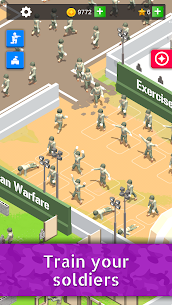
Each zone in Idle Army Base represents a separate income stream. Zones generate cash by training troops in specific military disciplines — from basic exercise yard sit-ups in the early game to naval warfare operations and paratrooper deployments in the late game. Every zone has its own upgrade track, and investing cash into upgrades increases the income that zone generates per cycle.
Troop training within each zone is the primary production activity. Troops cycle through training sequences and generate income at the end of each cycle. Shorter cycle times and higher per-cycle payouts come from zone upgrades. Therefore, concentrating upgrade investment into a small number of high-output zones rather than spreading thin across all unlocked zones is more efficient in the early and mid-game.
Zone synergies also matter. Some zones feed into others thematically and in terms of income multipliers. Understanding which zones in your current lineup produce the most income per upgrade dollar helps you prioritize spending during each play session rather than upgrading everything equally.
Hiring Army Managers to Automate Income
Managers are the automation layer that separates Idle Army Base from a manual resource game. Without managers, each zone requires manual activation to run its training cycle. With a manager assigned, that zone runs continuously without any input from you — day and night, online and offline.
Each manager is tied to a specific zone or function within the base. Hiring the right manager for your highest-income zones first creates the biggest automation impact. A top-producing zone running manually while a low-producing zone has a manager assigned is a common early-game mistake that significantly slows income growth.
Manager upgrades further increase the efficiency of automated zones. Investing in manager upgrades after the initial hire compounds the automation benefit over time. Because managers are what enable offline earnings to scale, treating manager investment as a top priority alongside zone upgrades is the most effective overall approach to the game’s economy.
Cash, Gold, and Profit — How the Economy Works
Idle Army Base uses two primary currencies — cash and gold. Cash is the main operational currency generated by zone training cycles and used for zone upgrades, manager hires, and general base expansion. Gold is the premium currency, earned through specific achievements, war victories, and prestige milestones, and used for high-value upgrades and accelerations.
Profit — the net income rate after accounting for all active zone outputs — is the key metric to track. Increasing profit rate is more valuable than accumulating a large cash balance, because a higher profit rate compounds faster over time. Every upgrade decision should be evaluated in terms of its impact on ongoing profit rate rather than its immediate cash cost.
Balancing cash spending between zone upgrades and manager hires is the central economic tension in the early and mid-game. Spending everything on zone upgrades without hiring managers leaves income dependent on manual activation. Spending everything on managers without upgrading zones creates fully automated but low-output income streams. The optimal balance shifts as the game progresses, so revisiting the allocation strategy regularly produces better results than setting a fixed spending ratio early and sticking with it.
All Zones in Idle Army Base — Full Unlock Order
Early Zones — Exercise Yard, Urban Warfare, and Jungle Warfare
The Exercise Yard is the starting zone and the foundation of the entire base operation. Troops do basic physical training here, and the income per cycle is modest but consistent. Upgrading the Exercise Yard early and assigning a manager to it as soon as possible establishes the automated income base that funds all subsequent zone unlocks.
Urban Warfare is the second major zone and introduces a more complex training scenario. The SWAT-style operations in this zone generate noticeably higher income than the Exercise Yard, making it the priority upgrade target once unlocked. Getting a manager assigned to Urban Warfare quickly converts it into a reliable passive income stream that accelerates mid-game progression significantly.
Jungle Warfare opens the adventure element of the zone lineup. The jungle environment introduces the capitalist copter mechanic — a transport asset that adds an income multiplier on top of base zone output. Because of this multiplier, Jungle Warfare tends to punch above its unlock cost in terms of income return. Prioritizing its upgrade track after Urban Warfare is stabilized is a strong early-game sequence.
Mid Game Zones — Arctic Warfare, Heavy Machine Gun, and Heavy Artillery
Arctic Warfare introduces stealth mechanics into the training loop. Snow stealth operations generate income at a different cycle rhythm than earlier zones, producing larger but less frequent payouts. This changes the upgrade priority logic — increasing the payout size per cycle is more valuable than cycle speed for Arctic Warfare compared to earlier zones.
The Heavy Machine Gun zone shifts the tone significantly. The rapid-fire training cycle produces consistent mid-sized payouts with high upgrade scalability. Because the Heavy Machine Gun zone responds well to incremental upgrades — each upgrade tier producing a meaningful income jump — it tends to become one of the highest-profit zones in the mid-game lineup if upgraded consistently.
Heavy Artillery is the big-investment zone of the mid-game. Unlock costs and upgrade costs are higher than earlier zones, but the income ceiling is correspondingly much higher. Unlocking Heavy Artillery without sufficient cash reserves to start upgrading it immediately is a common mid-game mistake. Arrive at the Heavy Artillery unlock with enough cash banked to push it through the first several upgrade tiers right away.
Late Game Zones — Tanks, Desert Warfare, Naval Warfare, and Beyond
Tanks represent a major income tier jump in the late game. The prestige associated with tank operations in the game’s narrative reflects their economic weight — tank zone upgrades produce some of the largest per-upgrade income increases in the entire unlock sequence. Reaching the Tank zone with a strong manager and upgrade infrastructure in place makes the late-game income scaling feel dramatically faster.
Desert Warfare introduces a racing dynamic to the training loop — desert course operations cycle quickly and reward consistent upgrade investment with fast-compounding income growth. Naval Warfare is the highest-cost unlock in the standard zone sequence and represents the tycoon peak of the base-building arc. Affording a naval operation requires substantial cash reserves and a fully automated lower zone lineup generating strong passive income.
Beyond Naval Warfare, the Chemical Warfare, Explosive Training, Paratrooper, and Obstacle Course zones extend the progression further. Each adds new income streams and unique training mechanics. The Paratrooper zone’s free-fall-to-target mechanic produces income in a burst-style pattern rather than a continuous cycle, which changes the optimal upgrade approach compared to earlier zones.
How to Win Wars in Idle Army Base
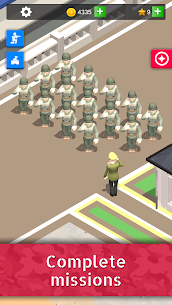
The war system in Idle Army Base is the active conquest layer sitting on top of the passive base management loop. Rather than defending your base from attackers, you send your trained troops out to conquer enemy territories and return with cash and gold profits. War outcomes depend on how well-trained and well-equipped your troops are at the time of deployment.
War missions become available as your base reaches specific development milestones. Each war mission targets a different enemy force and offers a different reward profile. Some missions prioritize cash returns. Others yield gold or unlock progression bonuses that affect the base economy. Choosing which war missions to pursue based on your current currency priorities is part of the strategic layer the war system adds to the overall game.
Troops deployed to war are drawn from the training output of your active zones. Because of this, maintaining high zone output is directly connected to war performance. A well-upgraded, fully automated base sends better-trained troops to war and earns larger returns from each mission.
Sending Troops to Conquer and Earn Big Profits
Conquering enemy territories in Idle Army Base produces profit multipliers that stack on top of your base income rate. Each conquered territory adds a permanent income bonus to the overall economy. Because of this, completing war missions as consistently as possible — rather than saving troops or waiting for optimal conditions — produces better long-term income growth.
The troop deployment process does not reduce your base’s operational capacity. Training continues in all active zones regardless of how many troops are currently deployed to war missions. Therefore, there is no economic downside to sending troops out aggressively. The only limiting factor is the cooldown between war mission deployments, which decreases as base upgrades progress.
Gold earned from war missions is particularly valuable because it funds manager upgrades and premium zone expansions that cash income cannot always cover quickly. Prioritizing war missions that yield gold during the mid-game — when manager upgrade costs start scaling significantly — accelerates overall progression more than equivalent cash-yielding missions.
Best Strategy for Maximizing War Income
The most effective war income strategy combines consistent mission deployment with targeted zone upgrades that increase troop quality. Upgrading the zones whose troop output directly feeds into available war missions produces a compounding effect — better troops earn more from each mission, which funds further zone upgrades, which improves the next mission’s output.
Timing war mission deployments around offline sessions is another high-value tactic. Deploying troops just before closing the app means the mission completes during the offline period and rewards are waiting when you return. This stacks war profits on top of offline base income for maximum return per real-world hour.
Additionally, unlocking later warfare zones — particularly Jungle Warfare, Arctic Warfare, and Naval Warfare — opens access to higher-tier war missions with significantly larger reward pools. Prioritizing zone unlocks that open new war mission tiers is therefore as valuable as pure income upgrade investment during the mid and late game.
Which Zones to Unlock First for Maximum Early Income
The highest-priority early sequence is Exercise Yard automation followed by Urban Warfare unlock and manager assignment. These two zones, running automatically, generate enough passive income to fund the Jungle Warfare unlock without requiring constant manual activation. Reaching this three-zone automated state as quickly as possible establishes the income foundation for all subsequent progression.
Resist the temptation to unlock new zones before the current ones are sufficiently upgraded. An unlocked zone with no upgrades and no manager generates negligible income while consuming the cash that could have meaningfully upgraded an existing high-performing zone. Each new unlock should come with a cash reserve earmarked for immediate upgrades — otherwise the unlock does more harm than good to overall income rate.
The Exercise Yard, despite being the starting zone with the lowest income ceiling, rewards early upgrade investment disproportionately because it funds the entire early unlock sequence. Treating it as throwaway content and ignoring its upgrade track is a mistake that slows the pace of reaching Urban Warfare and Jungle Warfare to a meaningful performance level.
When to Hire Managers and Which Ones to Prioritize
Hire managers for your highest-income zones first, without exception. The automation benefit scales directly with zone output — a manager running a high-income zone earns far more per real-world hour than the same manager running a low-income zone. Assigning managers to low-output zones first because they are cheaper is a false economy that costs significant long-term income.
The optimal timing for manager hires is immediately after a zone reaches a meaningful upgrade tier — typically after the third or fourth upgrade level, when per-cycle income is high enough to make automation genuinely impactful. Hiring a manager for a zone with minimal upgrades automates a trivially small income stream. Waiting until the zone is performing well before automating it produces a much larger return on the manager hire cost.
After each manager is hired, prioritize their upgrade track before hiring the next manager. An upgraded manager on a strong zone outperforms two unupgraded managers on weaker zones in most income scenarios.
Balancing Upgrades Between Troops and Zones
Upgrade investment in Idle Army Base splits between zone-level upgrades — which increase per-cycle output — and manager upgrades — which increase automation efficiency. Balancing between these two tracks is the core strategic challenge of the mid-game.
The general principle is that zone upgrades should lead manager upgrades by a meaningful margin. Upgrading zones creates the income that makes manager upgrades affordable. Letting manager upgrades outpace zone upgrades creates a fully automated but low-ceiling economy that stalls mid-game progression.
However, completely ignoring manager upgrades in favor of zone upgrades creates a different problem — offline earnings stagnate because offline income scales with manager efficiency. Checking in on manager upgrade costs periodically and making one or two manager upgrades per session alongside the primary zone upgrade focus keeps both tracks progressing at a healthy ratio.
The Prestige System in Idle Army Base
What Prestige Does and When to Use It
Prestige in Idle Army Base resets your base progress in exchange for permanent multipliers that make all subsequent playthroughs faster and more profitable. The reset is significant — zone upgrades, cash balances, and some manager progress return to starting values. However, the prestige multipliers stack across multiple prestige cycles, creating compounding long-term growth that eventually makes the early game trivially fast to complete.
The right time to prestige is when your income growth rate has slowed significantly and new zone upgrades are producing diminishing returns relative to their cost. This plateau signals that the current playthrough has reached its practical ceiling and a prestige reset would unlock faster progression than continued investment in the current state.
Prestiging too early — before reaching that plateau — wastes the potential of the current playthrough and reduces the multiplier earned from the prestige action. Each prestige event should feel like a meaningful step up rather than a minor reset. Patience before each prestige produces larger multipliers and faster subsequent progression.
How to Maximize Profits Before Prestiging
Before triggering a prestige reset, squeeze maximum value from the current playthrough by completing any available war missions, collecting all pending offline earnings, and pushing zone upgrades as far as the current cash balance allows. These final investments do not carry over through prestige, but they contribute to the prestige multiplier calculation.
Additionally, ensuring all managers are fully hired and at their current maximum upgrade tier before prestiging gives the largest possible multiplier. Manager state at the time of prestige is one of the key inputs into the multiplier formula. A fully managed, well-upgraded base at prestige produces a meaningfully larger multiplier than a partially managed one.
Gold should also be spent before prestiging rather than carried over as a reserve. Gold-funded upgrades that are active at prestige time contribute to the multiplier in the same way as cash-funded upgrades. Holding gold in reserve through a prestige reset sacrifices multiplier value for no benefit.
Expanding the Idle Army Empire After Prestige
The first playthrough after a prestige reset moves significantly faster than the original. Prestige multipliers compress the early zone unlock sequence — income from the starting zones is higher from turn one, manager costs feel more affordable sooner, and the mid-game zones unlock in a fraction of the original time.
Use this accelerated early phase to push further into the zone unlock sequence than you reached in the previous playthrough. Each prestige cycle should advance the high-water mark of zone progression. Reaching Naval Warfare or the late-game zones for the first time in a post-prestige playthrough unlocks new war mission tiers and income streams that were not accessible before.
Multiple prestige cycles create exponential income growth. Players who prestige consistently and strategically — rather than avoiding the reset out of attachment to current progress — build armies and empires on a scale that single-playthrough players never reach.
Common Mistakes New Players Make in Idle Army Base
Unlocking Zones Too Fast Without Upgrading First
The most damaging early-game mistake is spending all available cash on zone unlocks without investing in upgrades for existing zones. New zones are visually exciting and feel like progress — but an unupgraded, unmanaged zone contributes almost nothing to overall income rate. Meanwhile, the cash spent unlocking it could have pushed an existing zone several upgrade tiers higher and meaningfully increased passive income.
The result of this mistake compounds quickly. A player with six unlocked but poorly upgraded zones earns less than a player with three well-upgraded, fully managed zones. The unlock count looks impressive but the income rate tells the real story. Therefore, treating upgrade investment as the primary spending priority — with zone unlocks funded only from surplus cash above a maintained upgrade reserve — produces far better income growth.
A practical rule for early game spending is to never unlock a new zone unless the previous zone has a manager assigned and at least five upgrade tiers completed. This threshold ensures each new zone enters the lineup as a meaningful contributor rather than a cash drain.
Ignoring Managers and Losing Idle Income Potential
Players who delay manager hires significantly cap their idle income potential. Every hour the game runs without a manager on a high-output zone is an hour of manually-activated or completely inactive income. Over a typical play session, this represents a substantial missed income accumulation — particularly for offline periods where manual activation is impossible.
The psychological trap is the visible cash cost of manager hires. In the early game, a manager hire can feel like a major expense that delays zone upgrades. However, the math consistently favors the manager hire — the automation benefit recovers the hire cost within a short number of cycles and then generates pure profit indefinitely.
Resisting the temptation to treat managers as optional or late-game features and instead treating them as core infrastructure investments from the earliest opportunity is one of the highest-leverage mindset shifts available to new players.
Waiting Too Long to Prestige
The opposite of early prestige mistakes is waiting far too long to prestige. Some players avoid the reset entirely because returning to the starting zone feels like losing progress. This perspective misunderstands how the prestige system works — the multipliers earned from a well-timed prestige produce more total income in three post-prestige sessions than weeks of additional upgrades in a stalled pre-prestige state.
Recognizing the income plateau — when cash accumulation slows, upgrade costs feel disproportionate to their output gains, and war missions no longer produce exciting reward jumps — is the skill that separates efficient progressors from players who stall indefinitely in a single playthrough.
After the first prestige, subsequent prestige decisions become easier to time because the pattern is familiar. Each cycle reinforces the value of the reset and makes the long-term empire-building arc feel genuinely rewarding rather than repetitive.
Frequently Asked Questions About Idle Army Base
Does Idle Army Base require an internet connection?
No. Idle Army Base runs fully offline without any internet connection required. You can play, earn income, and progress through zone unlocks entirely without Wi-Fi or mobile data at any point.
Can you earn cash and gold while offline in Idle Army Base?
Yes. Cash and gold continue accumulating while the app is closed, provided managers are assigned to active zones. The amount earned offline scales directly with how upgraded and automated your base is at the time you close the app.
What is the best way to become a billionaire in Idle Army Base?
The fastest path to billionaire status combines consistent zone upgrading, early manager hiring, regular war mission deployment, and strategic prestige cycling. Each prestige multiplies the income rate of all subsequent playthroughs, compounding toward the billionaire milestone significantly faster than a single-playthrough approach.
Final Verdict on Idle Army Base
Idle Army Base delivers exactly what it promises — a military tycoon experience that rewards smart investment decisions over constant screen interaction. The zone progression from basic exercise drills to naval warfare and paratrooper operations creates a satisfying long-term arc. The manager automation system, offline earnings, and prestige mechanics give the game genuine strategic depth beneath its accessible idle surface.
Players who enjoy tycoon-style empire building with a military twist will find Idle Army Base consistently rewarding across many play sessions. The no-tap design makes it one of the most genuinely passive idle games available, while the investment and prestige strategy layers give engaged players meaningful decisions to make every time they open the app. It is a well-constructed idle tycoon that earns its place on any mobile strategy fan’s device.
Images



Download links
ℹ️ Download link not working? Please refresh the page and try again.
Related apps




What's new
3.6.0
Minor fixes
Enhanced data security
New Apps
-
 Ultimate Boxing Champion MOD APK (Free Shopping)1.6.1
 -
Raft Survival – Ocean Nomad MOD APK (Free Shopping)2.9.4
-
Ferryman from Hades Roguelike MOD APK (Free Shopping)1.19
-
Age of Clicks: Grand Strategy APK (Unlocked FULL GAME)0.70
-
Good Coffee, Great Coffee Mobile MOD APK (Unlimited Money, Gems)1.0.10
-
Most Played Mobile Games


