
D’Arak’Or – Medieval Fantasy MOD APK (Free Shopping)

Description
D’Arak’Or hands you one noble family, a patch of contested land and a simulation engine that remembers every promise you break. New rulers who keep losing provinces by their third generation get the loyalty rules, the gold order and the succession fixes here. The single biggest early gain comes from trade caravans and advisor missions, not from a bigger army, because campaign strength depends on which lords agree to march with you.
How to Play D’Arak’Or: Grand Strategy Basics
D’Arak’Or is a free-to-play grand strategy simulation in which you rule a single noble family on a fantasy map. Each turn you claim territory, collect gold, arrange a marriage, train troops or send an advisor, and the simulation answers back.
Aerilys built the game on the same engine that powers Clovis, and Studio Zero Games publishes it from Montreal. There are no energy timers. There is no wall that stops your session after five turns, which is rare for a mobile title in this genre.
The store lists it under Simulation, and roughly 5,000 players have installed it so far. Its rating sits at 4.3 stars across 163 reviews, so the audience is small but engaged. However, size is not the point here. The point is that a one-person team is shipping deep kingdom management on a phone.
What the turn-based simulation engine actually does
Every turn, the engine resolves hundreds of small checks at once. It scores your gold, your armies, your laws, your technologies and the private opinion of every named character on the map. Because those layers feed each other, a bad marriage can shrink your war strength two generations later.
Most actions cost either gold or a turn of someone’s attention. For example, an advisor sent on a mission cannot also sit in your council that turn. Choosing what not to do matters as much as choosing what to do.
The gritty setting and the lands of Lurion
The world of D’Arak’Or is dark fantasy rather than clean high fantasy. Ruined holdings, hungry rivals and blunt succession politics set the tone. Magic exists at the edges of the map, in the elven lands of Lurion and in the Dragon Den, but it never turns the game into a spell-slinging RPG.
Your family starts with almost nothing. First you secure income, then land, then a name people respect. That arc, from minor house to feared dynasty, is the story the simulation RPG tells instead of a scripted plot.
How it compares to Age of Dynasties and Knights of Ages
Age of Dynasties: Medieval Sim is the closest mobile comparison for most players. It runs on shorter event cycles and a lighter council system, so a session ends faster. By contrast, D’Arak’Or models loyalty, religion, laws and trade at the same time, and a single turn can take several minutes of real thought.
Knights of Ages: Turn-based SRPG leans toward tactical battles on a grid. Clovis, from the same developer, offers the historical version of this engine without dragons or elves. So the choice comes down to depth: pick Age of Dynasties for quick reigns, and pick this one for a simulation that argues back.
Gameplay Mechanics, Gold, and Kingdom Controls
Gold is the primary currency in D’Arak’Or, and it pays for armies, mercenaries, buildings, bribes and technology research. Income arrives every turn from your provinces, and three optional systems raise it further: trade caravans, advisor missions and naval expeditions.
Most new rulers under-build this side of the game. They spend early gold on troops, watch income stall, then borrow trouble from neighbours they cannot afford to fight. Kingdom management here rewards patience first.
The controls stay simple on a phone screen. You tap a province to see its holdings, tap a character to see traits and opinion, and confirm actions from a council panel. Character search filters help once your court grows past a dozen names.
Running the gold economy with trade caravans
Trade caravans are the steadiest income upgrade available early. You organise a caravan, assign it a route, and it returns gold on a regular cycle without any battle risk. Because the return compounds, a caravan started in year two funds a war in year six.
Naval expeditions pay far more per trip. However, the seas carry real danger, and a lost expedition costs both the investment and the turn. In my runs, one caravan network plus one careful expedition per few years kept the treasury positive through two wars.
Sending advisor missions across the map
Advisors do more than sit at your council table. You can send them out on missions to improve relations, gather leverage or push a plot forward. Each mission occupies that advisor for a stretch of turns, so the cost is real.
The best use is preventative. Send an advisor toward the lord who dislikes you most, before a war makes his opinion expensive. Missions also pair well with tournaments, since both raise your standing with the same set of characters.
War campaigns, duels and naval expeditions
War campaigns work as planned operations rather than single clicks. You commit forces, pick a target, and the battle resolves across more than one round of fighting. Mercenaries can plug a gap, but they drain gold fast.
War duels add a personal layer, where a single fight between leaders can swing morale. Meanwhile, joining your overlord’s war is sometimes smarter than starting your own. It earns favour, costs less, and keeps your borders quiet while someone else absorbs the losses.
How to Unlock the Dragon Den and Raise Dragons
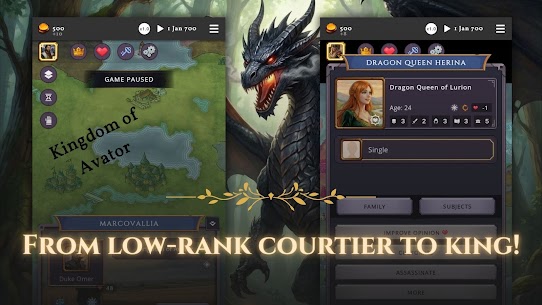
The Dragon Den is the feature in D’Arak’Or where a ruler raises a personal dragon rather than recruiting one. You reach it through the fantasy layer of the world, invest in the site, and then grow the creature over many turns until it matures.
Dragons are not a shortcut to victory. Instead, they act as a long-term prestige and power project, similar in shape to researching a rare technology. Rivals notice.
Queen Varana anchors this side of the game in her own scenario, and dragon content sits alongside the elven material rather than replacing it. Players who arrived from Clovis usually try this first, since it is the clearest break from the historical version.
Getting to the Dragon Den
First, make sure your save uses the fantasy setting, because the high fantasy features arrived with the fantasy update and shape which sites appear. Next, stabilise income, since the Den asks for investment you cannot spare while at war. Then commit.
Rushing the Den at year one is the classic error. A dragon raised in a bankrupt kingdom simply sits there while your lords drift away. Build the treasury, then build the Den.
Raising your first dragon
Raising a dragon runs on turns, not on cash alone. The creature grows in stages, and each stage widens what it can do for your reign. Because growth is slow, the players who benefit most are the ones who start the project during peacetime.
Treat the young dragon as an asset under construction. Do not plan a campaign around it in the same decade you start it. In my experience, the payoff lands late, and it lands hardest against neighbours who never invested in anything similar.
Playing the Dragon Queen scenario as Queen Varana
The Dragon Queen scenario puts you in the role of Queen Varana from turn one. It is the fastest way to see the dragon systems without a long build-up, which makes it a good testing ground. Nothing about it is a tutorial, though.
Varana’s start also reframes the politics. Ruling as a queen changes which marriage options matter and how rivals frame their claims. For that reason alone, the scenario is worth one run even for players who prefer a custom dynasty.
All About the Elves of Lurion and Queen Eariel
The Elves of Lurion are a fantasy faction ruled by Queen Eariel, added to the lands of D’Arak’Or in the fantasy setting. They function as a distinct power on the map, with their own diplomacy, their own portraits and their own place in the world’s balance.
Elves change your neighbourhood, not the rules. You still manage gold, loyalty and heirs the same way. What shifts is who sits across the negotiating table, and what a border with Lurion is worth.
The optional Mysteries of the Elves content adds more than 30 Elf portraits for players who want the faction to feel visually distinct. Legends such as the Vampire Queen Erika sit in the same fantasy tier, arriving through updates rather than through the base setting.
What the Elves of Lurion setting changes
Choosing the setting with Lurion active adds a faction that does not behave like a human kingdom. Eariel’s court holds together differently, and alliances with elves carry different weight in your standing. As a result, a border you would fight a human duke over may be worth trading with an elven queen instead.
Players who prefer a grounded medieval world can leave the fantasy layer alone. The core kingdom management runs identically either way. That flexibility is one of the quieter strengths of the design.
Legends such as the Vampire Queen Erika
Legends are named, unusually powerful characters who enter the world through updates. The Vampire Queen Erika is the most recent addition to that group. She is not a boss fight, and there is no health bar to grind down.
Instead, legends act as pressure. Their presence reshapes local politics, and dealing with one usually means diplomacy, plots or a very well-prepared campaign. For example, a legend on your border makes lord loyalty matter more, not less.
Portraits and the fantasy layer
Portraits carry more weight here than in most strategy sims, because you spend real time reading faces in your court. The elven portrait set exists specifically so Lurion characters do not look like relabelled humans. Over 30 of them ship in that optional content.
The base game still includes a full portrait set, so nobody plays a faceless court. Paid portraits are cosmetic depth rather than a gate. Nothing in the fantasy layer is locked behind them.
How Romance, Marriage and Heirs Shape Your Dynasty
Marriage in D’Arak’Or is a strategic instrument, because your spouse brings traits, alliances and a claim on the future of your house. An heir secures the throne, and a missing heir hands your progress to the simulation instead of your family.
Courtship runs through a matchmaking layer where you weigh affection against advantage. Some rulers marry for a powerful ally. Others marry for a strong bloodline, then spend two decades regretting the politics.
Children grow into adults with traits of their own, and those traits carry into their reign. Because succession is the real progression clock, dynasty building deserves attention long before your first serious war.
Courting a spouse and strategic matchmaking
Look at the candidate’s family first and their portrait second. A spouse tied to a strong neighbour can turn a hostile border into a quiet one for a generation. However, a match that offends a rival house creates a new enemy the same turn.
The optional Romance content deepens this side for players who want it. Even without it, the base matchmaking gives you enough levers. Marry deliberately, not opportunistically.
Raising children and naming an heir
Children arrive with traits that you can influence but never fully control. Watch them, and pick the heir who fits the kingdom you are actually building, not the one you imagined at the start. A brilliant diplomat inherits a peaceful realm badly if every neighbour smells weakness.
Plan a spare heir too. Illness, war and plots all remove characters without warning. One line of succession is a gamble that the simulation eventually punishes.
Rivals, plots and tournaments
Plots let ambitious characters move against you quietly, and they also let you move first. Tournaments do the opposite work, raising standing in public and pulling wavering lords back toward you. Both systems received fixes in a recent update.
Rivals are persistent. They remember slights, and they gather allies while you focus on the map. Therefore, spending a turn on a tournament is often cheaper than spending five turns putting down a revolt.
How Technologies, Titles and Tributaries Progress
Technology research in D’Arak’Or unlocks permanent capabilities, and the Fortress of Solitude technology is the one that grants a personal castle. Research runs alongside your economy rather than in a separate menu-driven track, so progress depends on a stable treasury.
Titles and territory form the second progression axis. Smaller kingdoms will sometimes ask to become your tributaries, which grows your influence without a single battle. That path is easy to miss if you treat conquest as the only way up.
Difficulty settings and starting options shape the whole run. You can begin with pre-made dynasties in the world, or start from nothing with a Zero to Hero run. Both change the pace of the first fifty turns considerably.
Researching technologies such as Fortress of Solitude
Technologies compound, so early research beats late research every time. Fortress of Solitude is the standout, because a personal castle changes both defence and prestige. Get income stable, then commit to a research order and stick to it.
Chasing every branch at once slows everything down. Pick the two lines that match your plan, whether that is trade, war or holding ground. The engine rewards focus.
Tributaries, vassals and independent kingdoms
Tributary requests are free power. When a smaller kingdom asks for your protection, you gain reach without the cost of a campaign or the resentment a conquest creates. Accepting is usually correct in the early game.
Independent kingdoms behave differently from tributaries and vassals under your crown. They negotiate as equals, and they will test you. For that reason, keeping a visible standing army matters even during long peaceful stretches.
Zero to Hero and difficulty settings
Zero to Hero starts you at the bottom with nothing inherited. It is the purest version of the game’s core promise, and it is also the harshest opening. New rulers often bounce off it and blame the game.
Easy difficulty was softened in an earlier update, and it remains the sensible first run. Play one relaxed dynasty to see how loyalty, gold and succession interact. Then restart on a harder setting with a plan.
What God Mode and the Excalibur Subscription add
Optional content sits outside the core loop, which keeps the free version complete. God Mode is the largest of the five optional purchases at 5.99 EUR, and it can prevent all wars and revolts or raise relations with an entire kingdom at once. Effectively, it is a sandbox switch for players who want to build without pressure.
The Excalibur Subscription and the Character Booster sit at 1.99 EUR each, with the Romance content at 3.99 EUR. None of them gates the map, the Dragon Den or the elven lands. The store listing is explicit that there are no timers and no gatekeeping purchases, and in practice that holds up.
Common Mistakes That Cost New Rulers Territory
Campaign strength in D’Arak’Or depends on which lords agree to march, so an army that looks strong on the roster can arrive at half size. The developer confirmed this directly when a player reported that attacks felt far harder than defences: the missing factor was loyalty, not troop counts.
That single insight fixes the most common complaint about the war system. Before any offensive, read the room. Check who resents you and fix it with an advisor, a tournament or a title.
Two other errors show up constantly in player reports. Rulers open too many fronts, and rulers ignore the faith layer entirely until a revolt teaches them otherwise.
Ignoring lord loyalty before a campaign
Loyalty is the hidden multiplier on every war you start. Unhappy lords hold their levies back, so your paper strength never reaches the field. Because the interface shows the roster rather than the willing, the shortfall only appears at the battle screen.
Fix it in advance. Send an advisor mission toward the worst offender, grant something that costs you little, or let a tournament do the public work. Then declare.
Overextending wars on every border
Grabbing three provinces in three directions feels efficient. It is not. Each front pulls troops, gold and attention away from the others, and one revolt at home can undo the whole decade.
Take one direction per generation. Consolidate, marry into the neighbourhood you just bruised, and let the treasury recover. Slow conquest holds; fast conquest unravels.
Treating religion and the All Mother as optional
Religion feeds loyalty, laws and the mood of your court. Players report that the All Mother is currently the only order available to join, which is worth knowing before you build a whole run around a faith strategy. In an actively developing title, that ceiling is real today and may lift later.
So treat faith as a stabiliser rather than a strategy. Use it to hold your realm together while you build gold and heirs. Do not expect a deep religious branch yet.
Best D’Arak’Or Tips and Tricks for Beginners
The fastest reliable opening in D’Arak’Or is caravan income first, advisor missions second, war third. Trade caravans compound without risk, advisors convert turns into loyalty, and a war fought after both is a war you can actually finish.
Beginners lose their first two dynasties to the same three problems: an empty treasury, an offended court and a missing heir. Each has a cheap fix available in the first twenty turns.
None of these tips need optional purchases. They work on Easy, on Zero to Hero and in the Dragon Queen scenario alike.
Build caravan income before your first war
Set up your trade caravans before you raise a single extra unit. The gold arrives whether you are at war or at peace, and it funds mercenaries when a campaign turns bad. A war financed by caravans survives a lost battle.
Add a naval expedition once the treasury holds a comfortable buffer. The seas pay well, yet they punish desperation. Never send one with your last reserve.
Keep advisors on missions every single turn
An idle advisor is a wasted turn. Rotate them constantly toward the relationships that will decide your next campaign, and toward the plots you would rather uncover early. Small, steady pressure beats one dramatic intervention.
Pair missions with tournaments for compounding effect. One improves private opinion, the other improves public standing. Together, they move lords who ignore either alone.
Marry early so the throne always has an heir
Delaying marriage is the quiet dynasty killer. Without heirs, a sudden death ends a run that took hours to build, and no amount of gold reverses it. Marry as soon as a reasonable match appears.
Then keep the line wide. Raise more than one viable child, watch their traits as they mature, and name your successor before a crisis forces the choice. Succession planning is dynasty building in its most literal form.
Frequently Asked Questions About D’Arak’Or
Is D’Arak’Or free to play on Android and iPhone?
Yes. D’Arak’Or is a free download on Google Play and the App Store, with five optional purchases available. The iOS build is around 272.5 MB and needs iOS 15.0 or later, while the Android release carries a 7+ content rating with implied violence and in-game purchases listed.
How long does one playthrough take?
Expect roughly 20 to 30 hours of turns to reach clear dominance on default difficulty, spread across many short sessions. Turns take a few minutes each, so it suits ten-minute bus rides better than one long sitting. A Zero to Hero start stretches that timeline noticeably.
Does the game still get regular updates?
Yes, and the pace has been quick: roughly one or two feature updates per month since launch, adding systems such as naval expeditions and new legends. The developer answers store reviews personally and takes feedback through Discord. Occasional crash reports appear, so save often during long sessions.
Who Should Rule the Lands and Why It Works
This one suits patient players who enjoy reading a court, planning three generations ahead and accepting that a bad marriage costs more than a lost battle. Anyone who wants fast conquests with instant payoffs should choose a lighter medieval title instead. I spent my first dynasty losing provinces I did not understand I was losing, and the moment loyalty clicked, the whole design opened up and became genuinely hard to put down. For a free game built largely by one developer, the depth on offer is unusual. Install it, play one relaxed run, then start again with a plan.
Images




Download links
ℹ️ Download link not working? Please refresh the page and try again.
Developer's apps

Related apps





What's new
-Your dragon can now join your army and fight by your side in battle!
-Build your Spy Network: hire spies, send them on covert missions, and beware of traitors!
-Customize your characters with the new AI Portrait Editor!
-Vaelith the Ember Herald and Erzek'Ar the Emberlord join the roster of legends you can summon!
-Countless improvements to romance, matchmaking, Promenade, events, wars and more!
New Apps
Most Played Mobile Games


