
City Island: Collections MOD APK (Free Shopping)
May 6, 2026
195 MB
1.7.0
6.0

Description
City Island Collections brings together buildings from all five City Island games and lets players merge them through rarity tiers that reach all the way to mythic. This post targets beginners and returning City Island fans who want a clear picture of how everything connects. Topics covered include the merge system, rarity tiers, pack opening, island unlocks, and starting strategies.
What Is City Island Collections and How Does It Work
City Island Collections is a mobile city builder developed and published by Sparkling Society. It combines two systems that most city builders keep separate — the construction of a city and the collection of building cards through a merge mechanic. Players build, collect, and merge simultaneously in every session.
The game draws directly from the City Island franchise. Buildings from City Island 1 through City Island 5 all appear here as collectible cards. However, this title adds the merge layer on top. So players are not just building a city. They are assembling a living archive of the entire franchise.
How the merge mechanic drives every decision in the game
Every building in this game exists as a card with a rarity tier. Players place cards on their city grid and merge matching cards to upgrade them to higher tiers. This single loop — place, match, merge — shapes everything players do from the first session onward.
The merge mechanic creates a constant feedback cycle. Players receive cards through packs, challenges, and trades. Then they place those cards and look for merge opportunities. As a result, the city grows not just in size but in quality as buildings upgrade in visual detail and power with each successful merge.
How City Island Collections fits into the broader franchise
Sparkling Society designed this game as a celebration of the full City Island series. Players who spent time with City Island 3 or City Island 5 will recognise many of the buildings that appear as collectible cards. This nostalgic element gives the game a different feel compared to a standalone city builder with original content.
The game functions as a standalone experience as well. New players without any history with the franchise can engage with the collection system without prior knowledge. However, franchise fans get an additional layer of recognition that adds meaning to every card they pull from a pack.
How City Island Collections compares to earlier franchise titles
Earlier City Island games focused on construction and expansion without a card-based merge layer. City Island 6, for example, uses a traditional build-and-upgrade format where players spend currency to improve structures directly. This title replaces that format entirely with the card-and-merge system.
By contrast, City Island Collections treats buildings as collectibles with rarity values rather than simple upgrades. This creates a different type of player goal. Instead of saving currency to buy the next building tier, players chase card drops and merge opportunities. The experience is more unpredictable and more collection-focused than any previous entry in the franchise.
How the Merge Mechanic Works in City Island Collections
The merge system is the engine that powers the entire game. Two matching cards of the same rarity placed next to each other on the city grid produce one card of the next tier up. This process continues all the way from the lowest rarity to mythic. Every merge therefore represents both a collection milestone and a visual upgrade to the city.
The system rewards patience. Players who resist placing every new card immediately and instead wait to accumulate matching pairs will progress through tiers much faster. Rushing placements without a merge strategy leads to a cluttered grid with no room to act.
How rarity tiers work from common to mythic
The rarity ladder in this game runs six levels deep. Starting from the bottom, the tiers are common, uncommon, rare, epic, legendary, and mythic. Each step up represents a significant visual and functional improvement to the building card in question.
Common cards arrive frequently through pack openings and daily rewards. As players move up the ladder, the cards become harder to obtain through standard drops. Therefore, merging becomes the primary path to legendary and mythic buildings rather than waiting for them to appear in packs.
How merging upgrades a building from one tier to the next
To trigger a merge, players need two identical cards at the same rarity tier placed on the city grid. The game combines them automatically into one card of the next tier. For example, two common residential buildings merge into one uncommon version of that building.
The visual change at each tier is noticeable. Buildings gain more detail, larger footprints, and more animation as they move up the rarity ladder. This gives each merge a clear and satisfying payoff. Players see the result immediately on their city grid.
What happens when players reach legendary and mythic tier
Legendary and mythic buildings represent the top of the collection hierarchy. Reaching these tiers takes significant time because the merge chain requires a large number of base cards. Players need two epics to make a legendary, and two legendaries to make a mythic.
At mythic tier, buildings become the visual centerpiece of any city layout. Additionally, reaching mythic on a specific building type counts as a collection milestone and can trigger achievement rewards. Many players treat the mythic tier as the end goal for each building category in their collection.
All Building Cards and Rarity Tiers in City Island Collections
The game offers more than 300 unique buildings and decorations as collectible cards. This number spans residential, commercial, and community categories. Each category contains multiple building types pulled from across the City Island franchise history.
The breadth of the collection is one of the strongest aspects of this title. Players who want to fill every slot in their card library will find long-term content here. Additionally, the variety across building categories means players can shape their city toward different visual identities — residential-heavy, commerce-focused, or community-rich.
What residential, commercial, and community buildings players collect
Residential buildings range from basic homes and cozy cottages to dense apartment blocks and island villas. Commercial buildings include cafes, restaurants, casinos, and shops. Community buildings cover gardens, farms, town halls, and civic structures that add variety to the city layout.
Each building type has its own merge chain. So a player collecting cafes will merge common cafes upward through the rarity tiers independently from their residential merge chain. This means players often run several parallel merge chains at once across different building categories.
What rarity tiers exist and how cards progress
The six-tier rarity system applies equally to all building types in the collection. A common garden and a common casino both start at the same baseline and follow the same ladder — common, uncommon, rare, epic, legendary, mythic. The progression structure is consistent across the full 300-plus building library.
However, not all buildings appear at equal rates in pack drops. Some buildings are rarer at the common level due to their franchise origin. Buildings from earlier City Island games may appear less frequently. As a result, completing certain merge chains requires more deliberate card hunting than others.
How the 300 plus building collection spans City Island 1 through 5
Sparkling Society drew from five separate games to build the collection. City Island 1 through City Island 5 each contribute their signature buildings to the card library. This means long-time franchise players will encounter structures they built years ago in a brand new context.
For new players, this depth means the collection never feels thin. There are always new building types to pull from packs and new merge chains to start. The five-game source pool gives the collection genuine variety rather than recycled variants of the same structure.
How to Collect Buildings Through Packs and Trading
Pack opening is the primary way players add new cards to their collection outside of merging. The game presents players with packs they can open to receive a randomised selection of building cards. The surprise element makes each pack opening a small event. Players never know exactly which building types or rarity tiers will appear.
This randomised system creates a different engagement loop than direct purchasing. Players accumulate packs through gameplay activity and then spend time opening them to see what fills the gaps in their collection. It also creates natural goals — players often identify which buildings they need and play toward earning the packs most likely to supply them.
How to earn cards through pack opening and friend trades
Packs arrive through multiple sources in the game. Players earn them by completing challenges, reaching level milestones, and through daily rewards. Additionally, the game supports friend trading. Players can trade cards with friends to fill specific gaps in their collection that packs have not yet supplied.
Friend trading is one of the most underused tools for new players. Because pack drops are randomised, a player may accumulate duplicates in one category while lacking cards in another. Trading lets players exchange those duplicates for cards they actually need. This makes social connections a meaningful part of collection strategy.
How completing challenges rewards additional cards
The challenge system runs parallel to the main city-building loop. Players receive specific construction or collection tasks — build a certain number of structures, reach a rarity milestone, or place specific building types. Completing these tasks awards card packs and other resources.
Challenges serve a secondary purpose beyond rewards. They direct player attention toward areas of the collection the game wants to develop. A challenge to build three commercial structures pushes players to open packs with a commercial focus. So challenges and packs work together to steer collection growth in productive directions.
How daily rewards and achievements feed the collection system
Logging in daily provides a consistent stream of cards and resources. The daily reward system gives players a reason to return even on sessions when they do not have time for extended play. Each daily login adds to the card pool available for merging and collection.
Achievements function differently from challenges. They reward long-term milestones rather than short-term tasks. Reaching a certain total number of merges or collecting a full set from one City Island game triggers an achievement reward. These larger payouts give players medium-term goals to work toward across multiple sessions.
Why Offline Play Sets City Island Collections Apart
Most mobile city builders require a constant internet connection to function. City Island Collections removes that requirement entirely. Players build, merge, and collect without any wifi or mobile data needed. This works for all core gameplay features including pack opening and city management.
The offline capability reflects a design philosophy centred on accessibility. Sparkling Society built this game to be playable anywhere. Long flights, commutes, areas with poor signal coverage — none of these interrupt the gameplay experience. Players simply open the app and continue where they left off.
How offline mode works without a wifi connection
The game stores all player data locally on the device during offline sessions. No active server connection drives the core gameplay loop. Players place cards, trigger merges, open packs, and manage their city without any dependency on network availability.
However, certain social features do require connectivity. Friend trading needs an active connection to reach another player’s account. Daily server-side rewards may also require a brief connection to claim. But the city building and merge systems work fully without internet at all times.
Why this feature matters for casual and commuter players
Casual players who pick up games in short bursts benefit most from offline availability. They do not need to wait for a strong signal before a session becomes possible. Also, because the game suits idle and short-session play, it fits naturally into commute windows where connectivity is inconsistent.
This positions City Island Collections differently from always-online competitors. Players who travel frequently or live in areas with unreliable mobile coverage can engage with every core mechanic without interruption. For this audience, the offline capability is not a minor feature — it is a primary reason to choose this game over alternatives.
How offline play compares to always-online city builders
Always-online city builders justify their connection requirement through real-time multiplayer events, live leaderboards, and server-side economies. City Island Collections trades those features for guaranteed availability. The result is a quieter, more self-contained experience.
For players who find always-online mechanics stressful or competitive, offline play removes that pressure entirely. There are no server event countdowns. There are no forced multiplayer interactions. Players build at their own pace without external time pressure. This suits a relaxed, casual playstyle very well.
How Island Unlocks and Progression Work
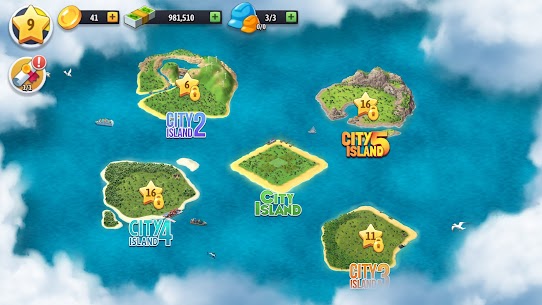
The level-up system controls access to new islands throughout the game. Players gain experience by constructing buildings, completing merges, and finishing challenges. Each level milestone unlocks new content, with new islands being the most significant rewards tied to progression.
Island unlocks create a strong long-term motivation structure. Players always have a visible next goal on the horizon. Additionally, each new island expands the grid space available for building and merging. More space directly enables more active merge chains, so island unlocks have immediate practical value.
How leveling up triggers new island access
Players accumulate experience from every major action in the game — placing buildings, executing merges, completing challenges, and opening packs. When enough experience accumulates, the player levels up. Certain level thresholds trigger a notification that a new island is now available to unlock.
The unlock itself usually requires players to meet a construction requirement first. This ensures players have developed their city to a minimum standard before expanding. It also prevents players from spreading resources too thin by unlocking islands before their main city grid is functional.
What building types players need to construct to unlock islands
Different islands have different construction requirements. Some require players to have placed a minimum number of residential buildings. Others require commercial structures like restaurants or casinos. A few islands unlock only after players have reached a specific rarity tier on certain building types.
This variety in unlock requirements pushes players to develop a balanced collection rather than focusing exclusively on one building category. Players who only build residential structures will eventually hit a wall when commercial or community building requirements block island access.
What new tycoon features each unlocked island adds
Each new island introduces additional tycoon mechanics — decorating tools, new building categories, and expanded management options. Some islands add specific building types that did not exist on the main grid, such as farms, gardens, or empire-scale civic structures.
New islands also add visual variety to the overall city layout. Players can arrange their merged buildings across multiple islands with different themes. This lets players build a more detailed and personalised city over time. Moreover, each island creates new opportunities for merge chains using the new building types that become available.
Best City Island Collections Tips and Tricks for Beginners
New players often make the same early mistakes — placing every card immediately without a merge strategy, ignoring friend trading, and skipping daily rewards. Avoiding these habits from the start creates a much faster path through the rarity tiers and toward island unlocks.
The most important mindset shift for beginners is treating the city grid as a workspace rather than a display. A grid that looks tidy but has no matching cards ready to merge is actually a blocked grid. Keeping pairs in proximity and holding space for incoming cards matters more than aesthetics in the early game.
How to prioritize merging for faster rarity progression
Focus merge energy on one building category at a time rather than running every chain simultaneously. Pick the building type appearing most frequently in current pack drops and push that chain as far as possible before switching. This concentrates resources and produces legendary-tier cards faster than spreading effort equally.
Also, avoid merging every common card immediately. Holding two or three common copies of a building in reserve creates flexibility. When a new pack drops the same common card again, players already have a merge ready to execute. This reserve strategy avoids the frustrating situation of needing one more common card to complete a chain.
How to use pack openings and trades to fill collection gaps
Before opening a pack, identify which building categories have the longest incomplete merge chains. This mental audit takes seconds but helps players recognise which new cards will be most immediately useful. When a pack delivers exactly what a stuck chain needs, the impact multiplies.
For friend trading, prioritise trading away duplicates from completed or stalled chains rather than holding every card. A duplicate common cafe sitting idle has more value as a trade chip than as dead weight on the grid. Active trading keeps the collection moving forward at all times.
What to do when progression feels slow or blocked
Progression slowdowns usually happen for one of two reasons — either the grid is too full to place new cards, or key building types have stopped appearing in pack drops. Both problems have direct solutions. A full grid requires merging existing cards before placing new ones. A card drought requires redirecting focus to challenges that reward packs most likely to contain the needed building types.
Daily rewards provide a consistent baseline during slow periods. Logging in every day maintains a steady trickle of cards even when challenge progress stalls. Over time, the accumulation from daily rewards alone can unblock a stuck merge chain without requiring any additional strategy.
Frequently Asked Questions About City Island Collections
What platforms is City Island Collections available on?
City Island Collections by Sparkling Society is available on iOS and Android devices. Players find it on the Apple App Store and the Google Play Store. The game runs offline on both platforms, so it functions without a wifi or mobile data connection for all core gameplay features including building, merging, and pack management.
How long does it take to unlock all islands in City Island Collections?
Unlocking all islands depends on how actively players complete challenges, open packs, and execute merges. Casual players logging in daily typically unlock early islands within the first week. Later islands require higher rarity buildings and more construction volume. Full island completion at a relaxed pace takes several weeks of consistent daily play.
How much does City Island Collections cost to play?
City Island Collections is free to play on both iOS and Android. Players access all core mechanics — merging, collecting, building, and island unlocking — without spending money. Sparkling Society does offer optional in-app purchases for players who want to accelerate progression. However, all content remains accessible through regular gameplay without any mandatory spending.
Top Players Who Should Add City Island Collections to Their List
City Island Collections suits three types of players especially well. First, franchise fans who played any City Island game from 1 through 5 will find genuine nostalgia value in the building card collection. Seeing a favourite structure from City Island 3 reappear as an epic-tier card feels rewarding in a way that a new IP simply cannot replicate. Second, casual players who want a city builder without always-online pressure will appreciate the offline mode and the relaxed merge loop.
Third, collection-driven players who enjoy the satisfaction of completing sets and climbing rarity ladders will find deep engagement in the 300-plus building library. The six-tier rarity system gives collectors a clear hierarchy to chase. Additionally, the pack opening and friend trading systems keep the collection process social and varied.
Personally, the merge-and-collect loop here holds attention better than standard city builders where progress feels purely numerical. Watching a common building merge step by step into a mythic version of itself creates a visible payoff that currency-based upgrades simply do not match. City Island Collections is a strong pick for anyone who wants a city builder with genuine collection depth and zero internet dependency.
Images



Download links
ℹ️ Download link not working? Please refresh the page and try again.
Developer's apps

Related apps




What's new
🐛 Bug fixes and lots of small improvements
New Apps
Most Played Mobile Games


