
Boxville 2 APK (FULL GAME)

Description
Boxville 2 stands out because every single character communicates through sketched doodles — there are no words anywhere in the game, not one line of text. This post is written for new players and returning fans of the first Boxville who want a clear path through the puzzles. It covers how the point-and-click controls work, how the wordless storytelling system functions, which achievements are missable, and the specific puzzle strategies that trip up most players.
What Is Boxville 2 and How Does It Play
Boxville 2 is a point-and-click adventure game from Triomatica Games. The player controls Red Can, a tin can character living in a cardboard city called Boxville. The game launched on June 26, 2025, across Android, iOS, PC, Nintendo Switch, PlayStation, and Xbox.
The story begins with a disaster. Red Can and his friend receive an important task from the Mayor: set up fireworks for the city’s celebration. The fireworks go wrong, chaos spreads across Boxville, and Red Can’s friend goes missing. That single event powers every puzzle and every location that follows.
What the point-and-click mechanic means for Red Can
Players tap or click on objects and characters in each scene to interact with them. Red Can picks up items, combines them in his inventory, and uses them to solve problems. Each scene contains a small number of interactive objects, so players need to tap everything they see until the screen responds.
The inventory sits on the right side of the screen as a permanent toolbar. This is an improvement over the original Boxville, where the inventory only appeared when the cursor reached the top edge. Because the toolbar is always visible, players spend less time hunting for it and more time focusing on the current puzzle.
The fireworks disaster story and what drives Red Can forward
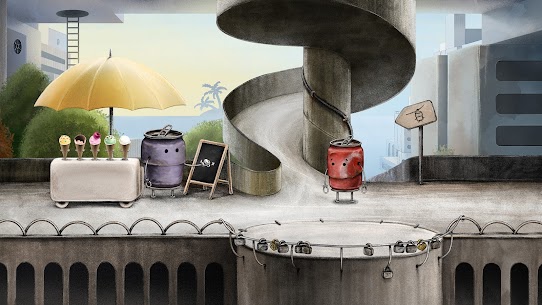
The emotional drive behind the game is simple: find the missing friend. Triomatica Games keeps this goal in focus throughout every location. Players move from the rooftop of Boxville, through the city streets, into the sewers, across a pasture, and eventually to a remote location far outside the city walls.
Each new area contains NPCs — other cans — who need help before they help Red Can in return. This chain of small favours builds the story without a single word of text. The friendship theme lands harder because of how little the game explains. Players feel the urgency rather than read about it.
How Boxville 2 compares to Machinarium and Botanicula on mobile
Machinarium and Botanicula, both from Amanita Design, are the closest mobile comparisons. All three games use wordless storytelling, hand-drawn art, and logic-puzzle progression on Android and iOS. However, Boxville 2 differs in one important way: its puzzle difficulty ramps up more aggressively in the second half. Machinarium includes a built-in hint system triggered by thought bubbles above the character. Boxville 2 does not include that system, which makes mid-game IQ-style puzzles feel more demanding. Botanicula focuses on exploration and character interaction rather than inventory logic, so players who found it gentle may need more patience with Boxville 2’s later puzzles.
How Boxville 2 Gameplay and Controls Work
The core loop in this adventure is straightforward. Players move Red Can between screens, tap objects to collect them, open the inventory to combine items, and then use the combined item on the correct target in the scene. Every puzzle in the game follows this same structure, though the specific logic changes with each one.
Triomatica designed the controls for touchscreens specifically. Taps feel deliberate, and the game responds to each interaction with a unique animation and sound. Nothing in the interface carries over from one puzzle to the next — each screen is its own challenge with its own rules.
What types of logic puzzles appear in Boxville 2
The puzzle variety in Boxville 2 is one of its strongest qualities. Players encounter sliding tile puzzles, memory sequences, pattern recognition challenges, bead threading mazes, a lights-out puzzle in the museum, and IQ-style logic challenges written on cardboard signs. The IQ puzzles require players to identify sequences and complete equations using images rather than numbers or words.
Some puzzles are procedurally randomised — the ice cream arrangement puzzle and the lights-out puzzle in the museum change layout with each new game. Others, like the spotlight bulb puzzle and the sticker book combination, have fixed solutions. Knowing which type a puzzle is helps players decide when to retry and when to follow a specific answer.
How the inventory system and item combining work
The inventory toolbar on the right stores every item Red Can collects. To combine two items, players select one from the toolbar and then tap the second item directly. The combination happens immediately if it is valid. If it fails, the game simply resets the selection without penalty.
Item combining is the most common source of progress in Boxville 2. For example, early in the game, Red Can collects a hammer handle and a hammer head separately. Players must combine them in the inventory before the hammer becomes usable on the leaking pipe. This pattern — collect, combine, apply — repeats throughout every location in the game.
What happens when Red Can completes a puzzle
Completing a puzzle always produces a reward. Sometimes Red Can receives a new inventory item. Sometimes an NPC reacts and opens a new path. In a few cases, completing a puzzle triggers a cutscene delivered entirely through sketched doodles. These reward moments are short, specific, and satisfying.
Certain puzzle completions also unlock achievements. The Happy Electrician achievement, for example, triggers the moment players solve the spotlight bulb puzzle correctly without making an error. Because achievements fire at the exact moment of completion, players who want the full list need to track which puzzles have attached achievements before they begin each section.
Why Boxville 2 Hand-Drawn Art Sets It Apart
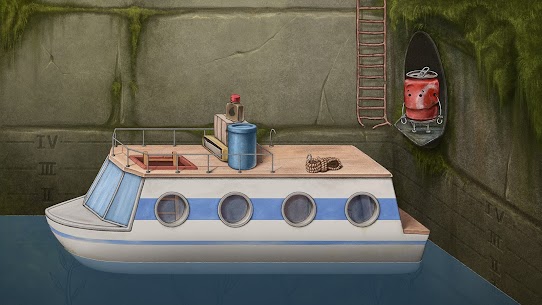
The art in Boxville 2 is the most immediately striking thing about it. Every background in every scene has been drawn by hand. The cardboard textures, the painted streets of Boxville, and the natural landscapes beyond the city all carry visible brushwork and colour choices made by a human artist rather than generated procedurally. This gives each screen a warmth that most mobile puzzle games do not achieve.
Triomatica also designed the audio to match the visual philosophy. There is no shared music loop that plays across the entire game. Instead, every scene has its own original music track. Players moving from the city rooftop to the sewers hear a completely different piece of music, composed specifically for that location and mood.
Hand-drawn backgrounds and scene-specific music in Boxville 2
The scene-specific music approach is rare in mobile games at this price point. Most puzzle adventures use two or three looping tracks across the entire experience. Boxville 2 treats each scene as its own world with its own audio identity. The rooftop section sounds different from the pasture section, and the pasture sounds different from the tribal village area near the end.
This decision by Triomatica adds emotional texture that players feel without necessarily noticing. The music shifts before any visual change confirms a new area, which builds anticipation. By the time Red Can reaches the outermost location beyond Boxville, the music has already told the player that something important is about to happen.
How every animation and sound is created per interaction
Beyond the music, Triomatica created individual animations and sound effects for every interactive object in the game. Tapping a can character produces a different sound from tapping a prop. Using the hammer on the pipe plays a specific impact sound. Using the gum on the pipe plays a different one.
This attention extends to NPC reactions. When Red Can successfully helps another can, that character’s response animation is unique to that interaction. No two completion animations in the game are identical. For players who pay attention to the details, this level of craft makes the world feel genuinely alive.
What the cartoony sketch communication system looks like in practice
When Red Can interacts with another character, a speech bubble appears above that character’s head. Inside the bubble, instead of words, the game shows a small hand-drawn sketch that communicates the character’s need or reaction. A can who wants food shows a sketch of food. A can who is upset shows a sketch that expresses frustration through simple imagery.
Players must interpret these sketches to understand what each NPC needs. This is the primary way the game communicates puzzle objectives. New players sometimes miss this system entirely and struggle to understand what they are supposed to do next. Paying close attention to each sketch before opening the inventory is the fastest way to stay on track.
What Makes Boxville 2 Wordless Storytelling Work
Triomatica Games built Boxville 2 entirely around silence. There are no written words anywhere in the game — no menus with text labels beyond the store interface, no subtitles, no dialogue boxes. Everything the player needs to understand is shown through images, animations, and sound.
This design choice has a significant effect on how the story feels. Because there is no text to read, players cannot skim past important moments. Every emotional beat requires visual attention. The result is a game that feels more like watching an animated short film than playing a traditional puzzle adventure.
How cartoony sketches replace dialogue in Boxville 2
The sketch communication system works on a simple visual logic. Characters do not speak in abstract symbols — they show concrete images of what they want or feel. A character who needs Red Can to move an object shows a sketch of that object and an arrow. A character who is grateful shows a sketch of a hand extending something in return.
Because the sketches are concrete rather than cryptic, most players can interpret them correctly on the first attempt. The system also means that Boxville 2 plays identically in every language without any localisation required. A player in any country reads the same sketches and reaches the same understanding.
How emotion and sound carry the friendship narrative
The friendship between Red Can and his missing companion is established entirely through the opening animation before the fireworks disaster. Players see the two characters working together, then separated in a moment of chaos. From that point, the sound design carries the emotional thread forward.
When Red Can finds traces of his friend — objects left behind, reactions from NPCs who have seen him — the music shifts subtly. These audio cues signal progress in the search without any text confirmation. Players who pay attention to the music alongside the visuals experience a richer emotional arc than those who focus only on the puzzle logic.
Why the silent format makes puzzles feel more rewarding
In a game with dialogue, puzzle objectives are often stated directly. A character says “bring me three apples” and the player follows instructions. In Boxville 2, the objective is inferred from a sketch. This additional interpretive step makes solving the puzzle feel like a personal discovery rather than a completed errand.
The moment a player correctly reads a sketch, finds the matching item, combines it, and uses it to satisfy an NPC — all without any text confirmation — the satisfaction is noticeably stronger. Triomatica designed the feedback for these moments carefully. The NPC’s reaction animation is always warm, specific, and brief, reinforcing the player’s sense of having genuinely communicated across a language barrier.
How Boxville 2 Progression and Achievements Work
Progression in Boxville 2 is entirely linear. Red Can moves through a fixed sequence of locations: the city rooftop, the streets, Chinatown, the sewers, the pasture, and finally the area beyond Boxville. Players cannot access a new location until they have solved all required puzzles in the current one. There are no branching paths or optional areas in the main story.
However, within each location, players have some freedom over the order in which they interact with objects and NPCs. The game does not force a rigid step sequence inside each area. This flexibility means players can sometimes gather multiple items before they know which puzzle each one solves.
How story progression advances through puzzle completion
Every puzzle completion in Boxville 2 moves the story forward by one step. This one-to-one relationship between puzzle and progress keeps the pacing tight. Players are never solving puzzles that feel disconnected from the story. Additionally, the puzzle completion animation always connects directly to Red Can’s search — fixing something for another can, for example, earns a reward that opens the next path.
The game does not use a level structure with numbered stages. Instead, the world is one continuous environment that players scroll and navigate between. This connected-world design makes Boxville 2 feel like an animated film with interactive scenes rather than a series of separate challenge rooms.
All 21 achievements in Boxville 2 and which are missable
Boxville 2 contains 21 achievements across all platforms. On mobile, these appear in the game’s internal system. Several achievements are missable — meaning players can pass the moment where they trigger without ever knowing it. The most important missable achievement is Perfect Maze, which requires players to cover every single tile in all three bead threading maze puzzles near the end of the game. Players who rush through these mazes will complete them without earning the achievement.
Other missable achievements include Not Fast Enough, which requires failing to get through a specific door three times before succeeding, and Stickerbomber, which requires placing all five stickers in the sticker book puzzle in the correct sequence. These achievements do not unlock retroactively, so players must attempt them on the same playthrough.
What unlocking Happy End and Perfect Maze requires
Happy End is the completion achievement that unlocks after players watch the final cutscene. It requires finishing the entire game from start to finish in a single file. Perfect Maze requires solving all three bead threading maze puzzles, in the tribal area near the end of the game, by guiding the string through every square tile in the maze grid — not just reaching the exit.
The bead threading mazes are the most technically precise puzzles in Boxville 2. Each has one valid solution that covers every tile. Players who accidentally retrace a path or miss a corner will complete the maze without meeting the achievement condition. The game provides no visual indicator that Perfect Maze is at risk, so players need to know about it in advance.
What Boxville 2 Players Get Wrong and How to Fix It
Most frustration in Boxville 2 comes from three specific situations: missing interactable objects in busy scenes, skipping missable achievements without realising it, and stalling on two particular mid-game puzzles. All three problems are predictable, and each has a simple fix.
The game’s hand-drawn art style works against discoverability in some scenes. Because everything in the scene looks visually consistent — the same artistic treatment applies to the background, the props, and the interactive objects — players sometimes miss a collectible or a hotspot entirely. This is not a design flaw. It is the trade-off that comes with a fully illustrated world.
Why players miss interactable objects in hand-drawn scenes
In most mobile games, interactive objects glow, pulse, or change colour when the player is nearby. Boxville 2 does not use these indicators by default. Objects respond only when tapped directly. This means players who move quickly through a scene may walk past a key item multiple times.
The fix is simple: tap every object in each new screen before moving Red Can to the next area. This includes background elements that look decorative. Triomatica hid several collectible items inside objects that appear to be part of the scenery. Systematic tapping takes an extra thirty seconds per screen and eliminates almost all cases of stuck progress.
How to avoid permanently losing missable achievements in Boxville 2
The most reliable approach is to read the full achievement list before starting a new playthrough. Achievements like Not Fast Enough require failing on purpose three times at a specific moment. Without knowing that in advance, players succeed immediately and permanently miss the achievement.
For the Stickerbomber achievement, players must use all five stickers on the right-hand page of the sticker book first, then transfer them to the left-hand page in a specific combination sequence. Doing this in the wrong order or using stickers individually rather than as a set prevents the achievement from triggering. The combinations are: Brown Horse and Piano equals Zebra, Plant and Clock equals Tree, Football and Mirror equals Disco Ball, Cucumber and Needle equals Cactus, and Heart and Lightning equals Defibrillator Heart.
What to do when the sticker book and lights-out puzzles stall progress
The lights-out puzzle in the museum is fully randomised. Therefore, there is no fixed solution to follow. However, the logic behind it is consistent: players need to illuminate all sixteen paper squares by tapping squares that toggle the light state of adjacent tiles. Players who do not know this rule will tap randomly and make no progress.
The sticker book puzzle, by contrast, has a fixed answer. The issue most players encounter is not knowing the correct pairing before they begin placing stickers. Moving a sticker to the wrong position does not lock the puzzle, but it can create confusion if players lose track of which combinations remain valid. The safest approach is to plan all five pairings mentally before placing any sticker on the left-hand page.
Best Boxville 2 Tips and Tricks for Beginners
How to read Red Can’s sketch-based clues before using inventory items
Before opening the inventory after collecting a new item, interact with every NPC in the current area. Each character’s sketch bubble contains the objective for that screen. Matching an inventory item to a sketch clue before attempting to use it prevents wasted attempts and reduces the chance of combining items in the wrong order.
This habit is especially important in the Chinatown section, where multiple NPCs have overlapping needs and several items in the inventory look similar in function. Reading every available sketch before making any move saves significant time in the game’s most complex environment.
Why solving the bead-threading maze puzzles in order unlocks Perfect Maze
The three bead-threading mazes appear consecutively near the end of the game in the tribal area. Each one increases in size and complexity — nine beads, then twelve, then seventeen. The Perfect Maze achievement requires covering every tile in all three, and the condition is tracked cumulatively. Players cannot replay a maze after completion without restarting the entire save file.
Approach each maze methodically. Start from the entry point and trace a path that visits every square before reaching the exit. Because the maze grids are small enough to visualise completely, sketching the grid on paper before starting is a practical option that many players use successfully.
How to handle the ice cream arrangement and spotlight bulb puzzles without guessing
The ice cream arrangement puzzle is randomised, so no fixed solution applies. However, the scoring counter above the arrangement tells players how many ice creams are in the correct position. Players should use this counter as feedback — make one swap at a time and check whether the number goes up or down before making the next move. This turns a random puzzle into a logical process of elimination.
The spotlight bulb puzzle has a fixed logic: place the slowest bulb on the outermost ring, then add progressively faster bulbs toward the centre, with the fastest bulb in the centre position. The bulbs are visually distinct. However, if players forget which bulb goes where, the Happy Electrician achievement also confirms that the solution was applied perfectly — no mistake was made during placement.
Frequently Asked Questions About Boxville 2
Is Boxville 2 available on Android and iOS?
Yes, Boxville 2 is available on both Android and iOS. The full game is available on the Google Play Store and the Apple App Store for $3.99. A free demo version — called Boxville 2 Demo on Android and Boxville 2 Lite on iOS — is also available for players who want to try the game before purchasing the full experience.
How long does it take to finish Boxville 2?
Boxville 2 takes most players between two and four hours to complete. Players who solve puzzles quickly or are familiar with the point-and-click genre may finish in under two hours. Players who stop to collect all 21 achievements, including missable ones like Perfect Maze, should expect to spend closer to three hours or more on a careful single playthrough.
Does Boxville 2 have a hint system?
Boxville 2 does not include a built-in hint system. Unlike Machinarium, which offers thought-bubble hints for difficult puzzles, Boxville 2 expects players to interpret the sketch-based clues from NPCs and experiment with their inventory. Players who become stuck can find community walkthroughs and video playthroughs online, which several players in App Store and Google Play reviews recommend using for the harder IQ-style puzzles.
Why Boxville 2 Deserves a Place on Your Mobile
Boxville 2 is the right game for players who want a short, beautiful, and emotionally satisfying puzzle experience without filler content. The hand-drawn art and scene-specific music make it one of the most carefully crafted mobile adventures available at its price. Players who finished Machinarium or Botanicula and want something in that same spirit will feel immediately at home.
The wordless format is a genuine design strength, not a gimmick. After playing through the full game, the friendship between Red Can and his missing companion lands with more weight than most games achieve with full voice acting. The silence does real work. Triomatica built something that respects the player’s attention, and that is rarer than it should be on mobile. If you enjoy puzzle adventures that treat atmosphere as seriously as mechanics, Boxville 2 is the one to play next.
Images



Download links
ℹ️ Download link not working? Please refresh the page and try again.




New Apps
Most Played Mobile Games


