
Big Hunter MOD APK (Free Shopping)

Description
Big Hunter hands a starving tribe’s Chief a spear and sends him after Mammoths the size of a hill, with every throw bending along a real physics arc. New hunters stuck on early Mammoth days, and returning players short on Ivory, get the throw angles and weapon order that actually clear those hunts. The biggest early gain comes from one number: every unbroken hit adds a flat 10 damage, so a steady chain often beats buying a stronger weapon.
How to Play Big Hunter: Physics Throws Against Giant Beasts
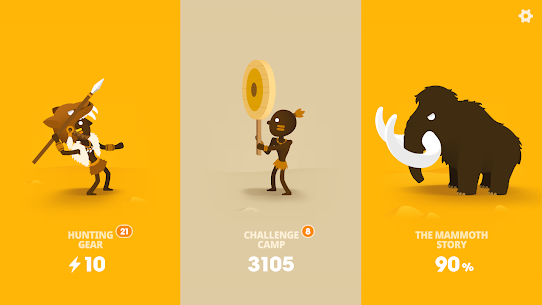
Big Hunter is a physics hunting game where the tribal chief throws spears, axes, and boomerangs at giant primeval animals until their health runs out. You hold the screen to step back, drag to set the throw arc, and release to throw, while dodging the animal’s attacks.
Kakarod Interactive released the game in May 2016, and its store page now cites 40 million downloads worldwide. That reach comes from a tiny loop. Each hunt is short, each miss hurts, and each clean hit feels heavy.
The Mammoth is only the first target. Later, the story moves the Chief through four more prehistoric beasts, each faster than the last. In my runs, no energy meter ever cut a session short, so you can keep hunting as long as you like.
Physics Hunting With Spear, Axe, and Boomerang
Every weapon follows a real flight path. A spear dips as it slows, an axe spins end over end, and a boomerang curves out and back. Because of that, the same drag distance lands in a different spot for each weapon.
The animal also reacts to physics. Weapons stick into flesh, bounce off hard parts, and sometimes fall out when a beast shakes its body. I quickly stopped thinking of hits as plain damage numbers. Instead, I watched where each throw landed and how the body moved after it.
The Drought Story Behind the Tribal Chief’s Hunt
A long drought leaves a remote village starving, so the Chief slips out alone each day to hunt. That quiet setup carries the whole campaign. Later chapters shift the reason from hunger to protection, as new beasts threaten the tribe’s new homes.
The tone stays light, with flat colors and a rhythmic soundtrack, yet the chapter endings land harder than the art suggests. The Mammoth chapter closes with a twist about the herd’s fate, and it made me pause before starting the next animal.
Big Hunter Compared With Knife Hit and Angry Birds 2
Knife Hit is the closest mobile match on timing, since both games reward a release at the exact right moment. However, Knife Hit aims at a spinning log that never threatens you. Here, one huge animal fills the screen and moves in patterns you can predict. It also hits back.
Angry Birds 2 shares the satisfying physics hits, but its targets never fight back. In this game, a missed throw can let a Woolly Rhinoceros run you down, and one hit ends the day on the spot. That threat is what makes each release feel tense rather than casual.
Big Hunter Controls: Hold, Drag, and Release to Throw
Holding a finger on the screen makes the Chief walk backward, and that same touch starts every throw in Big Hunter. Drag up or down to set the throw arc, then lift your finger to release. There is no power bar, so angle and timing do all the work.
This simple scheme hides real depth. Tusks, horns, and beaks act as armor that sends weapons bouncing away. Meanwhile, the head and neck reward a precise throw with far more damage than the body.
Most early losses come from the controls, not from weak weapons. Holding too long to dodge wastes time on timed days. By contrast, releasing too early wastes throws on days with a throw limit.
Stepping Back to Dodge a Charge
The retreat is your only defense, so keep holding, and the Chief backs away at walking pace while you line up the next throw. Since you aim with the same finger, you can retreat and aim at once.
The catch is space. Back away for too long and you run out of room at the screen edge, so an animal in its charge pattern still reaches you. I found it safer to take two short steps, throw, and step again. That rhythm keeps some room behind you for the real charge.
Deflecting Parts: Tusks, Horns, Beaks, and Fangs
Every animal carries deflecting parts that no weapon can pierce. The Mammoth has tusks, and the Woolly Rhinoceros has one large horn with a smaller one behind it. The Terror Bird relies on its beak, while the Saber-Toothed Tiger uses its long fangs.
A throw that strikes one of these parts bounces off and deals nothing. So the real skill is angle choice. Raise the arc to drop weapons onto the back, or flatten it to slip under the tusks toward the legs.
Headshots for Triple Damage
A hit on the head, the back of the head, or the neck triples the damage. That is the biggest single multiplier in the game. As a result, a basic spear that lands on the neck often outdamages a pricier weapon that hits a leg.
The problem is that the head sits right next to the armor. On the Mammoth, the tusks guard the front of the face, so I aim high and drop throws onto the back of the head. Also, the Woolly Rhinoceros horn does not reach the ground, which leaves a gap under it for flat throws.
How the Big Hunter Combo System Stacks Damage
The combo system in Big Hunter adds a flat 10 damage for every hit you land in a row without missing. A basic spear therefore deals 10, then 20, then 30, and a single miss or bounce resets the count to one.
That rule shapes almost every choice. It decides which weapons feel strong and which throws are worth risking. It also decides when a safe body hit beats a risky headshot. Although the bonus sounds small, it grows fast over a long fight.
Combo damage also feeds the Hunting Camp scoreboard. A long chain there means a bigger score, and a bigger score means a bigger Ivory payout at the end of the run.
How the Combo Chain Adds 10 Damage per Hit
The bonus stacks on top of the weapon’s base damage. On the fourth straight hit, a 10-damage spear deals 40, and by the tenth it deals 100. The weapon never changed, but the chain did.
In my runs, a steady chain of eight or nine hits ended Mammoth days faster than any single upgrade. For example, a Legendary tier long spear hits for 60 on its own. Yet a plain spear on its ninth straight hit already deals 90, which is why protecting the combo chain matters more than chasing big weapons early.
What Breaks a Combo Chain
Any throw that misses the body breaks the chain. So does a throw that bounces off tusks, horns, or a beak. The next hit then starts again from one, and all that stacked damage is gone.
Volley weapons add a harsh extra rule. If even one stone or arrow in a volley misses, the whole chain resets. Consequently, a spread shot at a small, early animal often costs more than it gains.
Why Multi-Hit Weapons Gain the Most From Combos
Here is the part most players miss. The combo bonus is a flat 10, not a percentage, so it helps weak hits far more than strong ones. A single pebble deals 5 damage. Yet on a ten-hit chain it deals 95, which is nineteen times its base.
Multi-hit weapons also build the chain faster, because every projectile that lands counts as a hit. A Legendary pebble volley throws 7 stones, so one clean volley can add seven links at once, which makes stones brutal on a big, slow target and risky on a fast one.
How to Unlock All Five Animals in Big Hunter Story
Five animals unlock in a fixed order in Big Hunter’s story: Mammoth, Woolly Rhinoceros, Terror Bird, Saber-Toothed Tiger, and Ancient Bat. Each animal has 100 days of hunts, and clearing day 50 of one animal opens the next beast in the chain.
Every day is one short hunt against a single animal. Getting hit ends the day at once, and so does breaking the day’s rule. Finishing all 100 days of an animal plays a short ending scene for that chapter.
Each new prehistoric beast moves faster and guards itself better than the last. That steady climb is what keeps the campaign fresh, even after dozens of Mammoth days.
Mammoth and Woolly Rhinoceros Days
The Mammoth is the gentlest of the primeval animals. Its long body gives a big target, and its tusks only guard the front, so low throws land easily. On late Mammoth days, though, the beast grows larger and tougher.
The Woolly Rhinoceros arrives when the tribe settles on a green plain the herd already owns. It stomps its feet 2 or 3 times, then charges straight at the tribal chief. I treat the first stomp as a signal to throw right away. That way, damage lands while it runs.
Terror Bird and Saber-Toothed Tiger Days
The Terror Bird shows up after an earthquake drives the birds into the village. It is far more agile than the first two animals. It jumps, lifts its legs to shield its body, and pecks the ground to swat weapons away. Before a charge, it bobs its beak 1 to 6 times and then rushes in with its head low.
The Saber-Toothed Tiger is the fastest of the first four animals. It claws with its front paws, and it sometimes leaps to dodge a throw mid-charge. The safe window comes when it raises its head, since that opens the neck for a clean hit.
Ancient Bat Swarms in the Cave
The Ancient Bat chapter arrived in a large update and moves the fight into a cave. Several bats fly together and share one health pool. They are faster than the Saber-Toothed Tiger, and their paths are hard to predict.
On weak point days, one big bat with high health appears instead, and smaller bats join it on later days. In my runs, some bats swooped in from far away with almost no warning, so I never let my guard drop just because the swarm looked distant.
What Each Day Number Means in Big Hunter Missions
Every day number in Big Hunter hides its rule in the last digit. Days ending in 1, 2, or 3 are timed hunts, days ending in 4, 5, or 6 limit your throws, and days ending in 7, 8, 9, or 0 require hitting every weak point.
Almost no one spells this out, yet it changes how you should play each day. A timed day rewards fast, safe body hits. A throw-limited day rewards patience. Meanwhile, a weak point day often favors spread weapons.
Knowing the rule before the hunt starts also tells you which weapon to equip. I check the digit first, then pick the weapon, and that habit alone cut my failed attempts noticeably.
Days Ending in 1 to 3: Beat the Timer
Timed days ask you to finish the animal before the clock runs out. Speed matters more than style here. Chasing a headshot that might bounce wastes seconds you cannot get back. A flat throw arc at the legs is faster and safer.
I use fast repeat weapons on these days, like a Powerful spear that throws 2 spears per release. Step back only when a charge is coming, because every extra retreat is time the clock keeps counting.
Days Ending in 4 to 6: Limited Throws
Throw-limited days give you a fixed number of throws to finish the hunt. A bounce off a tusk still counts as a throw, so armor hits hurt twice. You lose the throw. You also lose your combo chain.
A boomerang shines here, since one hit anywhere on its flight path keeps the chain alive. Also, a long spear with fixed damage makes each throw predictable. I take a breath before each release on these days, because rushing is the usual way to run dry.
Days Ending in 7 to 0: Weak Point Hunts
Weak point days mark target spots on the animal. You must hit all of them and also drain its health, all within a throw limit. These are the hardest days in each chapter, and a single strong weapon struggles because the spots sit in awkward places.
Spread weapons earn their place here. Pebbles scatter wide, so a single volley can tag spots a lone spear would never reach. From about Mammoth day 90 onward, I switched to a slingshot for these hunts, since its pellets cover the larger body well.
How to Unlock Big Hunter Weapons With Ivory
To buy a new weapon in Big Hunter, you spend Ivory, which you earn by clearing story days and scoring in the Hunting Camp. A first clear of any day pays 100 Ivory, while a repeat clear pays only 10, so fresh days are the richest source early on.
Every hunter starts with a plain spear. Everything else in the weapon shop, from the axe to the bow, costs Ivory. Prices then climb steeply across the three weapon tiers. A Legendary spear alone costs 12,000 Ivory.
Weapon choice still matters more than raw price. The cheapest axe costs 2,000 Ivory, yet a well-chosen cheap weapon can outperform a pricey one on the right day.
Ivory Math: What a Legendary Tier Weapon Really Costs
The Legendary bow is the priciest item in the shop at 25,000 Ivory. At 100 Ivory per first clear, that equals roughly 250 fresh days. At 10 Ivory per repeat, it would take around 2,500 replays, which no one wants to grind.
That math is why I stopped replaying old days for income. A strong Hunting Camp run pays far better per minute. So buy one weapon that fits the next wall you face, rather than a spread of cheap ones.
Normal, Powerful, and Legendary Weapon Tiers
Most weapons come in three tiers: a normal version, a Powerful version, and a Legendary version. Higher tiers usually add more projectiles rather than just bigger numbers. For example, the spear throws 1, then 2, then 3 spears per release.
Some weapons scale damage instead. The long spear goes from 20 to 40 to 60 damage and still throws just one spear. Later updates also added bone versions of basic weapons, such as the bone knife and bone boomerang, which sit above the originals.
Treasure Chest Weapons and Ad Removal
A few top weapons never show up for Ivory at all. The 10-shot chestnut bur, the durian, and the best slingshot only drop from a treasure chest. Player reviews on the store page also flag these chest-only weapons. For many players, they are a sore point.
The game itself is free, with ads between hunts, and a one-time payment removes those ads without touching weapon power. In my experience, the chest weapons are nice extras, and the Ivory weapons carried me through every chapter I played.
Best Big Hunter Weapons for Each Type of Hunt
Spear, axe, and boomerang are the three weapons the store page names, yet the full weapon shop now holds close to 20. Each one flies, spins, or scatters in its own way, and that behavior matters more than its damage number.
The roster falls into three rough families. Single throws, like the spear and knife, fly true. Spinning blades, like the axe and sickle, reward timing, while multi-hit weapons trade control for volume.
The best weapon changes with the animal and the day rule. I rotate between two or three favorites instead of sticking with one. A Legendary bow is great on a huge late Mammoth, yet it feels clumsy against a small early target because you cannot fine-tune its throw strength.
Spear, Long Spear, and Knife for Clean Single Throws
The spear has a steady, predictable arc, which makes it the best tool for reading angles. Its Legendary version costs 12,000 Ivory and throws 3 spears in a row. The long spear costs 4,000 Ivory at its first tier and has no random damage, so every hit is exactly what the label says.
The knife is lighter and easy to throw, with damage of 20, 30, and 40 across tiers. By contrast, the bone knife hits a little harder at 30 to 50 and costs 8,000 Ivory. I leaned on the long spear for throw-limited days. It never surprises you.
Axe, Horn Axe, and Sickle Spin Damage
Spinning weapons deal full damage only when the blade connects. The axe hits for 20 to 60 by tier, but a handle hit drops to 10, and you cannot choose where the spin lands, so the real average sits below the listed number.
The horn axe adds a horn behind the blade, and a horn hit deals the most damage. A sickle sticks into the target instead of bouncing. A Legendary sickle blade on the head deals 270, which makes it one of the best value picks at 9,000 Ivory. The coconut, durian, shuriken, and horn shuriken fill out the roster as heavier or faster alternatives.
Boomerang and Bone Boomerang Flight Path Control
The boomerang is the only weapon whose route you shape by dragging. It hits up to 2, 3, or 4 times along that route, depending on tier. Better still, the chain holds as long as it lands one hit anywhere on the way.
Its outbound flight also ignores armor until the turn. So a boomerang can slide under Mammoth tusks, hit the legs, and curve back without bouncing. The bone boomerang flies in a tighter, straighter line and deals 20 per hit instead of 10, although high arcs are harder with it.
Bow, Slingshot, and Pebbles for Late Days
The bow is the strongest option for big late animals. A Powerful bow fires 2 arrows at once, and a Legendary bow fires 3 in a fan. With a chain running, a single shot can climb toward 300 damage, and there is little delay after each release.
The slingshot works like a primitive shotgun and lets you keep moving between shots. Pebbles, by contrast, lock you in place until every stone flies. That delay is dangerous on fast animals, so I save pebbles for slow, huge targets and weak point days.
How the Chief’s Headdresses, Hunting Camp, and Rankings Work
Progress in Big Hunter shows up in three places: the Chief’s outfit, the Hunting Camp scoreboard, and the global rankings. Each finished chapter upgrades the Chief’s headwear, while the Hunting Camp turns your best scores into Ivory and a spot on the world board.
None of these systems changes weapon damage. Instead, they give you goals once the story days start to feel familiar. For me, the Hunting Camp became the main Ivory source after the first chapter. It still is.
The outfit changes also make a nice visual record. A glance at the Chief tells you how far into the campaign you are, and each new piece marks a milestone you earned.
Headdress Rewards and the Chief’s Changing Outfit
The Chief starts in a simple skirt with a single eagle feather on his head. Clearing the Mammoth chapter earns a feather headdress, and the Woolly Rhinoceros chapter earns a hat of eagle feathers. After the Terror Bird falls, its sturdy skull becomes his new headgear.
The rest of the outfit grows too. Fur clothing appears by the Terror Bird chapter, and the Saber-Toothed Tiger hunt ends with the tribe wearing tiger skins. These rewards are purely cosmetic, yet they made each chapter finish feel earned.
Hunting Camp Endless Run and Scoring
The Hunting Camp is an endless run for score. Tribesmen push wooden decoys shaped like birds, deer, Saber-Toothed Tigers, and Mammoths across the field. Your run ends after 5 misses, or the moment you collide with a wooden decoy.
At the end, the game pays out 10% of your score as Ivory. The decoys speed up as your score climbs, so every run eventually ends. Even so, a run of a few thousand points beats hours of replaying old days.
Global Rankings Against Hunters Worldwide
Hunting Camp scores feed the global rankings, where you compete with hunters around the world. This is the game’s only competitive layer. There is no guild or chat. You get just your number on the board.
Rankings reward long chains more than raw weapon power. The poison needle is a quirky pick for score runs, because its extra ticks grow with the combo, and on an 11-hit chain a Legendary poison needle deals 105 per tick across four ticks, though one miss wipes out that edge.
Common Big Hunter Mistakes That End a Hunt Early
Getting hit by the animal even once ends the current day at once, which makes defensive errors the costliest in Big Hunter. Breaking the day’s rule ends it just as fast. So most failed days trace back to a few repeat habits, not to weak weapons.
Those habits cost more than one day. Each failed attempt also resets your chain and burns time you could spend earning Ivory.
The fixes are small, and most of them come down to watching the animal a little longer before you let go of the screen. I made every one of these mistakes in my first Mammoth chapter.
Throwing Too Late Into a Charge Pattern
Every charging animal gives a tell first, and reacting after the rush starts is too late. The usual instinct is to back away and wait. However, an animal that takes no damage during its charge pattern simply keeps coming until it reaches you.
The fix is to throw at the tell, not at the rush. Hits that land mid-charge can stop the attack. Meanwhile, the Chief holds his ground. I now release on the first stomp or beak bob, then step back only if the rush continues.
Chasing Headshots Into Armored Tusks
The head is worth triple damage, so it is tempting to aim straight at it. On the Mammoth and Woolly Rhinoceros, though, that line usually meets deflecting parts first. The bounce costs the throw and the whole chain.
A body hit that keeps the chain alive is often worth more. For example, a spear on its sixth straight hit deals 60 to the body, while a bounced head attempt deals zero and resets you to 10. I only go for the head when the animal raises it. Then the throw arc is finally clear.
Using Slow Volleys Against the Saber-Toothed Tiger
The Saber-Toothed Tiger punishes any weapon with a long wind-down. Pebbles and the 10-shot chestnut bur keep the Chief in place for the full volley, and the tiger closes that gap in a blink. It also leaps over throws during its charge, so a slow volley often misses completely.
Single throws with little delay work far better here. A spear or knife lets you release, step back, and release again, so I swapped to a Powerful spear for the whole tiger chapter and stopped losing days to its claws.
Best Big Hunter Tips and Tricks for Beginners
Beginners in Big Hunter progress fastest by protecting the chain, earning Ivory in the Hunting Camp endless run, and matching each weapon to the animal. Those three habits matter more than quick reflexes. Together, they turn a wall of failed days into steady progress.
Early Mammoth days are the best place to build these habits. The beast is slow, its armor is easy to read, and a failed day costs little.
Later primeval animals test the same skills at a faster pace. The Ancient Bat swarm is where weak habits finally break. For me, the jump from the tiger to the bats was the sharpest spike in the whole campaign.
Aim Below the Mammoth’s Tusks on Early Days
The Mammoth’s upper body is tall and long, which leaves a wide open strip between its tusks and its feet. A flat throw aimed at the front legs clears almost every early day. It also builds the chain safely. The legs never deflect.
Treat these days as angle practice. I kept one drag length for the legs and one for the back, and I stopped guessing on every throw. That muscle memory carried straight into the Woolly Rhinoceros chapter.
Push Hunting Camp Scores Before Your Next Weapon Buy
Play a few Hunting Camp runs whenever the next story day stalls. A run that ends early still pays out, and each longer run lifts your ranking. That steady trickle funds weapons faster than replaying cleared days.
Use a weapon you already trust for these runs. A boomerang on a clean route keeps the chain alive through near misses, which lifts the score fast. Once the decoys get too fast to read, accept that the run is ending and aim for one last long chain.
Pick Spread Weapons for the Ancient Bat Swarm
The bats are where most players stall, because their shared health pool and random swoops make single throws unreliable. Stone-type weapons handle them best, since a spread of pebbles or a slingshot blast can tag several bats in one release.
Keep the Chief moving between volleys, and never trust a quiet moment. A slingshot is the better pick here, since it lets you move between shots. On weak point days, the single big bat is slow enough that a spread shot tags its spots in one or two volleys.
Frequently Asked Questions About Big Hunter
Is Big Hunter available on iPhone and Android?
Yes. Big Hunter is available on both Google Play and the Apple App Store. The iOS listing carries an Ages 9+ rating, and the game supports high resolution on phones and tablets. Google Play also lists it for PC play through its PC games store.
How long does it take to finish the story?
The story spans five animals with 100 days each, so a full clear means 500 hunts. Most days last well under a minute when they go right. In my playthrough, retries on weak point days took far more time than clean clears, and the bat chapter ate the most hours.
Does the game still get new content?
Yes, the developer still adds content. A 2019 update brought new weapons such as the horn axe, coconut, and bone boomerang, and a later large update added the bat chapter. Some store reviewers report losing progress during big updates, so note your unlocks and Ivory total before installing one.
Big Hunter Is Best for Players Who Love Precise Throws
Big Hunter suits players who enjoy short, tense sessions and reward themselves with precise aim. It fits fans of Knife Hit or Angry Birds 2 who want one huge target that fights back. Casual players will enjoy the early Mammoth days, while completionists get five chapters and a real Ivory economy to plan around.
After finishing the Mammoth and Woolly Rhinoceros chapters myself, I rate it as one of the most satisfying free throwing games on mobile, because every clean chain feels earned. Of all the Big Hunter tips here, protecting the chain matters most, so keep your early throws low under the tusks and let the chain do the heavy work.
Images



Download links
ℹ️ Download link not working? Please refresh the page and try again.
Related apps





What's new
- Supported 16 KB page sizes
- Bug fixes and improvements
Thank you for your continued interest and feedback.
New Apps
Most Played Mobile Games


