
Rebel Inc. MOD APK (Premium Unlocked)

Description
In the world of mobile and PC strategy gaming, few titles demand the level of cerebral engagement that Rebel Inc. MOD APK does. At a glance, it appears to be a military game about shooting insurgents. In reality, it is a deep, political chess match where bullets are just one tool in a very large shed.
Released by Ndemic Creations in late 2018, the game immediately set itself apart. It asks the player to step into the shoes of an administrator, not just a general. The core objective is not total annihilation of the enemy, but total stabilization of a region. Gamers quickly learned that brute force is a direct path to failure. The game simulates the fragile ecosystem of a post-conflict zone, where every airstrike and every school built carries equal weight. It is a strategy guide to the modern dilemma of nation-building.
Experience the Strategic Depth of Rebel Inc. Simulation
Rebel Inc. is not a game that can be “button-mashed.” The strategic depth is felt in the first ten minutes of play. Time moves in months, ticking away rapidly as the player watches funds flow in and support levels fluctuate. There is no pause button to issue perfect orders; the player must think on their feet.
What makes the simulation so addictive is the interlocking web of systems. A player cannot simply focus on roads while ignoring job creation. They cannot fund an army without realizing that inflation will drive up the cost of the very vaccines they need to buy next year. The simulation forces a constant state of triage. Every decision feels heavy because the game’s sophisticated algorithms ensure that every action has an equal and opposite reaction somewhere else on the map.
From the Creators of Plague Inc.: A New Political Challenge
Fans of the legendary Plague Inc. will immediately recognize the DNA of this title. James Vaughan and the team at Ndemic Creations took the global threat simulator formula and flipped it on its head. Instead of killing the world, the goal is to save it. However, this is not a simple hero simulator.
The challenge is far more complex than engineering a virus. In Plague Inc., the player fights biology and human response. In Rebel Inc., the player fights human nature. The game leaves behind the petri dish and enters the war room. It is a natural evolution for the studio, moving from hard science to political science. Players who enjoyed watching their pathogen evolve will find a new thrill in watching a broken region slowly heal under their guidance.
Balancing Military Action with Civilian Priorities
This is the tightrope walk that defines the Rebel Inc. experience. On one side, the Insurgents are ruthless. They will capture territory, destroy roads, and cause the local population to flee. The player needs soldiers. They need airstrikes. They need checkpoints.
However, the game cleverly teaches that a soldier with a gun is a temporary solution, but a doctor with medicine is a permanent one. If a player spends all their budget on Coalition Troops and heavy weapons, the civilian initiatives suffer. Schools remain closed. Water pumps stay broken. When the civilian sector is neglected, the population loses faith. They stop sharing intel with the government. They might even harbor the insurgents. The game constantly asks: are you protecting the people, or are you just fighting a war? The right answer is always both.
The Ultimate Goal: Winning Hearts and Minds to Stabilize Regions
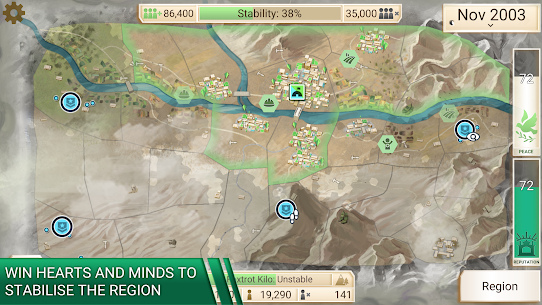
The term “Hearts and Minds” is not just marketing jargon in Rebel Inc.; it is a literal mechanic tracked by the game engine. The player’s reputation score serves as a health bar, but it is actually a representation of the population’s trust.
Winning a firefight might clear a zone of enemies, but it does not stabilize it. To truly turn a red zone blue, the player must bring services. When a road is paved to a remote village, the people feel connected to the government. When a university is built, the youth have hope. This focus on the psychological state of the simulated populace is what elevates the game. It understands that wars don’t end when the shooting stops; they end when the people decide they have more to gain from peace than from rebellion.
How to Fund Civilian Services and Development Projects
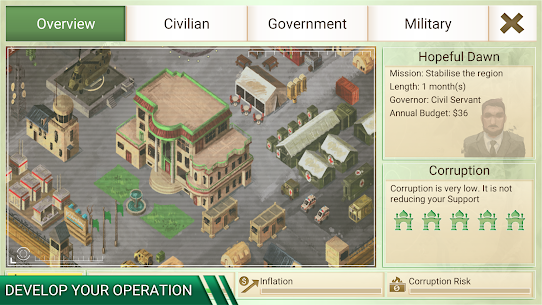
Money in Rebel Inc. is the fuel for the entire operation. Players receive a monthly or annual budget depending on the chosen governor. This cash must be funneled into the Development Tab. This is where the player invests in basic human needs. Education, healthcare, electricity, and running water are all available for purchase.
The game forces the player to prioritize by geography. A road in the remote mountains might cost a fortune, but it allows troops to move faster later. A sanitation program in the city might be cheap, but it boosts support quickly. The key is to generate a stable Support Level. High support means the population is resilient to Insurgent propaganda. Without these civilian projects, the region remains brittle. One attack in a low-support zone can cause a cascade of reputation loss that ends the campaign instantly.
Managing Inflation and Corruption Risk When Spending
Spending money sounds easy, but Rebel Inc. introduces two punishing economic debuffs to keep players honest: Inflation and Corruption.
Inflation is the silent killer. Every time a player buys a specific type of initiative, the next one in that category gets more expensive. Buying four military units in a row might price the player out of the fifth. This forces strategic purchasing. The player cannot just spam the same solution over and over.
Corruption is even more dangerous. As the operation pours millions of dollars into a fragile state, some of that money inevitably disappears. If the player ignores the Anti-Corruption initiatives in the Government tab, the funds become inefficient. A five-dollar project might only deliver one dollar of value because the rest is siphoned off. Managing corruption is not about being squeaky clean; it is about ensuring that the aid money actually reaches the starving villagers instead of lining the pockets of local warlords.
Understanding the Sophisticated Narrative Algorithms
Rebel Inc. is not a scripted experience. It relies on sophisticated narrative algorithms to keep the game fresh. This means the game reads the player’s strategy and throws specific curveballs back at them.
Is the player heavily reliant on airstrikes? The algorithm might generate a news event about civilian casualties, dropping reputation hard. Is the player ignoring the opium trade? Suddenly, the insurgents have a new funding stream, making them bolder. These emergent stories make every playthrough feel unique. The player is not just reading flavor text; they are reacting to a living world that pays attention to their specific playstyle and punishes their negligence accordingly.
Best Troop Movements to Corner and Neutralize Insurgents
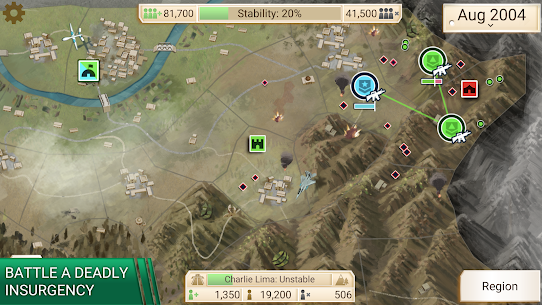
Combat in Rebel Inc. is abstracted, but positioning is everything. The map is a grid of connected zones. Insurgents are slippery. They do not stand and fight to the death; they flee into the mountains or blend into populated cities.
Smart players do not chase ghosts. Instead, they utilize the Garrison system. Garrisons provide a massive tactical advantage by revealing enemy positions and cutting off escape routes. The best strategy is to form a picket line. Troops should be spaced out to block the insurgents from flowing back into stabilized areas. The goal is containment, not slaughter. By cornering the Insurgents in a remote, low-population zone, the player can contain the threat while the rest of the country stabilizes peacefully.
When to Deploy Coalition Soldiers vs. National Soldiers
The military tab offers two distinct flavors of firepower, and understanding the difference is vital for long-term success. Coalition Soldiers are the heavy hitters. They arrive fully trained, incredibly deadly, and ready to fight. However, they are expensive, and they leave. The clock starts ticking the moment they touch down. Relying on Coalition forces exclusively means the player will be defenseless when the foreign troops inevitably go home.
National Soldiers are the opposite. They are weak at first. They have low combat strength and no experience. However, they are permanent. They cost less over time, and they do not abandon the region. The transition strategy is crucial. A wise governor uses Coalition forces to break the back of the Insurgency in the early years, buys time, and then uses that breathing room to train National Soldiers to hold the line long after the Coalition flags have been lowered.
Securing Zones to Prevent Reputation Loss and Defeat
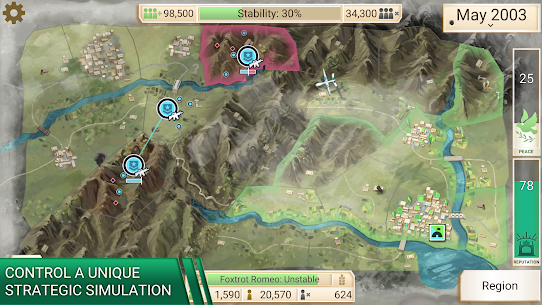
The reputation bar at the top of the screen is the player’s true lifeblood. It is not health; it is political capital. When a hostile zone exists for too long, or when a civilian is killed in the crossfire, reputation drops. If it hits zero, the international community pulls funding and the operation collapses.
Therefore, securing zones is not just about victory; it is about survival. An unsecured zone acts like a cancer. It drains reputation monthly. The player must constantly scan the map for “flickering” zones—areas that have been cleared of enemies but are not yet stabilized. Sending a single soldier to sit in that zone or funding a quick reconstruction initiative can “lock” the zone, stopping the reputation bleed. This mechanic teaches the player that leaving a vacuum is the worst possible mistake.
Analyzing the 9 Unique Governors and Their Radical Abilities
No two playthroughs feel the same thanks to the diverse roster of Governors. Each one fundamentally changes the economic or military rules of the game. The Civil Servant is the vanilla choice, perfect for learning. The Economist shakes things up by dumping the entire annual budget on day one, requiring extreme self-control from the player to save for emergencies.
The General is a fan favorite for military-focused players. He can start training troops before the Insurgency even begins, and his Martial Law ability can freeze a collapsing reputation meter in place. On the other end of the spectrum, the Smuggler makes money from corruption, a high-risk, high-reward playstyle. The Warlord relies on cheap militias, but these ragtag units anger the population. Mastering each governor requires unlearning the strategies that worked for the last one.
Tips for Completing the 10 Richly Modeled Map Regions
The terrain dictates the tactics. The Saffron Fields are wide and open, allowing Insurgents to scatter easily. The Azure Dam is a logistical nightmare, with long travel times that exhaust troops before they even reach the fight. The Opium Trail introduces an economic sub-game where the player must destroy poppy fields to cut off Insurgent funds.
Players should treat each map like a puzzle rather than a battlefield. On the Mountain Pass, controlling the highway chokepoints is more important than chasing enemies into the hills. On the Southern Desert, focusing on the one major city is key, as losing the urban center is a death sentence. The game rewards players who read the geography and adapt their spending priorities to the natural layout of the land.
Surviving the Large-Scale Operations in Campaign Mode
The Campaign mode is the ultimate test of endurance. Unlike a standard one-off game, Campaigns force the player to stabilize five different regions in sequence. The challenge is that resources are shared, and the Insurgency adapts.
After winning a map, the player selects powerful perks to carry forward, like Sniper Support or Advanced Development Experts. However, the rebels also gain “Adaptive Insurgency” tactics. They learn from previous defeats. They might start the next map with Ambush abilities or Swimming Lessons to cross rivers faster. Campaign mode is a war of attrition. The player must build a build-a-bear of synergistic perks while mitigating the increasingly unfair advantages the AI receives with every passing victory.
Real-World Research Behind the Counter-Insurgency Tactics
Rebel Inc. carries a weight that most strategy games do not. It is not just based on Hollywood action movies. Extensive research went into the simulation, including consultations with experts in regional politics, international charities, and global security .
The game was even praised by Said Tayeb Jawad, the former ambassador of Afghanistan to the United Kingdom, who called it sophisticated and engaging . The scenarios are fictional, but the pain points are real. The dilemma of balancing aggressive raids against civilian safety is a struggle that real-world commanders have faced. The game serves as an accessible, albeit simplified, introduction to the complexities of modern peacekeeping operations.
Reviewing the AI Behavior in Weekly Challenges
To keep the community engaged, Ndemic Creations releases Weekly Challenges. These are curated scenarios with specific rule sets, such as hyper-inflation or disease outbreaks on top of the Insurgency. The AI here is turned up to eleven.
In these challenges, the Insurgents display incredibly aggressive behavior. They target weak zones with surgical precision. They exploit gaps in troop lines instantly. Reviewing the AI patterns in these challenges reveals that the computer is not just reacting; it is hunting. It forces veteran players to abandon their standard “autopilot” strategies and actually read the room. It is the ultimate proving ground for those who claim to have mastered the game.
Offline Capabilities and Save/Load Functionality
In an age of constant online connectivity, Rebel Inc. remains a champion of accessibility. The game requires no internet connection. This makes it the perfect companion for commuters, travelers, or anyone in an area with spotty service .
Furthermore, the full Save and Load functionality respects the player’s time. A single game on Brutal difficulty can last over an hour. If the phone rings, or if a tough decision leads to a disaster, the player can load back to a previous month. This removes the frustration of permadeath while retaining the tension. It encourages experimentation, allowing the player to try a risky strategy and rewind if it backfires horribly.
Which Governor Is Best for Brutal Difficulty?
When the difficulty is set to Brutal, the margin for error vanishes. Insurgents spawn faster, inflation hurts more, and the population is harder to win over. In this environment, the General often rises to the top of the tier list.
His ability to fund military initiatives immediately is not a luxury on Brutal; it is a necessity. Waiting for the Insurgency to reveal itself before buying troops usually means losing two or three zones immediately. The General’s cheap National Soldier upgrades also allow him to build a formidable indigenous force without breaking the bank. While the Warlord has dedicated fans, the reliability and raw combat power of the General’s boosted infantry make him the safest pick when the AI is actively trying to cheat its way to victory.
How Do I Reduce Corruption Quickly Without Losing Support?
This is the question that plagues every intermediate player. Corruption rises with spending, and high corruption saps the effectiveness of civilian projects. The quickest way to reduce corruption is to fund the “Effective Procurement” and “Oversight Committees” initiatives in the Government tab.
However, these initiatives are expensive. The mistake many players make is waiting until corruption is already high before addressing it. The key is to pre-emptively buy one level of anti-corruption early, even if the corruption meter is still low. This slows the growth rate significantly. Additionally, players should avoid spamming expensive projects in a single month. Smooth, consistent spending keeps corruption risk lower than sudden massive injections of cash. Patience, not policing, is the cure.
Stabilize the Region and Secure Your Government Today
Rebel Inc. is more than just a time-killer on a phone. It is a masterclass in systems thinking. It teaches that victory is rarely achieved through overwhelming force, but through careful planning, empathy, and economic sense.
Every game is a story of a broken land trying to stand on its own two feet. The player is not there to rule forever; they are there to work themselves out of a job. By the time the final zone turns blue and the peace treaty is signed, the player feels not just the thrill of victory, but the immense relief of a job well done. For anyone seeking a strategy game that respects their intelligence and challenges their morals, the region is waiting. The insurgency will not wait, but with a steady hand, the government can still prevail.
Images
Download links
Note: If the link gives an error, refresh the page and press the link again.
- Visit Oyunclubnet and explore the collection.
- Please tap on the APK you want and save it to your phone.
- Open your File Manager and tap the APK file.
- Allow installation from unknown sources in your settings.
- Tap the Install button and wait for it to finish.
Developer's apps


Related apps





What's new
New Arcade Mode added! Choose if you want to mix up the combat for a more explosive experience. This update also brings… New Scenario: Insurgent Tide, a massive number of Insurgents are trying to take the region, can you stop them? New Player Tactics for Campaigns/Weekly Challenges Difficulty Balancing and polish: We've tweaked many areas across the game for a better experience!
-
Latest Apps
-
 Minecraft APK: Beta / Final1.26.10.4 Mojang
 -
 Arcane Quest Legends MOD APK (Unlimited Money, Gold, Unlocked)1.8.0 Nex Game Studios
 -
 The Walking Zombie 2 MOD APK (Free Shopping)3.52.0 Alda Games
 -
 Crate Simulator MOD APK (Unlimited Money, Gold)1.0.124 The One Int
 -
 Raft Survival – Ocean Nomad MOD APK (Free Shopping)2.8.2 Survival Games Ltd
-
Trending Apps
-
Minecraft APK: Beta / Final1.26.10.4 Mojang
-
 Manok Na Pula MOD APK (Unlimited Money, Eye, Max Level)8.2 TATAY GAMES
 -
 Off The Road MOD APK (Unlimited Money, VIP, Cars Unlock)1.18.0 DogByte Games
 -
 Car Parking Multiplayer MOD APK (Unlimited Money, Gold, Unlocked All)4.9.4 olzhass
 -
 Offroad Outlaws MOD APK (Free Shopping)7.0.419 Battle Creek Games LLC
-